How Great Ideas Win With Technology And Perfect Timing
January 13, 2026
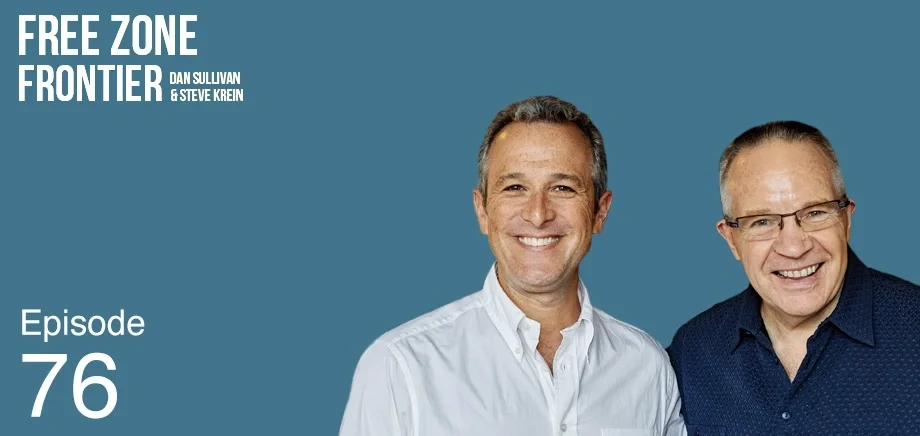
Hosted By
 Dan Sullivan
 Steve Krein
Wondering how you should be using AI and what will it mean for the future of your business? While the technology feels new, this kind of moment isn’t. Dan Sullivan and Steve Krein explore how today’s AI wave mirrors past major technology shifts, most notably the dot-com era 30 years ago, and what we can learn from those transitions.
Show Notes:
AI has quickly become impossible to ignore. If you’re not using it at all, you may already be relying on tools that are becoming outdated.
Every major technological boom in history has also come with a bust—and AI will be no different.
At its core, innovation isn’t about inventing something from nothing. Every new creation is simply a new combination of things that already exist.
AI dramatically shortens the distance between vision and execution—often eliminating barriers that once required teams, time, and resources.
AI changes how feedback works. You no longer need as many people—or sometimes any people at all—to test ideas, refine thinking, and move forward.
To use AI effectively, you must be clear about what you want. The tool amplifies intention; it doesn’t replace it.
Of all the goals someone can pursue, making money is one of the most harmless.
It’s unpredictable—and potentially dangerous—when consumers suddenly gain powerful new capabilities.
The faster you make a thoughtful decision about how you’ll engage with AI, the more freedom and leverage you’re likely to gain in return.
Resources:
Thinking About Your Thinking by Dan Sullivan
Superagency: What Could Possibly Go Right With Our AI Future by Reid Hoffman and Greg Beato
Free Zone Frontier by Dan Sullivan
Episode Transcript
Dan Sullivan: Hi, this is Dan Sullivan, and I'm here with Steve Krein, and we're going to talk about the Free Zone Frontier. And this is people who are using their entrepreneurial skills and all skills that come along with entrepreneurism to create new kinds of collaborations in the world, where it's not about buying someone else's company, it's not about owning other people's stuff, it's actually taking what's great about your company and putting it together with what's great about another company to create a third thing, all because you want to serve the same client. You know, you want to be a hero to the same client.
But Steve is a treasure for me because Steve is one of the few people who started their online business, their internet business for profit in the 1990s and was very smart about really making a lot of money and then timing his exit from it just before the dot-com crash. Because he's kind of like a real historian. He's been to the frontier of another technological breakthrough. And I just want to ask about this technological breakthrough with AI, what things he sees in common, you know, certain resemblances of what it takes to be an entrepreneur with a new technology, but also to have a sense of timing, because every technological boom we've ever had has had a technological bust.
Steve Krein: Well, hello, Dan. And it's great to be with you again today for this Free Zone Frontier Podcast episode. And I love the topic. I'd love to say I was smart. It was the mid-'90s. I was in my 20s. And I think I was more blissfully ignorant and ambitious than anything else because when I look back and I think about what I knew and what kind of experience I had in 1995, the year I graduated law school and started my first internet company, what did I really know about the context of how unique of a moment in time it was? And I think as we kind of look back now 30 years, literally 30 years to the exact year that the internet was being democratized and coming out of academia and going mainstream and dot-com entrepreneurs as we became known as became a unique identity to have, it was something of a gift to be 25 and, quite frankly, not having any of the context let me be ambitious without being overrun by the negative risks or the risks of the challenges that were ahead of me. And so we had just a lot of wind behind our back to kind of open up a conversation without regard for how big another company was. And we were able to disrupt industries and do things in the '90s that no other kind of generation had prior, even when you look back to the PC revolution or any of the other ones, never before were entrepreneurs at the center of the revolution.
And so, you know, I think back to some of the unique characteristics of the '90s, and it probably was best explained in a conversation I was having in my apartment in my third year of law school when the internet was coming on fast and there was a salesman living next to me. And he was, get this, a map salesman. He sold maps and encyclopedias on CD-ROM. And that was his business. He went around Philadelphia, I lived in Philly, and he went around and he was selling subscriptions to CD-ROM delivered every year, the updated version. And I remember seeing a very early version of Maps online and showing him. And he looked at me as I showed him this and he looked at his briefcase of CD-ROMs and he went, oh, shit, I'm screwed. And it was kind of that what I would call, you know, division of worlds where CD-ROMs and DVD-ROMs and the Internet were sitting on literally one side of the equation and the other. And that enabled me to see how powerful what was happening in front of me was going to be.
And I look today now, and just to kind of draw, you know, kind of a line to today, I think it's the same thing, an analog process of thinking about solving problems, not using AI to get organized, to think about your thinking, as you like to say, would be the equivalent of today using CD-ROMs versus the internet. Like, if you're not leveraging AI to help you think through a problem, come up with possible solutions and work with it, it's leaving you literally with a briefcase of CD-ROM. And so lots of parallels, very excited. I've been thinking about this topic a lot going back to the mid-'90s and thinking about how grateful I feel to have lived through that, obviously not realizing how unique of a moment in time it was, but I don't think there's been any innovation since the internet, even mobile phones or crypto or cloud computing, that has been equal to this seismic shift that's occurring right now for entrepreneurship, for business development, for the world.
Dan Sullivan: I mentioned in my introduction to the topic that we're going to talk about that. You are timely, OK? You have your own explanation about your timing. But from a historical standpoint, you had great timing. But I want to tell you, there was an even more important timing that you just mentioned. And that is, if I can quote you correctly, "I graduated from law school and then I started my tech startup." And I said, that was excellent timing. Not to become a lawyer.
Steve Krein: Yeah. Well, hallelujah. Yeah. I mean, interestingly enough, you know, my background, you know, I never wanted to be a lawyer. I just, my parents said, you know, not that they were going to pay for it, but you got to go to med school or law school. So my brother went to med school. My sister went to law school. I went to law school, but I never had an intention to practice. But it was a great learning experience.
Dan Sullivan: Critical thinking.
Steve Krein: It was critical thinking. And actually, it was a profound moment for me because I met someone who was incredibly instrumental in helping me think through the unique moment, a professor at the law school, a guy named Richard Herman. And in fact, I sit with this globe behind me. I'm holding it up. And this crystal ball was incredibly important, not just artifact for me, but it's symbolic to a discussion that I was having with my parents, because it was my third year of law school. I wanted to move to New York, get involved with the internet, and finish law school up here. My dad, in particular, was very against it. He thought I had to finish law school and at least become a lawyer. And I said I didn't want to. And Mr. Herman asked me to bring my parents to dinner, to have the conversation about what was in front of us, this unique moment in time. And when we got to the dinner, Mr. Herman had purchased this crystal ball, and he had it on my plate in front of me when I sat down. I had no idea what it was. We sat down, my mom, my dad, Mr. Herman, and we were talking, and he asked me to look into the crystal ball and describe the future I saw.
And it was a profound question. Nobody asked me before like that. I mean, I knew the internet was going to be big in the '90s when it was not so clear to a lot of people. But looking into this crystal ball, he made me describe to my parents the transformation that was ahead of us, how I was going to have the front row seat at, you know, not only being in New York, but getting exposed to the kind of thinking that was happening in New York and having a chance to build. At the time, it was an online service for lawyers, which was the opportunity I was coming up to New York to pursue. But this crystal ball, for a blissfully ignorant 25-year-old with just a law school education and no real business experience except doing magic shows as a magic clown for birthday parties and doing a paper route, was the shift for me. And the timing that I had then in this crystal ball symbolically defined the beginning of an era for me. And I've had it sitting next to me for the last 30 years. And only recently did I pull it back out and, summoning it for the crystal ball. You know, I'm 55 now, but looking ahead over the next 10 or 20 years and thinking about how we're undergoing the exact same thing where it's not so clear to everybody. A lot of fear, a lot of concern, but the timeliness of this is incredibly profound. Thirty years to the year.
Dan Sullivan: Yeah. Can you give a little description of how you developed that original company?
Steve Krein: Well, when I think back to the '90s and, you know, the difference between me then and today is, I was just looking at what was going to be an opportunity on how to, quite frankly, make money.
Dan Sullivan: Yeah. Yeah. In all the goals one can have in life, making money is the most harmless.
Steve Krein: Well, you know, I was a couple hundred thousand dollars in debt. I took college loans and law school loans. By the way, that crystal ball was helpful in giving my dad's permission—even though I didn't need it, I wanted it—to come up to New York. And the opportunity I was coming up for was to be the assistant publisher of the National Law Journal's online service for lawyers. And it ended up being the publisher who seeded the first company that I started, Webstakes, a $30,000 investment to start that company. And I defined it as an opportunity to make money from this new technology. And it was an idea around sweepstakes and contests and instant win games. And I really came out of the work we were doing at the Law Journal, and I saw that nobody was willing to share their email addresses. Which, again, was a very protected thing at the time. And so we came up with giving away free subscriptions, little sweepstakes and contests at the Law Journal.
That was the spin-out idea, to launch Webstakes to create games and promotions that, again, didn't know there was an industry that had been around for decades in that analog world, but to bring that to the internet. And so the original idea was make money by helping companies like the Law Journal, and ended up being like Kraft and Nabisco and McDonald's, move all of their contests online so that you could, you know, get opt-in email addresses and market to people and sell them things. And so that germ of an idea was just how to build a company that could never have been built in the previous era with the exponential trajectory and capabilities that the internet was enabling us to do.
Dan Sullivan: Yeah. Steve, there's a great technology writer, and I think he probably lives within a mile of you in New York City, called Mark Mills. And he's with the Manhattan Institute. He says that all new things are a combination of old things. For example, he describes iTunes. He says, you know, Apple was never the pioneer of any new technology, especially in the person of Steve Jobs, that he would just take this and this and this, and it was always a triple play. He said, there's something interesting about technology that's kind of a triple play. But these three things have never been together before. One of them is new. One of them is more new than the others. And he just used iTunes. And he said, MP3 players were already out there. Sony was the 800-pound gorilla. And then the other thing was, Napster was already out there, and they were downloading music online, but they were stealing it. They just didn't feel that theft was a good long-term business model. And the other thing was, he already had a platform on Apple called iTunes where you put your music, you know, you download it in your music.
And he was fired. He was essentially fired by Apple. And he said, you know, I got really interested in music. You know, he went out and he was part of the beginning of Pixar and he did other things. But he says, "I was out there," and he said, "I'd hear a tune." And he said, "You know, I really like the tune. So I'd go to the music store. And in order to get my tune, I had to buy 11 other tunes. And he said, but I didn't want the other 11 tunes. I just wanted my tune. And they were charging me. So I said, why don't we just take the Napster model and the MP3 model and my platform already and just put them together so it costs you a dollar to download a tune?" And he says, and the other thing is, "The musicians get very little money. So why don't we just make a real big offer to the musicians—already recorded music—so we'll just give them a bonus?" And in two years, Apple was the number one distributor of music in the world.
Steve Krein: You know, it's funny. I just finished watching- There's a tremendous series. I, at least as an entrepreneur, found it really fascinating about Spotify on Netflix. And it's the six-part episode about the founding of Spotify. But what's interesting, which ties back to your story, is the entire thing, it's six episodes, is told by six different perspectives of the exact same thing. So they tell the story from the entrepreneur's perspective, the founder, Daniel Ek. They go through his funder and founding partner. They take you through the executive from Sony, what you're describing right now. They take you through the artist. They take you through the lawyer and a developer. I think those are the six different perspectives.
And it's really interesting as you talk about what, from the old world, you take, you know, I go back, I told you my sweepstakes story, like, sweepstakes were being done. McDonald's had one, you know, Publishers Clearing House, they all had them. I was doing it obviously differently with the internet, but you're taking old, and maybe even a couple old things, but you're combining it with new. And what's interesting is the lens that I took away from the Spotify experience, which is similar to the Steve Jobs experience, is it's just looking at the exact same thing with a different mindset and a different skill set and then a different tool set to kind of change the outcome. And nobody believes it when you're describing it. And that was the interesting thing about the Spotify series, was that it took you through all the obstacles that quite frankly would pretty much stop everything from happening if it wasn't the entrepreneur leading it. Again, even if he or she elevated the lawyer, elevated the artist, it was always the entrepreneur pushing through the biggest walls to overcome.
Dan Sullivan: Yeah. Mark Mills even says you can go back to the 19th century, and he said if you take the railroads... The railroads historically have been the biggest technological breakthrough, you know, because they got rid of our sense of distance, they got rid of our sense of time. But he said it was basically because steel suddenly became available. Early 1800s, you didn't have steel. It was cast iron, and you couldn't do railroads with cast iron. You needed steel. And then he said you could really have great steam power. And he said the other thing was the telegraph. It was actually those three things, because they just had single tracks, and you had to let the eastbound train know where the westbound train was. I don't know who said this, but I think it's probably the greatest insight into what happens in the world in the dot-com age and also AI age: There's nothing more unpredictably dangerous in the world than a consumer with a new capability.
Steve Krein: Yeah, we're going to look that up. That's actually a good one. What's your take out of curiosity? You're a couple decades older than me, but I can't look back over the past 30 years and not unsee what you're describing. You know, AI was the big one, but there's been like many transformations that have upended industries and created industries and changed a lot of capabilities of entrepreneurship. But this one seems, and I think back to some of the original books I read when I joined Coach 30 years ago or almost 30 years ago around the chip and the PC and the capability of even having like a Macintosh to do design work was like a democratization of agency for people to create right from their head without farming it out.
One of the things I've observed in my own use of AI, and also my team and my community's use of AI, is that the gap between the idea or the vision and execution has completely been transformed and almost completely eliminated. And the feedback loop from vision to execution has become much more... less chefs in the kitchen, even, and less dependency on as many people as you used to need. In some cases, not even any other person because of what you now have the capability to do. That's a pretty profound and powerful shift in entrepreneurship.
Dan Sullivan: Yeah. The agency topic is really the crucial one. I went to college late. I was 23 to 27 because I just didn't have money. My family had no money, and they weren't going to give us money for beyond high school. So I had to do a whole bunch of things. And I also took big loans to go through, which I didn't have to pay back. I wanted to pay back. My first job out of college was a big ad agency, BBDO. I worked for the Toronto, you know, I got to come across the border. In those days, you had a letter from an employer in the United States, you'd come to Toronto, and it took six weeks and you had your Canadian equivalent of a green card, six weeks. It was kind of like buying a five-year subway pass. It was easy to get it.
But I remember, because we have a creative department, we have a production department at our company, we have about six people involved in it. And when I think back of how much our agency would produce, how long it would take to create an ad, how long it would take to create radio commercial, TV commercial, and everything else. And you had to plan in terms of months, and you had to use outside agencies for part of it. And our team can produce more in one week with the constant update of software and hardware than that agency could produce in three months. And we're not an advertising agency, we're just supporting our own program. I mean, we're marketing, we're using it for marketing, we're using it for registering new people and everything else, but you just have this massive capability available to you. And the only thing, the requirement is, you be real clear about what it is that you want.
Steve Krein: That's it. By the way, it's getting more significant by the week because all the models are competing against each other. Google's latest version is significantly different than the version before that and is now really comparable to what's happening with OpenAI and ChatGPT. But I'm finding that, like when you talk to people, if you're not clear, the results aren't going to be what you're looking for. And so the clarity that is required to get what you want is amplified by your dialogue and your own use of AI. It's actually something that even if you put a person in between you and the AI, you degrade the clarity of the vision. And so it's interesting, the translation even, like if I'm working with AI on behalf of somebody, it's gonna be radically different than the person themselves using the tools. Because the further you get away from that clarity of vision, the dilution and the results are completely different.
Dan Sullivan: Yeah. You know, it's my own way of approaching things, but I had about 20 months since I started using AI, and I just use it for one reason and that's to make my writing better and to speed up my writing. When I was 70, I set a goal that in the next hundred quarters, I'm going to write a hundred books. Okay. So this is quarter number 45, and I'm writing book 45. But I'm aware of the simplification and the speeding up each quarter, and I have a 10-person team. There's 10 people who have something to do with the production of the new book, one thing or another. But two weeks ago, I started a new book. And it usually takes me about two weeks to scope it out and kind of get…
Steve Krein: What's the book called, just as you tell the story?
Dan Sullivan: It's called Guessing & Betting Confidence. Being confident about guessing and betting.
Steve Krein: Love it. Know the concept.
Dan Sullivan: That's what I think the future is. The future is just guessing and betting, you know.
Steve Krein: All right. So it typically takes two weeks to scope?
Dan Sullivan: This time it took two hours.
Steve Krein: Two hours. The same exact...?
Dan Sullivan: Same exact.
Steve Krein: Do you think the results are better than what you would have done in two weeks?
Dan Sullivan: Yeah. The speed makes a big difference. I mean, in all creative activity, I can tell you this is very interesting. There was a very famous woman detective story writer in Great Britain, Dorothy Sayers. She was 1920s, '30s, and '40s, and she was the very first female detective story writer. But she had gone to college at Oxford. She was a theology student, and she was Christian. And she said, "You know, the one thing I could never wrap my mind around about Christianity was this thing of the Father, the Son, and the Holy Spirit." And she said, "It wasn't until I wrote my first detective story that I understood what they were describing was the creative process."
And the creative process is the father, and you just fall in love with the idea so much that you'll bet the future on it. You know, anytime you bet on one thing in the future, you're forgoing all the other opportunities. And she says, "So I had the complete picture, I had the complete plot, I had the characters." And she said, "And then you have to start writing." And she said, "And that's crucifixion." She says, pure crucifixion. You know, if you're in the middle of a project, it feels like a failure. You know, you've got sunk cost, you've got time and everything else, and you feel desperate. And then you get it out there and it does all sorts of things in the world. And she says, that's the Holy Spirit. She says, you don't know where it goes.
But the big thing is, that can take two years or that can take two hours. If you can pull it off in two hours, the original idea is intact. If it takes you two years, there are so many distractions, there are so many other possibilities, that it throws you off the original idea. And what I'm seeing now is that you can go from idea to execution in a couple hours, and it produces a higher quality product.
Steve Krein: It produces a higher quality product, and it also creates a different feeling from the work that you're doing. And I know everybody in Coach can relate to this. You go into Strategic Coach workshop, you come out excited and know exactly in your mind what the next 90 days is going to be like, and you know exactly what ideas and actions you're going to take. And it doesn't take more than anywhere from one hour to one day for someone on your team or something to be said to you to just erase the excitement and energy and clarity because reality sets in. And then you have to pick your battles. Which of those things that you're coming back with from your clear thinking is going to get executed? And the team—again, even great teamwork and great people with great intentions who want to keep you on track and keep things from getting distracted—will weigh that clarity of idea down.
So if you can come back with more baked and more done, go back to your two-hour framework, you're armed with a much, much more impactful capability going into that quarter. I think this speed is not just about, well, you get it out, it's a better quality product. I think your teamwork can be improved. But more importantly, your agency as an entrepreneur is exponentially different. And there's a great book, by the way, if you haven't heard about it, you know, it's really interesting. Superagency is written by Reid Hoffman from LinkedIn. Have you heard about this book?
Dan Sullivan: No, but sounds good.
Steve Krein: It's great. It's called Superagency. And he goes back in history to the printing press and the threats that were the headlines of conversations because there was no printing press yet. What the printing press was going to do and how it was going to threaten agency and was going to threaten all these things and basically takes you through all of the innovations of the last several hundred years all the way to the automatic transmission with cars and everything all the way up to today and saying that agency is amplified both positively or negatively. If you have high agency, it could become super agency. If you have low agency, it could be really low agency because of AI.
And this is the first time an individual can take responsibility for more production of whatever it is because high-agency people can become super agentic. And so to this point, your Unique Ability be exponentially greater because of AI, not threatened, but better. And can you, with each new tool that you're using or person you're interacting with who's also super agentic, be amplified? But I think it's the age of super agency. I mean, it's the Unique Ability on steroids.
Dan Sullivan: I'm a history buff, and technology is one of my favorite subjects. Technological breakthroughs are always good and bad, okay? They're good from the standpoint of the people they empower, and they're bad for the people who get disempowered.
Steve Krein: Well said. Yeah. I was at a holiday party last week and having a conversation with a good friend and doesn't use any AI. He's at a big bank and he talks about, "Oh, the CEO is always yapping about we got to start using AI and they're going to do layoffs in the first quarter and they're going to get rid of the people who aren't using." And he's like, "I'm an old dog. It's hard to teach me new tricks." And he's not leaning in. And it's so obvious. But what you just described for the people who have high agency and lean into it, it's a superpower. And for people with low agency and no connection to their Unique Ability.
Dan Sullivan: The great one and maybe the greatest one from an employment standpoint in the 1800s was Cyrus McCormick's reaper. It was processing wheat. It used to take 17 people to do what the reaper did when the reaper was created. You needed one farmer, a horse, and the reaper. So there was one person, it was 16 people got unemployed. And it was terrible at the time because a lot of people just were jobless for the rest of their career. But he said, unless that reaper had come along, you wouldn't have had the manpower to develop all the other industries in the world, you know. And it's painful, and you have people who just can never make the shift, but it's a lot more painful if there's no shift.
Steve Krein: Yup. In Coach terms, when I read Superagency, I was thinking about Unique Ability and how, especially those who understand what their Unique Ability is and are in touch with it, you can see the shift in a conversation, because I've recommended the book to a lot of people, as you can tell. And I'm seeing very different responses from it from what you're just saying, which is, you know, people are not looking at it like that. And by the way, I'm not even talking about just entrepreneurs. There's some entrepreneurs who have built very successful businesses, have a lot of money, have a lot of historical success, and are not at all connecting with the way we're describing the superpower and the agency that comes from these tools. It's gonna separate a whole generation again.
Dan Sullivan: Yeah, but that happened with the printing press. It happened. I mean, this is what humans do.
Steve Krein: Going back to what we were talking about before the call, a lot of the value of the tools is about using it but combining it with your lived experience and your taste and your judgment. And I know you described in the article you shared around your intuition, your imagination, your emotions, your common sense. But this is the first time I think it actually is an advantage to be an older entrepreneur, a seasoned entrepreneur, an experienced entrepreneur, or entrepreneurial thinker versus one who's bright-eyed, bushy-tailed. So the 24-year-old or 25-year-old version of me who comes in and just sees the capability but has none of that yet. Because you can't read, watch, or listen to it. You've got to live it, right? So I feel like the advantage here is, it skews to an older entrepreneur.
Dan Sullivan: And being in touch with your experience.
Steve Krein: Yeah, and being able to reflect on it. Because I've seen, by the way, the words they're using is like "AI slop" when stuff looks not really processed through a human. Because AI on its own is pretty sloppy. It's actually raw material, raw stuff that... I've gotten emails and I've gotten documents from people who say they used AI, but all they did was put it in and take it out and send it over. That's radically different than working with it and iterating through it. So I know it's too much to get into on this episode, but I want to get into some AI-first teamwork and the impact that it has for entrepreneurs working with other people, because I think it's really making a profound shift in teamwork and collaboration with other people.
Dan Sullivan: Yeah, good. There's a goldmine of experience you have, because you were in very early, you know. You had success in this. I find luck happens to people who are really watching what's happening. I think alertness and luck go together.
Steve Krein: Well, I could have timed it even better and could have been even luckier, but I have no complaints. And what I really am trying to do is, you know, for this moment, you know, use the past to create a bigger future. And I couldn't be more excited to be on this journey with you, Dan, and talking through something that I think is even more profound when you look back and have that kind of anchored experience of having lived through a transformation.
I was on a call with our community the other day, and I was saying that being a dot-com entrepreneur, which is what we were called at the time, it was like you're an internet entrepreneur, a dot-com entrepreneur, was a calling card because you understood the profound shift happening. And I remember, literally, you could get in any door you wanted because you were representing a new type of thinker, a new type of business person, a new type of entrepreneur. I think it's the same thing today. I think as an AI-first entrepreneur, I think it matters. Because if you're an analog thinker or even human-first thinker, you're at a disadvantage. But if you surround yourself with AI-first thinkers and people who are really tapping into it the right way, it's incredibly powerful and incredibly exciting. So what was your biggest insight from today's call, Dan?
Dan Sullivan: I think the discussion of agency is very, very central here, and you mentioned the Reid Hoffman book, which I'm going to read. I'm always looking for a new something for our Free Zone clients, and I'm going to order those books. But the thing that really strikes me, you know, there's all these scares about unemployment, and I said, I don't think the fear that people have of AI, of losing their jobs, is as big as the fear of actually being a complete human, of actually being fully human and taking responsibility for your agency. And I said, I think more people are scared of taking full agency than they are of losing their jobs.
Steve Krein: Yeah, it's interesting, Dan, the word agency. I haven't looked it up yet, but I bet you if you look up the Google searches and the AI searches, the word agency probably has not been used more than in the past year by people in business and people around the world who are seeing firsthand. It almost is like the great amplifier. By the way, both ways, agency to super agency or low agency to even lower. I've even looked more into understanding the origin of the word agency. Most people, when you bring it up, think of the company type of agency, not the individual type of agency. An agency versus having agency. And so I think it's going to be one of the big words in 2026.
I think it's going to be in, and should be, by the way, whether it's in elementary school, or high school or college or business or medicine or education or financial services. I think agency- I used to confuse it, I think, with entrepreneurship, but it's not. And I think everyone, even if you're not an entrepreneur and you're a team member on a startup team or a company's team, need to have a direct relationship with your own agency and where it sits along the spectrum. And it's a choice whether you want to become super agentic and have super agency or not.
Dan Sullivan: Yeah, and the big thing is that it's not a choice, it's a decision. There's a big difference between a choice and an agency. You know, a choice is like life is a smorgasbord. What will I try today? Decision—and I always talk to people about decision—it's from a Latin word, decidere, and decidere means to kill off the alternative. You know, I mean, really great marriage is a decision, it's not a choice.
Steve Krein: Very interesting, wow, I love it.
Dan Sullivan: And it works, and the freedom is because you've killed off the alternative. And I think AI, you can dabble in AI, and that's sort of a choice. It's like bacon and eggs: for the chicken, it's participation, but for the pig, it's a complete commitment. And everything else, but you know and I know that just relating it to marriage, the freedom is that you've killed off all the alternatives for life. So everything you need is available to you 24 hours a day.
Steve Krein: I love it. That's a great way to cap off the conversation.
Dan Sullivan: The faster you make a decision about AI, the more freedom you will receive as a reward.
Steve Krein: Mic drop. There you go. Dan, always love our conversations. Great seeing you.
Dan Sullivan: Thanks, Steve.
Related Content

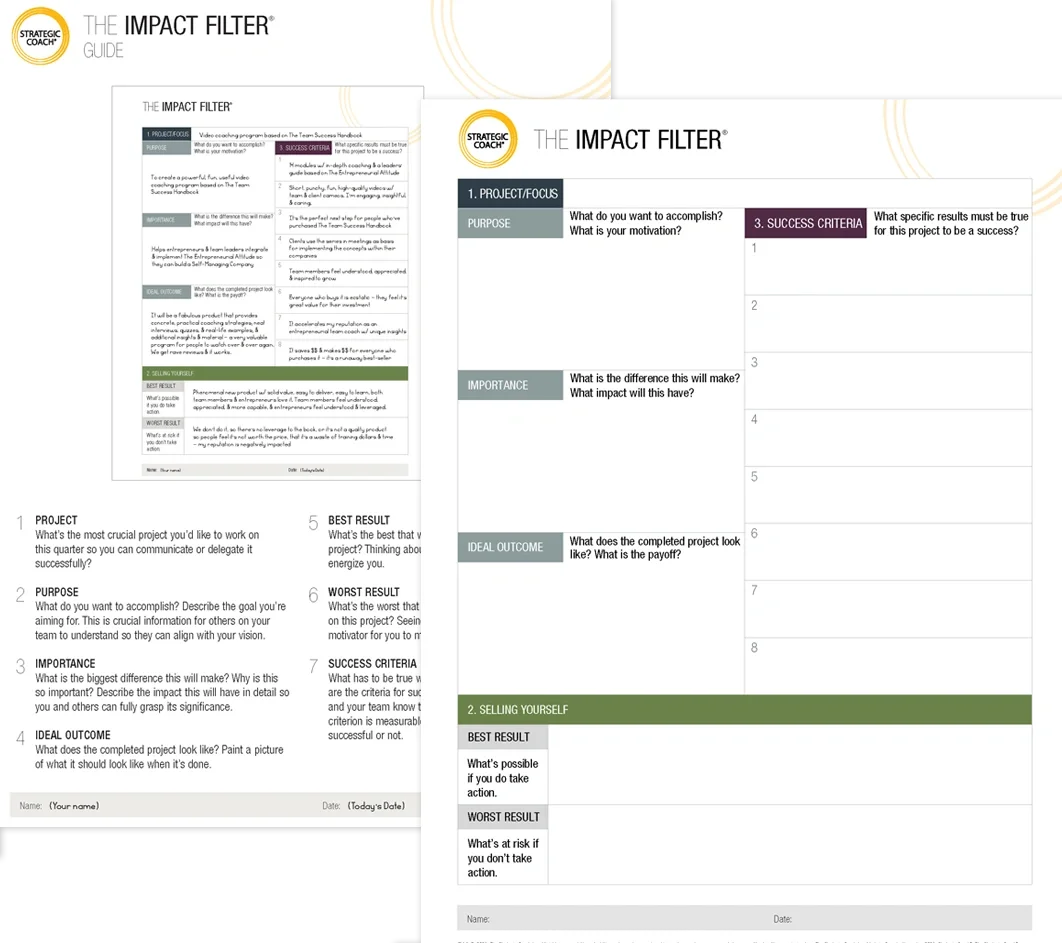
The Impact Filter®
Dan Sullivan’s #1 Thinking Tool
Are you tired of feeling overwhelmed by your goals? The Impact Filter is a powerful planning tool that can help you find clarity and focus. It’s a thinking process that filters out everything except the impact you want to have, and it’s the same tool that Dan Sullivan uses in every meeting.