Make Every Day A Great Yesterday
April 21, 2026

Hosted By
 Dan Sullivan
 Steve Krein
No one can control the future, but something we can do is make sure we have a great past. Dan Sullivan and Steve Krein discuss how a good life is when you focus on making every day a great yesterday.
Show Notes:
Entrepreneurs often fall in love with exciting future possibilities and end up pulled in 10 different directions at once.
When you commit to creating great yesterdays, you naturally think less about abstract futures and more about the quality of what you’re doing right now.
Today is real. The future exists only in your mind.
Like strengthening a muscle, you get better at creating great yesterdays the more you practice it.
Seeing each day as tomorrow’s yesterday changes your behavior, even in frustrating situations like travel delays or schedule disruptions.
Thinking of today as tomorrow’s yesterday increases your intentionality, so more of your time goes to activities that compound.
As a result of new technologies and tools, what you can accomplish in a single day is radically different from a few years ago, which makes your daily choices even more important.
Many entrepreneurs suffer from too much opportunity and too much achievement, which makes it hard to stay grounded in the present.
The greatest challenge that entrepreneurs face is loneliness, but Strategic Coach gives ambitious entrepreneurs a community where they feel understood and can talk freely about their goals and successes.
Resources:
The Entrepreneur’s Guide To Time Management
Who Not How by Dan Sullivan with Dr. Benjamin Hardy
10x Is Easier Than 2x by Dan Sullivan with Dr. Benjamin Hardy
Casting Not Hiring by Dan Sullivan and Jeffrey Madoff
My Plan For Living To 156 by Dan Sullivan
Thinking About Your Thinking by Dan Sullivan
Episode Transcript
Dan Sullivan: Hi, everybody, it's Dan Sullivan, and this is the Free Zone Frontier, and I have the great pleasure of spending an hour or so with my great conversational partner, Steve Krein. Steve, last time we brought up the time concept that I'm working on, and I'm 100 days further than the last time we had this conversation.
Steve Krein: Yeah, I think, first of all, it's great to be with you, as always, Dan. And you had just shared a new concept that I found very simple, but yet profound in how to think about it. And it was the idea of making today a great yesterday. Take us back a little bit, because you were about like 10, 12 days into it.
Dan Sullivan: Yeah, a little bit. As I mentioned last time, it wasn't something that I just suddenly thought up. It was a comment made by one of our clients, Lior Weinstein, who had a couples conference in Africa on the last night. All the parents were talking about why they were getting together and why they were doing things. And their stated goal was we want to create a great future for our children. And Lior says, well, I don't know anything about the future. You know, he said, I mean, I don't know anything more about the future than anybody else does. And none of us knows anything about the future. My job is to make sure that my children have a great past. That, he says, I've got control over that. But I don't have control over their future. I don't know what they're going to do with their future. So it really landed as an enormous insight to me. Of course, that's what you're trying to do. The best way to make sure, from your standpoint as a parent, that your children can have a great future is that when they think about their past, it was a great past. You might be able to do it on a daily basis.
And so I just started experimenting. And so when I get up in the morning, I said my entire goal for today is that tomorrow morning, this was a great yesterday. I mean, I have control over today. It's in the schedule. Some of it is just me and what I'm going to be doing, but I'm doing it with other people. So when I'm working with other people, I want to do it in such a way that I think about it 24 hours later as having been a really great day. It's had a profound impact, so I'm 100 days further down the road. I was on day 12 when we talked last time, and now I'm on day 112. And it's had some profound impacts.
Steve Krein: What's been the biggest impact, Dan? And then I'll share with you the impact it had, because I left our conversation and started talking to my family about it, but I'm interested in what your compounding of 100 more days has done.
Dan Sullivan: Yeah, well, about day 40, I noticed I wasn't ADD anymore. There was something about just focusing on today that had become powerful enough that I wasn't thinking too much about tomorrow and I wasn't thinking too much about the future. And I noticed my attention was a lot better just for the day that I'm working on. Gave me a thought, I say, why is it the ADD? You know, I've been diagnosed, I went to the Amen Clinic, you know, I checked most of the boxes for ADD, according to psychological structures. What I realized is that I have a tendency, and I think it's an entrepreneurial tendency, to fall in love with something that's in the future that's not even actually existing now. I'm just falling in love with an idea. And then I realized it would be okay if it was one thing, but it wasn't. I was falling in love with 10 things, and each of the 10 things are competing for my present attention, but they don't exist. There are things that could happen, but they aren't real, whereas today is real.
So it's kind of like a strengthening of a muscle that I'm just doing today. When I'm in a meeting, I remind myself, remember, this meeting is important for having a great yesterday. You know, I'm doing a writing section, and I says, you want to be able to remember this writing session tomorrow as having been a great yesterday. And then I've had some, you know, travel interruptions. One especially, we had, like, you're in New York and you had it even worse over the last three months than we did. But we had 26 inches one day here in Toronto. The airline industry just went crazy. I mean, we sat on the runway here in Toronto for two hours before we could get a gate. And then when we got to the gate, there was no crew. And then when the crew came, they found out the jetway didn't work. So from the moment we landed until the time we got in our limousine was six hours, and then we didn't have our luggage because they didn't have the crews to get the luggage out. And I was just sitting there and I said, now, if this is going to be a great today, and I was just really cool. And I said, that's fine. I'm just sitting here. I'm going to be cool. I'm not going to get angry. I'm just going to be really cool. I have a novel with me at all times, so I just read my novel for six hours and everything like that. But it changes behavior when you realize how important this day is going to be a day later.
Steve Krein: Yeah, that was the perspective shift. And it's interesting, you shared it on that last podcast we did and I got off and I was talking to my, my daughters are now 17, 20, and 22. We talked about it at our family dinner that night. And the conversation turned to what's the difference between that and, and make it a great day or have a great day. And we started talking about the perspective shift of being aware, not only that you're creating a memory or that this will be a memory, but the intentionality of going into a day, not with we'll see what happens, but the reflective nature of thinking about it being tomorrow morning is pretty profound. And so it kind of was, I would say, brushed off the night we talked about it, and then a couple days later, we started talking about it as actually working and my girls are doing it in different ways. And I found the same thing you did, which is it really does shift instantly your perspective of planning your day. And even when things don't go well or don't go right or don't go the way you're planned, it does have a really unique way of jolting you back.
Dan Sullivan: I've got a couple questions for you. First of all, that is great feedback. You know, I'm really happy. And I found that it's fairly simple to explain once you're in it. But what about work-wise with you? That's your family and your life with your family. As far as I know, you've done a pretty good job of this before you even had the concept, because I'm ‘97, I think, since 1997 I've known you and you always did a tremendous job with your family for as far as I know.
Steve Krein: Yeah, well, I think a great deal of credit goes to the perspective of thinking about and planning and seeing, by the way, other entrepreneurs and people not do it the way I've done it, but it's been priority number one from day one. So before I even had a family, I was thinking about, I remember that couples conference back in 2002 or 2003. No, no, it was 2003. My daughter was born in 2003 because my wife was pregnant with Andy at the time and the intentionality that goes into it. You know, it's interesting when you think about planning, in some ways, it's also that same reflection back and I'm just thinking about it as I'm describing it, but what kind of family do you want? How do you want to treat each other? How do you want to spend time together? How do you want to prioritize and share your values? Some ways similar to the idea of make today a great yesterday. Make sure when you get to the point your kids are in college and out of college, you know, what kind of family do you want to have when you look back?
So I think it's a little bit of that same reflective back framing. But on the business front, in this world of AI where everything's moving so quickly, I think it's really hard to even get context for how to think about one day. What you can accomplish in one day is in many ways significantly different than it was a year or two or three years ago because of what you can do with the tools today. And so we haven't shared it as much internally. I think I'm probably the biggest user of the framework on the business side, but I think it's interesting to think about the kind of artifacts and the things that you do with AI to be not validation, but a demonstration of how you spent your day.
Dan Sullivan: Yeah, it's really good. Yeah, one of the things I notice is my writing speed and the completion of writing projects is easily, I'll just pick a number, but it's about four times. And what I'm saying, one of the quarterly books, I bring out a book every quarter and have done for, I'm in my 12th year now of having a book every quarter, so I'm working on number 46 right now. The interesting thing is, it used to take me about two weeks to get the structure of the book. Like, I like to have the whole structure. I like the introduction, the number of chapters, the conclusion, and everything. I like to have that all framed out. Before we start the process, I'm interviewed on my layouts, and that's recorded, and then there's a writer and an editor. We have standard format for the books, so it's always the same number of pages. But the one I'm working on right now is called Who We're Looking For, and this is actually gonna be sort of a marketing book for Strategic Coach. And it's just eight chapters. You're already this kind of person. How would you like to be in a community where everybody else is this kind of person, you know?
Steve Krein: Is it a play on the ideal, what'd you call him, a non-ideal customer? What's the tool called?
Dan Sullivan: Target, Target Hero.
Steve Krein: Yeah, your Target Hero. Is that an evolution of that tool?
Dan Sullivan: Yeah, we got off the road a little bit over the past couple of years where our marketing team, as they were then, they're not there anymore. And they started looking for all the pain points of being an entrepreneur. And I said, I have to tell you, the people who are coming into the Program, this is not a pain for them. This is like they found the place that they were looking for. And I said, they're already good at this stuff. They're not suffering. They've got too much going on in their brain, but they're not suffering from lack of opportunity, they're suffering from too much opportunity, and actually too much achievement. And they're just having a hard time being in the present. And I said, what we give them is an opportunity to, one, be understood, because in a lot of parts of their life with, you know, the family they grew up with, with friends and everything else, they can't talk about what they're really interested in. They can't enjoy talking about their successes because people are going to take it the wrong way. They're thinking, we're bragging. And what about all the people who, you know, don't have food and everything else? You know, they just like to have a conversation with like-minded people who are also ….
Steve Krein: Yeah, the community. It's about the community.
Dan Sullivan: Yeah. So I said, let's talk to them as if they already know this stuff. But they don't know about it consistently. They can't do it consistently just because of where they are.
Steve Krein: So what's the evolution of your thinking from the original target customer of Strategic Coach 10 years ago versus today?
Dan Sullivan: Well, I was just taking a look at who the people are in the Free Zone, and there's just a radical difference of the Free Zone people, you know. I mean, they're very, very transparent. I had one yesterday. I had a small group here in Toronto, and because of travel issues, TSA issues in the United States, we got about half the room. So I had 11 yesterday. So I think it may be one of the smaller Free Zone. I mean, we have 110 in the Program. What I noticed two weeks ago with this new workshop, they all do The Signature Program. They learn the basics. They have to learn Free Days, Focus Days, and Buffer Days, Unique Ability, you know, Impact Filter, all the basic tools. You know, I was in the office when another coach was introducing them to their first workshop, and I said, if any of them want to talk to me, I'm in the cafe, and about nine piled in right away. I was just talking to them, and they're just radically different kinds of people, and they've all read the books. Everybody at the table had read all three books, asking me about this concept, this concept. They haven't even gotten those concepts in the Program, but they already know them. And I said, we're doing what we need to do now, because I would say every one of them had the potential of being in the Free Zone in three or four years.
Steve Krein: So because they're reading your books or listening to your podcast or watching videos, they know the language. They know what they're quote unquote getting themselves into. Do you think they have the same ambition to, given they have some of these tools, how are they responding to the tools versus just the community part of it? Like in other words, they're getting for free or for low cost some of the value out of reading the books and implementing, maybe implementing, maybe even struggling to implement them, but how are you seeing them one, two, three years in?
Dan Sullivan: I told the coach, I said there was about 32 of them, and I said, I don't know what the other 23 were like, but these are very bright. We have two entry levels. If you're making between $200,000 and $500,000, that's one entry level, or you're above $500,000, and we require financials to verify that. Last year, we had around 860 started new, and 60% of them were over half a million. Well, someone making more than half a million has a company. I mean, they're not just a super-duper one-person show. So they're interested in company things. They want to grow their company. All of them are using AI.
Steve Krein: Yeah, everybody is today, yeah.
Dan Sullivan: It's not so much they knew the content of the Program, they really comprehended the context of the Program. It's a big difference. They were looking for the environment. They were looking for the, as you said, community. Because I think loneliness is the biggest problem that entrepreneurs have.
Steve Krein: Well, I'm going to take this in a little different direction because I'm touching on one of the reasons why I think our community too plays such an important role in these founders' lives today, because working with AI is a very different sport, if you will. When you're the one with the keyboard and the ability to talk to AI and get the results you do, you oftentimes spend less time collaborating with other humans, because AI becomes your go-to collaborator; at least that's what I found in a lot of our conversations and a lot of our communities and even myself included, you can take ideas a lot further by yourself than you used to be able to. You were talking about this even with your writing, what it used to take two weeks to get your book outlined.
Dan Sullivan: Now I do it in three hours.
Steve Krein: And so because it's such an individual sport using AI, community becomes an even more important part of the ingredients for a successful entrepreneurial life.
Dan Sullivan: Yeah, I mean, there are people who just don't like people, you know, I mean, I mean, some of the people I'm thinking of Mr. Altman, you know, open AI, I just don't think he likes people, you know, I just get a feeling, you know, he wants to merge with the machine. But for the most part, there's a very positive social aspect to the clients that are coming in. They really, really like people. They really like their customers. They really like their teams. They like their families. But they also like success and achievement, you know, so they want to grow. You know, and The Lifetime Extender lands differently for them. One is because I have a bit of a reputation because I'm in my eighties now and I'm far more ambitious at 82 than I was at 52. And when I first met you, I'm way more ambitious now than I was back then. And just a little side note that proves it, so we're still going for our stem cells in Argentina. And I've had, I think how many visits we've made, you know, we've made about 12 visits down there. There's about 14 other Coach clients now who are going down and doing it. And they get down there and they said, whatever Dan's doing, we want to do that.
Steve Krein: On what he's having?
Dan Sullivan: Yeah, because I noticed that I'm improving. I mean …
Steve Krein: Was it your knee the first time?
Dan Sullivan: Yeah, well, the knee is interesting because I'm the oldest person that this clinic has ever done with cartilage. This is a cartilage replacement. I've got the complete cartilage back. The problem is that it comes from your fat cells and fat cells don't age throughout your life. Fat cells are just fat cells. So I have the complete cartilage back, but it's a baby's cartilage.
Steve Krein: Interesting.
Dan Sullivan: Yeah.
Steve Krein: How does that affect it?
Dan Sullivan: Well, they're having to do some other things with it. How old is the baby when he stands up for the first time? 20 pounds, 25 pounds. This is a baby's cartilage with 185-pound body, you know. So when I take the MRI, lying down, it's a full cartilage. When I do the MRI where I'm putting total weight on the left knee, it's like that. So this is new territory for them.
Steve Krein: I was just going to say, do they even have experience with this?
Dan Sullivan: No, this is new territory, because what 82-year-old gets a cartilage replacement, you know?
Steve Krein: Yeah, that's funny.
Dan Sullivan: But the other thing is my brain volume has gone up by 12 percent.
Steve Krein: Measured how?
Dan Sullivan: Well, they do a lot of things. They do your vascular system. They actually do it, bones, strengthening bones, because bones, you know, get kind of worn out. So brain volume is a really big deal, because after about 60, you lose about four-tenths of 1% of brain volume every year. So I just got 12% back. That's like 30 years. And brain volume is correlated to cognitive function.
Dan Sullivan: Do you feel different?
Steve Krein: Oh, yeah. Yeah. Yeah. I'm just way quicker. And I see the humor of things more. There's a lot of humor in the world right now.
Steve Krein: A lot of humor. That perspective, beautiful. It's not a conversation you probably have with a lot of other 82-year-olds.
Dan Sullivan: Yeah. So anyway, we're in a great age for regenerative medicine, and AI is the main reason. The kind of testing they can do in the lab and the kind of testing they can do on patients, it's just, I mean, it's a century into the future from where it was, let's say, in the year 2000.
Steve Krein: What are you noticing the entrepreneurs in the community are capable of with your thinking tools and AI?
Dan Sullivan: Yeah, my sense is that every brain, individual brain that interacts with AI does something different with it.
Steve Krein: Yes.
Dan Sullivan: I don't think there's any trend lines. They say, teach them AI and they'll start doing this. I said, I think it's a guess and a bet. And I think it's causing a lot of unease in the technology world that this is true. And it's certainly causing a lot of unease in the investment world that this is true. It's not like getting a personal computer back in the 1980s. You know, more or less, people did the same thing with the personal computer. But when their brain is interacting, they're relating to experiences in their life that go back 30 or 40 years, and they're doing hobbies differently, and they're just playing around. And I think it's causing a lot of concern that there isn't any conformity. Predictability requires a certain level of conformity. The horses are all out of the barns now.
Steve Krein: I find it to be a significant amplifier, by the way, good and bad, of people's Unique Abilities. So it either amplifies their Unique Ability and they become a super human version of themselves, because they can really amplify and multiply their Unique Ability, and when you have high-agency people who have a defined Unique Ability can be a great amplifier. I think it's the same way on the other side, which is, I think …
Dan Sullivan: Oh yeah, I think it amplifies distractions.
Steve Krein: Yes, yes. I think it amplifies obsessions. It amplifies, if you don't have direction and you don't know what your Unique Ability is and you let it come back to you with whatever it is, I think it becomes a little bit like word salad, you know, a lot of people talk about AI slop because people are just turning out or publishing whatever comes out. And I find that oftentimes younger people who might not have the experience, might not have the pattern recognition, might not have the taste, don't produce the same thing that experienced entrepreneurs or even people do. So I think there is something very profound about the more developed someone's Unique Ability is and the more work they've done on it. It's like hitting a candy store. It's a big multiplier. But I find the opposite is so true that you have to be very careful of who's on your team with regards to using it. And so I think there's a huge gap now being created by those who are leveraging it right and those who aren't.
Dan Sullivan: I did a search, an AI search, and I said, 10 ways in which human agency is different from human activism. It's because we've got a big upswing in activism right now. You know, I mean, activists are people who attach themselves to a purpose that other people have created. And you see it with Greta Thunberg. Greta Thunberg is an activist, and it was about global warming, and it was about climate change. And that sort of went into a ditch. You could tell that energy is something you don't want to fool around with when you're running large societies. You want to have the most energy-intensive sources that you possibly can, and wind and solar just, you know, the bouncer doesn't even allow them into the casino. You know, it's natural gas, it's oil, it's coal, and everything. So that wasn't good enough, so now her issue is Israel and Palestine. She's an activist. And my sense is that activists right in New York, you can see it with the Columbia University thing, you can see it, is that it's not that they are passionate about the cause, they're passionate about having a cause they can attach themselves to. Well, people who have agency just avoid that together. Their cause is their internal intentions of what they want to do with their life.
Steve Krein: Yep, yep. And AI is the great divider of those with agency. It's interesting you're bringing up, I hadn't thought about it in the context of activism versus agency, but it brings me back to, and I've just talked about this recently, many years ago you talked about the four types of things people talk about.
Dan Sullivan: Yeah, four levels of thinking, yeah.
Steve Krein: Four levels of thinking. Let's go back to that because it was …
Dan Sullivan: Yeah, first of all, people who think about things, you know, they just talk about things. Once I had that structure in my mind, I could just spot people, they talk for about five minutes and you know they're a thing thinker. And then there's people who just talk about people, you know, on social media. I mean, that's why social media is so big. They want to talk about their 500 closest friends, you know, and they make sure that every day they've communicated in such way with hundreds of individuals. And then there's people who think about thoughts, and the entire higher education industry is people who think about thoughts. But they aren't their thoughts. They're somebody else's thoughts. And then there's people who think about their thinking, and that's the creative class on the planet. I mean, it's largely entrepreneurial, and entrepreneurs are the most successful, but there's artists, there's writers, and, you know, and everybody else. But as you say here, if each of them is being amplified, you know, the thing thinkers are amplified, the people thinkers are amplified, the thought thinkers are amplified, and the thinking about your thinking people are amplified, too. So you've got these enormous ruptures in society.
Steve Krein: Yeah, and when you stare at a chatbot text box cursor blinking and you can put in anything and you don't have a structure and you go down the line of that from thinking your own thoughts to, and I think one of those used to call news. I don't know if that's the people one. People would just talk about news and things going on, but then nothing's substantive. It becomes, it's like, what tool belt are you strapping on? Because I think of like a superhero in my mind, those that are leveraging AI now the right way, who know their Unique Ability, who are AI first or even AI native thinkers, they're strapping on a very different superhero tool belt and costume or outfit than somebody who's not. Therein lies, how are you using AI? You know, a lot of people say, I used AI to do that. Or I've even had team members say, you know, when they try to defend their work or present their work, they'll say, I used AI, you know, like, how did you use AI? Like how you're using it for your own individual work product, whether it's thinking, whether it's producing, whether it's analyzing, makes a huge difference. It's a huge gap just saying I use it versus I use it really well. Or I know how to use it.
Dan Sullivan: Yeah. I think that technology of any kind has had that impact, you know, in the past. But this is an order higher of … this is a completely new realm.
Steve Krein: When I think back 30 years ago to the internet and my first company was an internet company and it was a huge shift even in capabilities being a true internet company, leveraging things that analog companies who had never done before. I think it was a multiplier of company capabilities. I don't think it was the same kind of multiplier as individual capability. And I feel like AI is the true individual capability multiplier. What an individual can do today is radically different than what 30 years ago the internet did for companies.
Dan Sullivan: That's my experience. We're just watching. We do an interesting exercise, and I talked about this. We actually had a bit of a podcast a year ago on this. So every quarter, we encourage everybody in Strategic Coach to do a 4 x 4 worksheet about their next quarter, okay? Last year, every time they did it, they got $250 for doing it. This year, it's $300. And now we're introducing that they're going to do it backwards every quarter. So they're going to say, you know, the last quarter, I was really alert about this. I was really curious about this, you know, responsive to this resourceful, faster, easier, bigger, better. So they give a complete report, progress report and then they do it for the company. So they're doing a quarter backwards.
Steve Krein: Were they not doing that a year ago?
Dan Sullivan: No. No, we just did it forward. We just did it forward. And what we're noticing is an increase in cross-border collaboration. They're doing projects now. I just said, without too much pushing on our side, I just want to see what they do from, you know, structuring their intentions for the next quarter, and they get $300. So for example, I think the thing of Gord doing the narration for the book wouldn't have come up as an idea on our part and really agreed to very positively by him if we didn't have this year under our belt of everybody looking at the next quarter. So I'm gonna watch what kind of team projects happen as a result of individuals doing this every quarter. And the big thing is, I have a book planned for the future, and I said, you know, it looks like that everything that's working in the 21st century, I don't care what area of activity is, it seems to me that it has three components. Technology has one of the main strands, it has teamwork as one of the main strands, and in the middle is coaching. And it's very different from the 20th century, where management of components and management of labor was the big thing.
Here, there's new things being created, and technology doesn't coach itself. You know, for all the talk about technology coaching itself, we're not going to be taking our cues from a machine. People just don't like it. But the technology has great advantages because it speeds things up. Speed is money. Teamwork has always been there, but teamwork doesn't naturally turn to technology to amplify itself, okay? And my feeling what's in the middle is coaching, and coaching of anything. I'm just noticing the number of coaches of different things that are joining the coach Program now. And I think the reason is people want custom design plans for themselves and management can't custom design your plans. It can standardize your plans, it can't custom design plans.
Steve Krein: I want to talk about that in the next episode, the kind of teamwork that you do internally and externally as it relates to the kind of work that is going to be done in the future by companies. You're talking about, there's I think there's a whole episode on this, is because you're talking about the end product people get paid for, the value they create is changing, what you're getting paid to do is changing because it's no longer about time. It used to be everything was measured, I'm going to spend, you know, 20 hours a week, or it's going to be a 500-hour project, and everything was priced by the hour. And that was the indicator of value. Even though you didn't want to be a time-based entrepreneur, oftentimes that's the currency people are using to value how much something costs to be worth it. But if you can get the outcome for someone or a company or, you know, your client in a fraction of the time, is it worth less?
Dan Sullivan: Well, it certainly is in the marketplace. I mean, you take the professions, as a good example, and take lawyers and billable hours.
Steve Krein: That's the easiest one, yeah. Billable hours.
Dan Sullivan: I doubt if there are many lawyers today that are making too much more per hour than they were 10 years ago. And people know the game, you know, I mean, the game about lawyers. The lawyer is charging $500 an hour, but everybody knows that anything that's boilerplate is being done by somebody who they're paying $20 an hour. Well, those people have disappeared because that's the easiest type of person to replace with AI. And it's really a cause. I mean, I'm sure you've had this discussion with your daughters, but it used to be when they were in university, they could easy entry level right out of university. And now those jobs that were easy entry level are not there anymore because an AI program is doing it. So there is obviously some work that has really, you can't make money doing this anymore. But here's something that you can make money doing. I wouldn't be surprised for the next five years that when a plumber comes to your house, he gets the first 500 just for showing up.
Steve Krein: Yeah, the trades are, they can be AI powered, AI enhanced. The phone and a ChatGPT can solve quite a plumbing problem these days that you would have had to call plumber for. So yeah, those kinds of skills and knowing what bolt or nut or pipe to change as a result of it is not going to be based upon the hour you put in or the hours you put in. Well, let's bookend this because I want to come back. I think it's a really interesting topic to kind of cover for an entire episode. What's your biggest insight about this conversation, Dan?
Dan Sullivan: The big thing that occurred to me while we were talking, because the start off of this conversation was using today to create a great yesterday. It really, really occurred to me that if you're doing the right things today, you're making qualitative choices. Is this an activity worth me doing? Today, you're actually predicting your future. You're establishing quality today that has an exponential effect in the future. You know, it's a bit like investing. It's a good investment, you know, because it's going to compound. And what I'm noticing more and more, I'm only doing today what will compound in the future, the type of activities that I'm doing. So my sense is that I'm not bothered by the future nearly as much as I was four months ago. I think about it and I says, you know, I'll get to that thought when I get to the day when it's on my schedule. I'm not going to be trying to understand the world. Our newest book just came out. It's called Guessing And Betting Confidence. And it's really, really interesting. My best way to predict the future is be totally present today. The best way to say it, again, the best way to predict the future is to be totally present today.
Steve Krein: Yeah.
Dan Sullivan: And what I'm predicting when I get to that day in the future, I'm going to be focusing on being present in that day.
Steve Krein: Yeah. Well, I think that that ended up being one of the discoveries across my kids using it. And my family discussion around making today great yesterday is the intentionality of being present, even though you can say being present, one of my things that my daughter does, which I love is, you know, when she says goodbye, when she walks in, she does an eye check. Are you looking at me? And it's like, you know, people are looking at their phone, people are looking at things like, it's just eye check. And now her friends do it too. And it's like this, they do an eye check and it's like, just look, you know, are we connecting eyes? And it's not that different when people sometimes toast, it's like, look each other in the eyes. But that connection back, is, I think, part of the make today great yesterday. Are you connecting with the people around you? Are you connecting with the people you're talking to?
I found one other by-product of the make today great yesterday is when you sit down with AI to do a session on something, do you have a much better idea of what success looks like from that session? So that you can say, this will be a really good session? I'm gonna make this a great session so that when I'm done and I look back, there's an artifact or an output that is useful versus it just being an intellectual conversation that you never end up coming back to. So there ends up being deliverables at the end of every session for me.
Dan Sullivan: Yeah, yeah. Yeah, I think we're being freed up from a lot that used to bother us. I think AI is going to be very liberating for people who are looking for freedom.
Steve Krein: Yes. All right, Dan, great being with you, as always.
Related Content

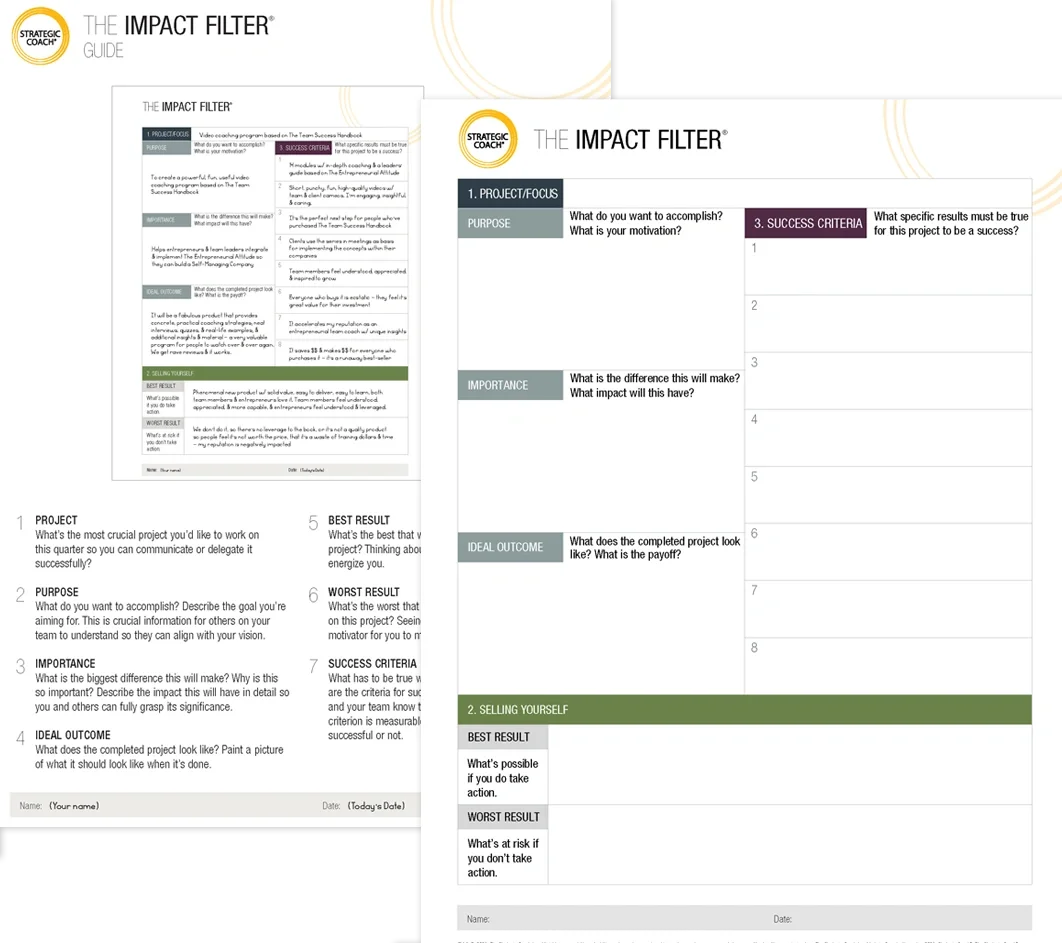
The Impact Filter®
Dan Sullivan’s #1 Thinking Tool
Are you tired of feeling overwhelmed by your goals? The Impact Filter is a powerful planning tool that can help you find clarity and focus. It’s a thinking process that filters out everything except the impact you want to have, and it’s the same tool that Dan Sullivan uses in every meeting.