The Attention Shift That Makes Every Hour Matter
September 23, 2026

Hosted By
 Dan Sullivan
 Steve Krein
Entrepreneurs waste a lot of mental energy replaying the past or worrying about what’s still to come. Dan Sullivan and Steve Krein discuss a simple practice for putting your attention back on today: consciously choosing activities that will make tomorrow’s yesterday feel worthwhile, satisfying, and complete.
Here’s some of what you’ll learn in this episode:
- How this mental shift relieves self-imposed pressure.
- How using this tool feels from the first planning stage.
- The compounding value of sticking with the process.
- How your daily activities earn you points.
Show Notes:
You cannot spend time in the past or the future; the only time you can actually do anything with is today.
Entrepreneurs don’t have bosses creating pressure for them; they’re usually more than capable of doing that themselves.
Each morning, look back at yesterday and ask yourself whether you created a great day.
What matters isn’t how many hours you worked, but whether what you did made the day worthwhile.
Give yourself one point for everyday activities, five points for things you do less often, and 10 points for creative things you’ve never done before.
The more impact something has, the more points it deserves.
The point system is a way to notice what you’re doing and give yourself credit for it.
It’s the quality of the activities you got done during the day that matters, not how long you spent doing them.
There are no penalties in this game, so every positive action helps create a better yesterday.
You can’t always control what happens during the day, but you always have a choice about how you respond to it.
When you’re paying attention to your day, you’re less likely to feel like you wasted it.
Resources:
Yesterday Creates Tomorrow by Dan Sullivan
Time Management Strategies For Entrepreneurs (Effective Strategies Only)
Your Life As A Strategy Circle by Dan Sullivan
Casting Not Hiring by Dan Sullivan and Jeffrey Madoff
The Gap And The Gain by Dan Sullivan with Dr. Benjamin Hardy
You Are Not A Computer by Dan Sullivan
Episode Transcript
Dan Sullivan: Hi, everybody, it's Dan Sullivan here, and I'm here with Steve Krein, and this is one of our favorite activities—favorite for me, I don't know about Steve. We call this Free Zone Frontier, and it's very, very advanced entrepreneurial thinking, new types of opportunities, new types of tools, new types of customers and clients. Steve, I think it was last time that we were together, I introduced an idea that I've been working on almost a year, and it's called Yesterday Creates Tomorrow. Within about a week or so, I have a quarterly book, a little book, 50-60 page book coming out, and I sent you the PDF version, but I was very pleased when we first came on today that you had actually been experimenting with this time system. Basically, the time system is a recognition that you've never spent any time either in the past or in the future. In other words, they're not visitable. You cannot actually be in the past. You can't be in the future. You're only in today. So then, what's the best use of today? And what I came to, the best use of today is that first thing tomorrow morning, this was a great yesterday.
Steve Krein: Do the mic drop right there, Dan. I think that's like, you know, for me, hearing you say that, nothing more. And I want you to unpack it a little bit, but when you describe that, it's like a switch. And it's the beauty of it, it's simple to understand and hear, but once you hear it, you can't unhear it. And I just wanted to give you my first reaction to it before you kind of describe it, because that was for me, and it has been as I've shared it as well, the biggest shift in time that I've made in decades in terms of relationship with time. And I remember back, you know, 25 years ago, almost 30 years ago, when I started in Strategic Coach, having no understanding of what an Entrepreneurial Time System actually gives you a life and make sure you have relationships and other people besides yourself to consider. And The Entrepreneurial Time System was, I think, the first time I was given permission to take weekends off, or I felt like I was given permission to take weekends off.
Entrepreneurs don't have bosses. They put their own self-imposed pressure on themselves and so you work seven days a week and you work around the clock and the original time system was a big leap to have some structure around Free, Focus, and Buffer Days, and for a long time that's enough, right. Just having those boundaries is enough, and you start to build a muscle. You just don't work weekends. For me, at least, it was, those were my Free Days for life. I've never, in 30 years, ever intentionally worked a weekend unless there was something going on, and that made my days of the week much better, much stronger. And then, at the end of every week, when you plan the next week, or the night before, you plan the next day, everything was around, is it a Free Day, is it a Focus Day, is it a Buffer Day, et cetera.
When you shared the idea that making sure that tomorrow is a good yesterday when you're planning it, or today is a great yesterday when you're in it, is such a fundamental shift in the relationship with the pressure you put on yourself. By the way, most of it's self-imposed, so I don't think this is something coming from the outside. It's a redefinition and almost a calmness that kind of takes over—at least it did for me, as I thought about the lens of tomorrow, not of what do I have to get done tomorrow, but how do I make sure that when I wake up the next day, it was a great yesterday. So I've seen it as a planning tool for my next day, not just to use during the day that I'm in, but in my planning of the day. And as I shared with you, by the way, before the call, I'm not just doing it for the day. I'm looking at my end of my week, and I look at the next week, and I'm like, how do I make next week a great last week? And it's that same time jump that has made a huge difference, I think more in my calmness and my anxiety—not anxiety, because I don't have anxiety, but my cycling on things that were just, you know, in my head because I felt either behind or I felt like there was too much to get done.
Dan Sullivan: Yeah. Can I ask you the first day that you tried it? I mean, is there an impact that's immediate or does it take a couple of days just staying with the idea?
Steve Krein: Well, it was immediate for me because you shared it with me and I remember coming out and telling Rebecca about it, right? She doesn't have the same relationship with time that I do in terms of that. So it was interesting, but I felt myself defending it almost like, well, how is it going to be used for good? And how is it going to be used as a tool? But I sat down that night and as I wrote out my top three things I need to do tomorrow, I didn't think about it as what I have to get done tomorrow. I was like, are these the things that the next morning I'm going to look back and say it was a great yesterday? That planning part was, I found, immediate. The next day it felt different, but that planning part was where I felt it immediately. It wasn't even a delay thing. And then I walked back out of the room and I had a really interesting conversation with her about it. And she got it right away as soon as I described that it gave me clarity on my planning. It's subtle in the beginning, but I found it's been compounding. I mean, it's how I plan my following day and it's how I plan my following week now.
Dan Sullivan: Yeah, so in the book, and I don't know how far I had been along; I think I had developed the idea really quite along, but I put scores to the activities. And in the book, I just say, let's just experiment with having scores, giving yourself credit for the activities that you do during the day, so that tomorrow morning you have a total score for yesterday's day. I mean, there's lots of things I just do every day. You know, I brush my teeth, I shave.
Steve Krein: Rituals.
Dan Sullivan: Yeah, they're rituals. And it took me about maybe a month and I said, you know, I just always do these. So I'm not going to itemize them every day, but I'm going to go through all of them together and I'm going to give myself a total score for things I do every day. You know, I'm the dish washer in the couple.
Steve Krein: I never would have pegged you for that, Dan.
Dan Sullivan: I have to return things to order. And Babs uses way more pans and dishes than is necessary. So it's quite a job. And she's got a Ninja. And the Ninja comes with all kinds of parts that you have to get clean. And I gave myself a set score every day. So I said, this is just the same. I may be a little above. I may be below. And then I check in four times a day. So I check in first thing in the morning and establish what I did yesterday. And I have a running score. And every week, I divide the total score by the total number of days to see what my average is. Then I check in around 11 o'clock, I check in at 4 o'clock, and I check in just before I go to bed, and I'm updating the score. So what I tell people, if it's just something that you do, a ritual every day, as you call it, I said, give it a 1. And then there's some activities which are new today, but you've done them before; you don't do them every day, give that a 5. And then something that's creative, something brand new, give it a 10.
Steve Krein: Go over there again. What's a 1, 5, and 10?
Dan Sullivan: A 10 is just a daily ritual. It requires no attention. It's habit.
Steve Krein: Even exercise. So do you just get up every day, exercise?
Dan Sullivan: No, no. Exercise requires a decision every day.
Steve Krein: Yeah. All right. So you're distinguishing between just brushing your teeth to working out. So working out to five?
Dan Sullivan: It depends on how much I do. I mean, a minimum would be a 10. And I do VASPR. I have a VASPR machine. And I have a power plate. And the two of them together are excellent. So it's about a half hour. And depending on which VASPRs, some of them are more challenging than others. I'll give myself 30, because you get about 2,000 steps in 20 minutes. It's a really good activity. But the creation of new things for work, like a new book I'm working on, a new tool I'm working on, that depends upon how much progress I make. Yesterday, for example, after working on this idea for a year, I explained it at a Zoom team meeting with all of our team. We have 110 team members. And I just took them through the whole system. And you know who really loved it, Kolbe-wise?
Steve Krein: Fact Finders?
Dan Sullivan: Follow Thrus. Yeah, because they already have a list, but they cross off the thing when they've done it. And I said, well, that's no fun. I said, give yourself a number, how much it was worth. I said, Follow Thrus, the problem with you is that you start every day in a hole, and you've got to work to get back up to even ground.
Steve Krein: Yeah, I went no.
Dan Sullivan: No, I'm a 2, you know. So anyway, I did that. And then at the end of the day, this was, you know, we were finished the meeting one o'clock after he had lunch. And I said, that was a really big day, because about 15 of the team members came up and said, I'm gonna do this every day. That's a big impact. So one of the things, the scoring is a very qualitative score. If you just passed it on to one person, then it'd be worth this much, but if you're passing it on and there's 15 people who immediately say, I'm going to do this, and this is going to make a big difference, that's a much bigger impact, so you should get a bigger score. So anyway, we've now completed the quarterly book on that, and we've created a great app. So the book is coming out, and we've got a simple tool that you can download from the book, but we're just introducing it to our team. We're just introducing it to entrepreneurs who are in Strategic Coach. We're just doing that right now. So we're just gonna give the app out and say, you know, if you have any suggestions on the app, we'll give it three months, and then we're gonna go widespread with it. This is an upgrade to the wins. WinStreak.
Steve Krein: Yeah, WinStreak. Yeah. Well, it takes it from just gratitude for the day or the biggest insider Positive Focus for the day, and you're down qualifying the activities. Where do you put Focus Day or strategic or Unique Ability activities in there, score-wise, where you're able to get a full day in Unique Ability or activity and action in Unique Ability?
Dan Sullivan: You know, the interesting thing about it, I mean, I'm so aware of Free, Focus, and Buffer Days, so it's just built in that the activities I'm doing on a free day are Free Day activities and the Focus Day are Focus Day. But one of the things I've noticed is I've completely lost the sense of wasting time.
Steve Krein: How so?
Dan Sullivan: It's just the quality of the activities that you got done that day that matter. It's not how you spent your time. So it's not quantity of time, it's quality of result, quality of experience. It's a very qualitative process, and maybe you've noticed that too. You just feel better about yourself. But the other thing is that giving it a score, you have to express judgment about it. And what I'm noticing is that if it has a big impact and it goes out to thousands of people and makes a difference, it deserves a bigger score than just getting a single thing done.
Steve Krein: So what will you give, like a day of writing that you're working on?
Dan Sullivan: Well, I'll apply it to the day. I'm on day 282 today. It's about nine and a half months. And the scores keep going up. And there's a natural desire that the score should keep up. I want a bigger score today than I had yesterday. So when I first started I would have a score like 30 or a score like 50 and now I'm in the 250 range. So yesterday I spent an hour and I had Shannon Waller and she's using the system and I had Hamish MacDonald and he's using the system and we have a great British, Alex Varley, and he created the app for me, so he's been going through. And we got finished, and they said, what kind of score are you going to give you for this? I said, it's a 50. I'm going to give myself a 50. Well, it's my game. It's my scoring. It's my rules. And people say, well, I wouldn't do that. And I said, that would be your game.
Steve Krein: Have you ever qualified your day, the activities in your day, besides whether it's a Unique Ability, you know, whether it's your excellent Unique Ability, you know. You've never done that?
Dan Sullivan: Not quantitatively. Yeah. Can I tell you another experience? And I think I mentioned this on our last podcast. It works for negatives too. So for example, we had this awful day in January coming back from Chicago where we had a two o'clock flight that would have got us in around four because there's a time chain. And there were about five delays and we got home at three in the morning without our luggage. The moment it started, I said, I'm just gonna be really, really cool and calm about this. I don't care what happens. I said, I have absolutely no control over what's happening, but I do have control how I respond to it. And Babs, when we were coming home, she says, “You were really different with this. Usually you're pretty angsty about this type of thing.” I says, “I'm getting a really high score for putting up with this.”
We had a massive rain in Toronto last week, just massive hail, rain, and everything. And we're building a brand-new recording studio in the basement of our building. Water leaked in and it destroyed some of the new flooring. So I was talking to the project manager on this yesterday, and he says, boy, what a shit. And I said, how'd you handle that, Mitch? He said, well, you know, I handled it really well. I went into action. I talked to everybody I need to talk to, insurance, the landlord and everything like that. And I said, “So what kind of score would you give yourself for handling it really well?” Oh, he says, “Oh, that was worth a 20. That was worth a 20.” I said, “How do you feel getting a 20 for putting up with that crap?” And he says, “That's really terrific, I really like that.” And I said, “Mitch, do you know any jerks in your life that you have to spend time with? Yeah, they've been living rent free in your brain. Why don't you give your score every time you have to put up with a jerk?” And he says, “Oh, wow, wow. That's really good.” So context. Context is everything.
Steve Krein: So what's changing how you score now that you're doing it? What changed in how you thought about the impact scoring would have versus what it did have? And when you look back now at it, what are some best practices or what have you found that works best in terms of that scoring?
Dan Sullivan: There's different things that pop up. Let's say you're doing a new thing, and you've never done it before. So I say, because it's brand new, I'm going to give it a high score because it's new, and I should be rewarded for the commitment and courage to do something new. So the big thing is that you're evaluating quality of experience. I think the scoring after a while, it's not quantity of experience. And I think most entrepreneurs grade themselves on quantity of result, quantity of activity. And what I've noticed is that's disappeared. It's the quality of the experience. So, for example, I'll do another important thing before I go to bed and jack up the score a little bit more. So what I'm noticing is that I'm getting out of this quantifying of time and I don't feel I can waste time anymore.
Steve Krein: Because of the significance of what you're getting done around it. So what were you doing before for your days? You were just saying, what are the three things you need to get done the next day to make it a great day in that call today?
Dan Sullivan: Yeah, I'm not planning for the next day. I'm planning to make this a great day. I'll let tomorrow take care of itself just based on my constant positive record of having great yesterdays. So I get up in the morning and I said, okay, I don't do it the night before. I do it when I get up in the day. And a lot of it's already in the schedule. I'm an incredibly scheduled person by other people.
Steve Krein: Shifting this over to what I think you know, it's happening across the board, especially with entrepreneurs today, is AI can do the same thing that social media and media has always done, which is give you something else to do. There's using AI and working on a significant project, a significant activity, valuable activity for one reason or another. Have you brought the scoring to your sessions with AI and been not critical, but been mindful of which activities if you're sitting down and sparring with or innovating with or iterating with AI?
Dan Sullivan: Yeah, all AI is a very high score.
Steve Krein: Let's unpack that a little bit.
Dan Sullivan: All AI is a high score. Yeah. First of all, I'm getting better at AI, and getting better at AI gives you a higher score. So, you know, I just use it for one thing, and that's writing. But I'm noticing the different ways I approach my writing. It's improving by the week, and it's been improving by the week for two and a half years. And Perplexity has done a neat trick because my main, you know, where I go is Perplexity, but they have a dropdown and you can go to any other. Yesterday I was using Grok, I was using Quad, I was using other things. I think they're being very smart on the way they're going about it.
Steve Krein: At this point, they shifted, I think, to not competing with the Frontier models like that.
Dan Sullivan: Yeah, I think it makes total sense on their part. But anyway, I just did one because I was supposed to have a podcast with someone else today, and there was a particular topic I knew we were going to talk about. So I went on and did a search, and basically it was about why, although Moore's Law has been going more or less as predicted for 60 years now, 65. Gordon Moore didn't make a prediction. He simply noticed a pattern, and he shared the pattern, you know, that every two years or so, it seems to me that we get twice as many bits on a chip. So it's been 60 years now, and I said, I believe in Moore's law, but what does Newton's third law say about this? So Newton's third law is for every action, there's an opposite and equal reaction. And I said, what are the 10 ways in which Newton's law in the form of politics, in the form of economics, in the form of culture, what's this say about something getting twice as fast every two years.? And they said, well, there's been no change to Moore's laws every couple of years. It seems that it doubles in computing power.
But humans are now reacting against this. You know, they're using lawyers to react against it. They're using legislature, for example, data centers right now. I mean, data centers is, you know, they just fuck them. And I said, well, the problem isn't the data center. The problem is that it's running their electricity bills. They're pumping into the grid. The data centers can't come off the grid. They have to get their own nuclear plant in and supply their own thing. So this is a reaction to the data centers. This is a reaction to AI, because AI is requiring the data centers. So I was just going through and it showed 10 ways that people will slow down the advance of Moore's Law as far as impact in their daily lives. So I did that for about 45 minutes. It was really great. I mean, it's an original thesis. I've never seen anyone do that before. And I says, I feel very equipped to talk about this issue. I said, maybe in the future, all the money is in the obstacles. I mean, he went to law school. Law school is about learning how to throw obstacles.
Steve Krein: The models now, and I would say over the last three or four months, some of the newer models have become—well, first of all, they seem as though they want to help you think through more, at least I found it to be, maybe it's probably my training a little bit, of not being so biased. One of the activities, or prompts, I should say, that has become a really useful one is this red team, green team, where you're telling it, and every model I found understands this really well, whatever you're working on, red team it and green team it. And it's literally like doing a Strategy Circle where it says, give me all the obstacles and then give me all the strategies to overcome the obstacles. And red team, green team on anything you're working on makes it better. So 10 out of 10. I do another one, which is just, is this a 10 out of 10? And in a crazy world, you won't believe it. It's always a seven or eight because it always gives great answers, but there's always another squeeze in the lemon.
Dan Sullivan: Well, the whole point, I gave myself 40 points for that session. I said, this is terrific. My mind just expanded. I'll be able to talk about this. So the big thing is I'm noticing that AI rewards in higher scores.
Steve Krein: Yeah, well that's what I was asking is like, the activity, is the app a game?
Dan Sullivan: It's a great activity. It's good use of my brain and it's a good use of the technology. I'm smarter in terms of understanding the landscape of the issue and the history of the issue and everything else. I said that was incredibly well worth time. It didn't have anything to do with my schedule for the day. It was play. It was play.
Steve Krein: Has it changed your relationship with, so I know we're talking about time. It used to be, and I know even with the Casting Not Hiring and some of these things, everything that you've always espoused has been about teamwork and about, you know, delegating, not things that aren't Unique Ability, but the lines are blurred a lot. How do you look at solo activity like sitting down at the computer and working with AI on what you just described versus what used to be teamwork? And how do you view the quality of your planning that morning of what you want to get done today? And are you putting that AI time into your calendar? Are you looking at it the same way you would Unique Ability or focus time?
Dan Sullivan: Yeah, I think there are dimensions to this. The one thing I've noticed is that I would say if you—we've known each other for 30 years—that there was a lot of stuff that I was just doing on my own that had a high priority. Yeah, late ‘90s or early 2000s, that I would say, unless I'm doing something that has a teamwork impact, somebody else should be doing it.
Steve Krein: Great. Say it again.
Dan Sullivan: Unless what I'm doing has an impact on greater teamwork, somebody else should be doing the activity.
Steve Krein: So your activity is pushing the greater teamwork.
Dan Sullivan: Oh, yeah. Yeah. I would say 10 times in the use of my time, 10 times in the impact of what I do on a daily basis.
Steve Krein: Yeah. What are you seeing across the community?
Dan Sullivan: You know, it's very, very interesting. This is where some of the other profiles, I mean, you have Kolbe and you have StrengthsFinder and you have it, is that there are people in StrengthsFinder who have Competition as their number one StrengthsFinder. They have, like, Competition. It's hard for them not to compete. You know, if your number one strength is Competition, it's very hard for you not to compete. Mine is number 32, Competition. I just think competition is a waste of time. Why would you be focusing on that? Why don't you just create something new that's valuable for the people who are writing your checks? Why are you paying attention to what somebody else is doing? So I would say people vary enormously in terms of what they count as daily achievement and daily progress.
Steve Krein: Tell me about the app. Is it gamified?
Dan Sullivan: Yeah, totally gamified. So it shows you two days at a time. And you put the dates up, and it's got a little calendar so you can go back in time. And you can't go forward in time because you haven't gotten there yet, but you can go back in time. And then it's got about 20 lines that you can write down what you did that day that's scoreable and you have the ability to extend it if maybe it's 30 things in the day. Okay, so it's got a lot of flexibility to it. It automatically, when you do it and you give something a score, the total at the bottom goes up. And then there's another thing that's your grand total since you started doing it, and the total number of days you're doing and what your average is. It's probably a good 80 percent app right now. And then we'll get feedback, and we'll say maybe we should do this, maybe we should do that, and everything like that. But my whole attitude is get it out there and get feedback.
Steve Krein: Are you sharing the link to the app yet? Or is it downloadable, or is it just a web app?
Dan Sullivan: There's some adjustments being made to it, but I can send it to you middle of next week. It'll be ready next week. You can already do that because the links are in your PDF.
Steve Krein: Yeah, I saw that this morning. I'm gonna definitely listen to it as I always do.
Dan Sullivan: Yeah, but I think this is a big one because this isn't about entrepreneurism. This is about being a human individual and having a relationship with time. So I'm really interested. I told my team members, if any of you want to talk to me about your scoring and your better yesterdays, I'd be happy to sit down and talk to you.
Steve Krein: And I finally found a language that I was just about to say, which is something you've never said before, which is you managing and interacting with the team like that probably would have bored you or made you kind of glaze over to talk about people's days and time. But I think it does re-establish. And the reason I brought up the time system from the beginning is kids grow up, you know, their parents teach them their time system and they learn the pressures of society and school and all these different things. And at least for me, when I, you know, I was probably 27 or 28 when I joined Strategic Coach, I remember like, while you can read lots of things, and there's a lot more to read now than there was in the ‘90s, the idea of a suggested way to think about your days and weeks, just forgetting about what happens inside of the day being game the way you're describing now, just the idea that you're creating boundaries. I think this is another level of that. I don't know if you describe it in the book as an upgrade or compliment to your entrepreneurial time.
Dan Sullivan: No, no, because I think that vastly more people are going to be reading and listening to this. I talk about it in teamwork terms, but this is the most universally human idea that we've had so far. It just applies to everybody. I remember learning how to read. I remember learning how to write. I remember learning how to see what the clock meant. I remember math, you know, arithmetic. I remember all that. I don't remember anyone teaching me how to handle time.
Steve Krein: Yeah. So I said, like, you know, you just grow up and your relationship with it, good and bad, by the way, is inherited from your environment as an entrepreneur. And I want to circle back to this in the lens of today's world of everyone using AI one way or another, whether you're using it well or not. And I think about everybody has the capabilities now to have more agency in their day because they can do more with the tools they have access to. And I think the idea that this tool resonates, as you described with your team meeting yesterday, with more than just the leaders of a company or the entrepreneurs, but everybody. But I think it's an interesting thing not just about time, about all activities. Like when you look at the team and what individuals can now do to contribute to value creation on a team, it's just different than it used to be. It used to be in a box. This is what the roles and responsibilities are. This is what you're going to be measured on. This is what you do. And obviously, when you outgrow that, you move on. But I feel like everything's being redefined now. And how people are using their time is at the top of the list of at least being aware of it. I think that hyper-awareness thing is different.
Dan Sullivan: Yeah, so let me ask you a question on that, you know, and I think that you're, of all the people I've met since we created Strategic Coach, I think you're one of the more advanced people of thinking how business and work and teamwork. You know, I think you have a fairly integrated sense of how people are responding. But my sense is that AI is as powerful as any technology that's ever been created. That's my first three years. You know, I mean, it's at the top and it's having an intellectual, it's having a psychological, it's having an emotional impact on people that is actually changing their views about a lot of things, not just the technology, that they're starting to discover all sorts of thoughts in their mind about things.
For example, the socialist movement, the democratic socialist movement, is, as far as I can tell, it's mostly white people. I think it's 85 percent white people are democratic socialists. They're all college graduates. They're all in college or they're college graduates. And they're really angry. You can tell they're really angry. And my sense is that they were told, starting in junior kindergarten, that if they did enough in junior kindergarten to get into the best kindergarten, and then get into the best grade school, and the best high school, and get into the best college, and even go on for a graduate degree, the rest of their life was gonna be an escalator to the top.
Steve Krein: Yes, and there's a lot of them here in New York City. Many of them actually grew up with a lot of advantages. I've had more conversations with very wealthy, successful families, parents, oftentimes entrepreneurs or grandparents that set up a very nice life that the family, a generation down or two, has no connection to the entrepreneurial or risk-taking or activities of their parents or grandparents that created to begin with. And so to them, it just looks different than just they were told this and they expected more. A lot of them have it.
Dan Sullivan: Yeah. But what I'm saying is that I think that, you know, and I'm just using them as a subset of modern-day people. But my feeling is that I'm starting to pick up on because, you know, basically the only people I deal with are entrepreneurs or my entrepreneurial team. I know nobody in government. I know nobody in corporations. I know nobody in the charitable non-profit world. I just know entrepreneurism. And my sense is that entrepreneurs are quicker to pick up a change in the wind than other people are. And my feeling is that AI is changing our sense of time because you can get, as you've pointed out earlier in our conversation here, that what you can do in an hour now used to take you 10 hours and it was really hard. Okay.
Steve Krein: Yeah.
Dan Sullivan: My sense is that if you're not deeply thought out, like you haven't taken responsibility for your life or anything like that, is if there's a sudden change in the current, there's a sudden change in the tide, there's a sudden change in the wind, it's somebody else's fault.
Steve Krein: Well, the idea of agency, of having agency, which I kind of doubled back to learn more about it recently, because I didn't realize that's what I, you know, as an entrepreneur, you have it, you just, you don't realize it's like breathing, because you just, you know, always think about the independent, whether it's decisions or responsibility or whatever it ends up being. I feel like AI is the ultimate tool for someone with agency. And it's scary if you don't have it. Yeah, but I expect, you know, you were talking about being forward looking on teamwork and technology and things like that. You know, I was around for that first go around, as you know, with the internet and the idea that the internet in 1995, ‘94, ‘95, ‘96, ’97, was transforming the way teams worked and could collaborate and digitizing so many things that were previously analog. It didn't impact individual agency the way this does.
And this shift, which I think is much more significant than anything in our lifetime, is such an exciting amplifier of human agency. My expectation is that an organization is no longer just about leading a team. It's about leading a team that is leading a team of agents. And interestingly enough, I believe that an organization that has 50 or 60 people, rather than helping them make it 50 or 40 or 30 and get the same amount done. If you look at the 50 or 60 people and expect them to do more because of the tools they have now, and now the agency they have, it could be the work of 650 people or 500 people. The magnification of it's so powerful. And I think as CEOs and founders, we have the opportunity to expect more from our team. Expect them to leverage AI really well.
And I found that it's not about learning AI; it's about AI learning you. And when it knows who you are, when it knows who your organization is, when it knows what your priorities are, and your values, and your mission, and your priorities, and what your goals are, and what your floor is, the more it knows, the easier it is. And then you want to know when someone, I expect this a year or two from now, when you interview people to join your organization, they're not going to be an analog person coming to work with you. They have probably a suite of agents that work and help them do more with whatever it is their Unique Ability is. So I feel like people have exponentially more impact on a company today, can have it than they did a year or two ago. And I think it's going to get only bigger of an opportunity as we go forward.
Dan Sullivan: So to bring this back to the yesterday creates tomorrow, my sense is that there's a difference between expectation and appreciation. And what I mean is my job as the leader is to appreciate that they're going beyond where they are right now and to comment on that. You know, it's really great what you did. For example, we have the app for the new book, Yesterday Creates Tomorrow. I didn't ask for that. Alex Varley is our tech guy on our records with Shannon and me that creates the raw copy. And he says, I've been listening to what you've been talking about. And he said, I just created an app to support.
Steve Krein: I was just going to say, I didn't even know the story, but I know with different subjects. You can listen and create, and by the time you were done, he probably had the first version of the app done for you.
Dan Sullivan: Yeah. Yeah. But actually, Hamish, who's the cartoonist, because he's going to cartoon all this stuff, I said, he might as well be in on the conversation that created the text. He's an artist, so he created a scorecard with 1, 5, and 10, and you indicate, and then total. And Alex said, oh, that's beautiful. He's telling us this. We didn't know what was going on. And he brought it right in the app. Yeah, put it right into the app. So my sense is that I don't know what do I expect. It's not a question of what I expected, but the moment I noticed they've gone beyond what was asked for, I reward them. And my sense is it's hard to reward a person who isn't rewarding himself. So what I wanted to create this time system is I want people to become self-rewarding in their work, in their life.
Steve Krein: Looping in agency to that.
Dan Sullivan: I think this ties directly to …
Steve Krein: That's why I'm talking about this, because this is agency. This is that super agency we talked about in the Reid Hoffman book. The idea that you have superhuman capabilities now at your disposal. I'm sure that you call him a tech guy. I don't know if he could have done an app the old way with code and with all the things.
Dan Sullivan: No, no.
Steve Krein: But it's creating and leading now, as a leader of a company, it is creating a team of entrepreneurial thinkers or people that you want to be and want to reward entrepreneurial thinking. Because many of the activities right now that you have capability to do have been things that entrepreneurs have done for years. They just needed a team to do it. And so it's an interesting democratization, if you will, of the creative process. I think you're building the first, or you built the first tool, if you will, to redefine time in a gentic world, even though I know that wasn't the intent. I think it's giving the people who are not used to being entrepreneurs, don't think of themselves as entrepreneurs, but they are in control of their day. They're in control of how they see their day, characterize their day, plan their day, and reflect on their day. That's new.
Dan Sullivan: I'll tell you about a podcast I had. Have you ever come across the name Martin Seligman? He's the happiness guy.
Steve Krein: I have two or three of his books. Yes.
Dan Sullivan: It was actually U Penn. He's been at Penn longer than any other professor in American history. I think he's late eighties right now. He started in late ‘20s, so he's been there 60 years. And they can't get rid of him because he has these adult classes that are very lucrative. So two of our clients have attended his adult classes, and one of them put me in touch. And he sent him the book, The Gap And The Gain. And Martin Seligman really liked The Gap And The Gain idea. So I had about an hour podcast with him, and near the end of the podcast, I asked him, so, you know, you've been thinking about happiness for how long? And he says, around 50 years. You know, he says, it seemed to me that psychology is always focusing on what makes people unhappy, and he felt that there would be a great value of just finding out what are people doing who are happy. What are they actually doing?
So anyway, we talked a little bit and I said, “So is happiness still the center of your interest in humanist psychology?” And he says, “No, it isn't.” He says, “I don't think happiness is the center.” He said, “I think happiness is the result of agency.” And he says, “I think it's taking responsibility and ownership of your experience that leads to happiness.” I mean, it may not be a happy experience, Viktor Frankl, unhappiest experience you can have, but he took total agency for his existence at Auschwitz. And it got me thinking that, you know, we're living more and more in a world where you have binary technology. I mean, that's one or it's zero. And my sense is, I wonder if that binary quality operates on the political level, on the economic level, on the cultural level. And I think it is very polarized right now. This is one of the more polarizing periods. And my feeling is there's a fork in the road and you choose agency. Then it's you playing your game for the rest of your life, you know, setting your own rules, or you're an activist of somebody else's cause.
Steve Krein: Yeah.
Dan Sullivan: People who are activists need someone to tell them what life's all about. Agency is telling yourself what life is all about.
Steve Krein: I think as an entrepreneur, you take that for granted. Hard stop. You think of it as entrepreneur mindset, employee mindset, right? You think people are waiting to be told what to do or they need somebody else's vision or they need whatever. I don't think those who have never had agency before really understands that relationship with that ability to have control of what you're doing. It's The Four Freedoms. It's the idea that you can do what you want, where you want, how you want, with who you want, all the things around time, money, relationship, purpose, commitment, and courage, capability, and confidence. But anyway, you cut it, like the idea of we're living in a moment in time where human agency is going to be rewarded for those who can collaborate with other people. They have agency. You're looking for team members with agency, collaborators with agency. You want to raise children who have their own look at agency. It's a very powerful moment in time to see the tools through the lens of what can they help me do, not waiting to be told or asked to do something.
Dan Sullivan: Yeah. It just struck me because I've been talking to Jeff Madoff. He says, you know, this is probably the most polarized time I can remember. I think he's talking politically, probably politically and culturally, because I think culture is upstream from politics. So I did a search on AI. A lot of people are acting as if the history of the United States was calm and gentle and harmonious before we got to prison age. The founding fathers, Hamilton and Jefferson and Adams, they created newspapers to attack each other. I mean, that was social media in those days. Hamilton had a duel with the former Vice President of the United States, you know, Aaron Burr.
Steve Krein: Yeah, well documented.
Dan Sullivan: Yeah. So I went through and actually it's been rare in American history that there was a period of harmony and unity and common purpose. It's rare. But it's always a different issue each time that it has. It's a very specific situation. But this one is the outcome of sort of the binary technology impacting on every part of life, and you're at a fork in the road. As an individual, you're at a fork in the road. You either own your experience, or you ask someone else to own your experience. Yeah.
Steve Krein: I talk a lot about this on a daily basis. AI is not separate from you. You know, you wrote a book, maybe it was a couple years ago now, the You Are Not the Computer.
Dan Sullivan: You Are Not A Computer.
Steve Krein: You Are Not A Computer. But what's interesting is, with AI, if you know what your Unique Ability is and isn't, and you know what your taste and your judgment and your pattern recognition and all those things are, AI is a really unique superpower. To strap on a tool belt—and I think of a superhero outfit that you put on—and all of a sudden you have superhuman capabilities that amplify your Unique Ability. Sure, there's things you're not good at can help you with as well, but if you stay in your lane and you stick with it's an amplifier of your Unique Ability. It's a really exciting moment to think about that relationship you have with what you know you're good at and where you can double, triple down. Even though there is a democratization of intelligence, it's still general intelligence. It doesn't know about your organization, about your customer, the way you do, about your unique perspective on things.
So I think this book is coming out at a moment in time where the future of time and how you use it, measure it, reward it, think about it, by looking at whether today making it a great yesterday or tomorrow making it a great yesterday, again, that planning thing, it's a big unlock. And I see it being a great tool for those living in this new world of AI every day, thinking about, did I spend three hours messing around building something that I'm not going to use or just searching or surfing or reading versus building something that's going to help me be more productive? But still measuring it and rewarding in your scoring is going to be helpful.
Dan Sullivan: Yeah, well, I really appreciate your insight. First of all, that you've actually experimented with the method. I'm getting it out there because we're now approaching the release date for Casting Not Hiring. And it's time to go back to Hay House. And I say, I got another one for ‘27. They turn around. I mean, it's a matter of a few days. They'll make the decision. But I think Casting Not Hiring is a very timely book, and I think that Yesterday Creates Tomorrow is a timely book. But I appreciate, one, you're playing with the idea and actually applying it, but also you're great at teamwork, you're great at entrepreneurship and everything, but you know a lot about technology, so your insights are terrific.
Steve Krein: Can't wait to play with the app. My biggest takeaway, Dan, from the call is twofold. One, I really appreciate your thinking about your thinking around time and taking something you heard from Lior and turning it into a framework that can be utilized. I think the scoring, which I had not done and applied, is only going to upgrade my use of it. So I'm looking forward to reporting back to you that change, hearing about people's use of the app and using the app. But I'm going to also hopefully refer and recommend this book to others now that there's something to read and document their own time with that'll go along with the app. So what's your biggest insight from the session, Dan?
Dan Sullivan: Yeah, I think the big thing is that what I'm doing here in this podcast, I'm just going to have lots of conversations about it. You know, I already got the structure of the book. I mean, it won't change that much. The structure of the book is pretty good, but it's now getting what's called the social proof that people are actually doing it. And I get my ideas from that. That thing that Steve said, Jim, I wonder how we build that in, you know, that's how my mind works. Yeah.
Steve Krein: Yep. Well, great to be with you, Dan. Have a great day. Make it a great day, a great week, and look forward to making today a great yesterday. I should say, instead of make it a great day, make it a great yesterday.
Dan Sullivan: Thanks, Steve.
Steve Krein: Bye, Dan.
Related Content

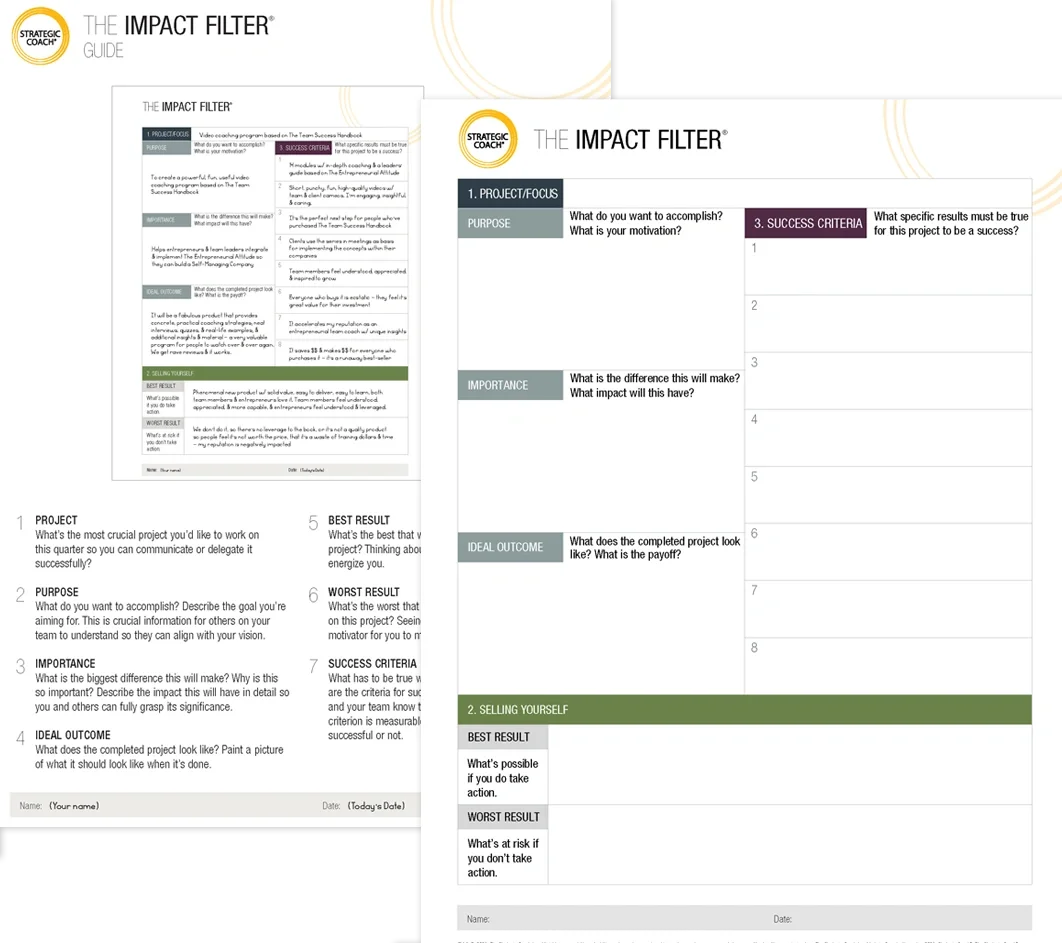
The Impact Filter®
Dan Sullivan’s #1 Thinking Tool
Are you tired of feeling overwhelmed by your goals? The Impact Filter is a powerful planning tool that can help you find clarity and focus. It’s a thinking process that filters out everything except the impact you want to have, and it’s the same tool that Dan Sullivan uses in every meeting.