Simple Habits For True Happiness While Building Your Business
February 10, 2026

Hosted By
 Dan Sullivan
 Shannon Waller
Happiness can be tricky for entrepreneurs, especially when the outside world thinks you’ve already “made it.” In this episode, Dan Sullivan shares a simple daily framework for staying genuinely happy as an entrepreneur, regardless of what’s happening in your business, your relationships, or the larger world around you.
Here’s some of what you’ll learn in this episode:
- Why an entrepreneur’s happiness depends on three simple ingredients.
- How to measure your daily achievement in a way that actually feels like progress.
- What excites Dan most about creating and sharing a brand-new thinking tool.
- Why your greatest value shows up when you spend your time doing activities you genuinely love.
Show Notes:
Entrepreneurial happiness comes from a way of being that you practice every day, not a goal or a destination.
The first ingredient for a happy entrepreneurial life is making real daily progress, not just occasional big wins.
Measuring yourself against an ideal future is like measuring your distance to the horizon line—you never feel any closer.
You feel genuinely successful when you measure progress against where you started and what you’ve actually achieved.
A simple end-of-day reflection on what you accomplished turns an ordinary day into a tangible gain you can build on tomorrow.
The second ingredient for a happy entrepreneur is liking who you are, which means appreciating how you handle setbacks, not pretending you’ve never made mistakes.
When you give yourself grace for past decisions, it becomes much easier to extend that same grace to other people.
Even if you don’t achieve your goal, you can be pleased with how you went about things.
Being truly useful to other people each day is the third ingredient that makes entrepreneurial happiness feel complete.
Strategic Coach® is built on hundreds of thinking tools that help entrepreneurs reframe situations and recognize the progress they’re actually making.
These three ingredients—progress, self-liking, and usefulness—keep you grounded in the present instead of trapped in past regrets or future fantasies.
Of the three, liking who you are carries special weight because without self-respect, progress and usefulness don’t feel satisfying.
It’s hard to feel useful doing work you’re not good at or don’t enjoy, so designing your role around your Unique Ability® is crucial for happiness.
Greater self-awareness helps you like yourself more because you understand which situations you handle well and which ones you should avoid or delegate.
Dan describes happiness as living in “local reality”—what’s real, available, and actionable right now, instead of chasing someone else’s reality.
Viewing each day through this three-part lens is a practical way to keep your entrepreneurial confidence high, no matter what challenges arise.
Resources:
The Gap And The Gain by Dan Sullivan with Dr. Benjamin Hardy
Shannon Waller’s Team Success podcast
Episode Transcript
Shannon Waller: Hi, Shannon Waller here and welcome to Inside Strategic Coach with Dan Sullivan. Dan, we were talking earlier today and you gave a definition of happiness that was really interesting. It's not a singular thing. It's actually composed of three, which I thought was really fascinating and particularly helpful. And I cannot wait to share it with people. I thought, oh, this will be perfect to talk about on our podcast. So let's talk a little bit about happiness. Is it something that is individual to each person? Do you think there's a commonality? Let's talk about happiness for a second before we get into your definition.
Dan Sullivan: Yeah, I think that would be right. Probably what constitutes happiness is different for other people, and they use maybe different words. But my life, you know, for the last 50 years has really been working with entrepreneurs. And I think that what constitutes happiness for entrepreneurs is probably different from people who aren't, just because of the circumstances. They put themselves in a position where they're the ones who have to guarantee their success, their financial security. But I've been a very happy person almost all my life, and it wasn't really a function so much of circumstances, although when my mother was 75, I took her to Italy for two and a half weeks, and we talked a lot. She dropped a line while I was there, and she said, you know, I'm one of seven children, and number five in the family. And she said, you know, of all the children, you were the happiest baby. She said, you were just really happy. You know, she said, you came out happy. You just seem to be happy, sort of contented.
So I think I was lucky. I think I was just lucky for whatever reason, my younger life was a happy life. But working with entrepreneurs, I've just discovered that I think where everybody's the same, that I've talked to about happiness, it's not one thing. What it seems to be is three things. And the other thing is that it tends to be a way of being rather than a destination. In other words, it's not a goal, you know, when I achieve this goal, then I'll be happy. You know, it's not a destination. If I do this, then I'll be happy when. It's actually a way of operating on a daily basis. And so I was just thinking about it while we were doing a book recording this morning. We had a little break and I just draw a triangle and I said, I think it's a Triple Play. I think there's three things for me. And the first one is the feeling of making daily progress. We have a concept in Coach called The Gap And The Gain. It's how you experience progress and how you measure progress and how you're doing it.
And people who are in The Gap, who are unhappy people, they have an ideal. They have a sense of an ideal for their future. And that ideal actually motivates them to create goals that are in the direction of the ideal. But when they get to the ideal and they measure how much progress they've made, in their mind, they haven't made any progress because they're measuring their achievement against the ideal. And it's like measuring your distance against the horizon line. And so as much progress that they've made, and it's apparent to other people outside them, they said, you know, that's amazing. In their mind, they haven't made any progress whatsoever. Okay. And the solution to that in our Strategic Coach system is that you're in The Gain, which means that when you set a goal and you achieve the goal, you turn around, look backwards to where you started, and you've made real progress. So it's not an ideal. You're working back and forth of setting new goals, having new achievements. And you can do this on a daily basis. So what I try to do at the end of each day is I spend some time going back, what did I achieve today? And as I go through the exercise of writing this down and writing this down, I said, that was a really good day. Then I go to bed and next morning I get to do the exercise all over. So the sense of experiencing daily progress and actually measuring it, I think is one of the ingredients of happiness.
The second one is that I've pretty much all my life, I've really liked who I was. I like the person I'm going through life inside of. Even when I've had bad experiences in the past, I liked how I handled it. I wasn't happy in the moment. There could have been setbacks. I've had injuries. I've had quite a number of injuries that required orthopedic operations, lots of general anesthesia. But when I think back to my childhood life, my adolescent life, my twenties, thirties, whatever, my recollection is that I was pretty happy. I'm never embarrassed When I think back to failures, I'm never really embarrassed or feel badly that it was a mistake or it was a setback. I generally admired the way that I went about things. You know, and I've been through a lot of the difficulties that entrepreneurs go through, especially in the first 10 years. So those are my first two. And then we can talk about my third one.
Shannon Waller: Interesting, okay, I'm looking forward to that. Dan, before we go on to the third one, with regard to the second, because you, you do like yourself. And it's interesting, you know, if I reflect on, because you and I've worked together for a very long time, 34 and a half years now, is that you do like yourself. And there's something about being with someone who likes themselves, there's just a little more to go around. There's a graciousness, a generosity. And I think that's actually because you give yourself grace, but then you also give that to other people. And then you can also flip it and go, oh, well, people who do not give themselves grace also do not give it to other people. And they put other people into that Gap, right? Because they're not meeting their own expectations and you're not meeting their expectations either, which is not really all that much fun to be around. This is a word I've used to describe you forever, which is that you're gracious. I'm actually gonna do a podcast on what it's like to be in teamwork with you for my Team Success podcast, because you are one of the very best teammates I've ever had, which is kind of fun. I didn't tell you that until right now.
Dan Sullivan: Thank you. You're welcome.
Shannon Waller: Yep, I'm looking forward to it.
Dan Sullivan: Good way to start the year.
Shannon Waller: Right? I love that. So this is always making progress and liking who you are. And I love being around people who are comfortable in their own skin, right? Who just are at ease with it. Sure, they may have had setbacks and breakdowns and they may have even done some things that were questionable at some point, but they've made peace with that. They've learned from it. They've used it to build a much bigger, better future for themselves and others. And they are at peace with themselves. I appreciate being around people like that. There's just more room for everyone and everything. So I particularly like that one. All right, Dan, what is the third aspect?
Dan Sullivan: Yeah, I think the third one is just being really useful to other people. You're looking at situations where if you step in and you volunteer for something, and you're just really, really useful. And like measuring progress every day, you do this on a daily basis. And that's one of the measures of progress, that you were useful in a way that really mattered to other people. Like, I love my coaching, you know, coaching the entrepreneurs. I get so many opportunities to ask the right question or to point out progress that someone else is making, introduce them to a new thinking tool, which is really the fundamental structure of Strategic Coach, is hundreds of different ways of looking at entrepreneurial situations. And it's a thrill to me when I create a new one that just does what I thought it was going to do and you see the energy that comes back when people use the thinking tool and then, you know, report about it afterwards. They'll say, you know, I use that new tool and boy, it really, really works. So that gives me enormous amount of positive feedback.
But it's the three things, you know, I think if it were just two, it wouldn't work. I think you need the three things. And if there were three things which are necessary for you to feel happy, what are the three things? And it would be interesting. But my sense is, well, they would use different words. But mine are pretty close to the present. These three things actually keep me more in the present than trapped in the past or trapped in the future. And I think both of those conditions, being trapped either in your past in an experience, and I don't think that makes you happy. And I think if you're trapped in the future and you're trying to escape from the present, the present is not a happy situation. So you either go back in the past and you try to live something or be a way that you were in the past, or you're doing the opposite. You're trying to be in the future. So I think those three components of what makes me happy, when I'm doing all three in a day, I've spent a lot of that day really being in the present.
Shannon Waller: Mmm, that's a really great point, Dan. One of the thoughts I have when you were first talking about the three things is what happens if you took one of them away? What would be the answer? But before we even do that, I wanna take all three away, because that I think is a recipe for unhappiness. If you have no sense of progress, you don't like who you are, you feel useless, I don't know how anyone would be happy under those circumstances. So from a check and balance standpoint …
Dan Sullivan: Yeah, I hadn't thought about that at all. I think the one that probably counts the most is liking who you are from that standpoint, because there can be someone who is making progress, but because they don't like themselves …
Shannon Waller: Doesn't matter.
Dan Sullivan: Doesn't matter.
Shannon Waller: They're in The Gap.
Dan Sullivan: Yeah. And if they didn't like themselves and they were really useful, I don't think they'd get any energy out of that either.
Shannon Waller: I think you're right. I think you're right. And it's interesting because they might be content, like someone could like who they are and be useful, but if they're not making progress, I feel like they'll be content, not happy. Does that make sense? It's like there's a level just of staying in this current place, but you're not actually moving ahead. You're not fulfilling that purpose.
Dan Sullivan: Personally, I think it's impossible to know how other people are experiencing themselves. I think it's completely subjective. But I think that whether someone is happy, I think, can be observed from the outside.
Shannon Waller: Not only can you see it in their body language and their facial expression, but there's also an energy that someone puts out. And human beings are very tuned into that, whether you're conscious of it or not. We kind of know when we're around someone who is genuinely happy. There's an openness, there's a freedom that comes with that. And you can tell when someone's kind of faking it. I think it's part of our survival to have antenna for that sort of awareness. Dan, let's go back and talk about being present because I think one of the other terms that you came up with today, which was so cool, which is local reality, which I think is really neat. And that is kind of like what is available to you. It's what's around you. It's what's real right now versus some reality for someone else you're projecting or future or past, as you've discussed. You said it allows you to stay very present. And as an entrepreneur, that's kind of a superpower.
Dan Sullivan: One of the benefits I have that I think probably really supports my being happy is that I have tremendous teamwork around me. The way we've designed Strategic Coach and the way we've built Strategic Coach, everything starts with the concept of Unique Ability, that everybody's got a Unique Ability. And to make your company stronger, you really systematically and continually try to free people up just to be in the area of activity where they're really good, they're really great at what they do, but it's also they're most energized by being that type of activity. And you create structures that support them in doing, don't have them doing things they're not good at, don't have them doing things that they don't really like. So I think that's a great support and I'm a prime demonstration, you know, exhibit for someone who's just surrounded by enormously great teamwork of very, very skillful people. So that allows me to like who I am and allows me to experience daily progress and it allows me to be more and more useful myself just because I can be in my Unique Ability.
Shannon Waller: Oh, that's a really great point. Yeah, that's a great point, Dan. It's really difficult to be useful doing something you're either not bad at or really don't enjoy. That's the opposite of, yeah, that's a really great point. So I think actually, especially with the useful component, yes, I know it's your recipe for happiness, but I suspect that a lot of entrepreneurs listening will go, oh, check, this is also me. We were just talking about happiness, but I actually wrote down entrepreneurial happiness. To my mind, this is a great formula for someone to try out or test out anyway. So why is this important for entrepreneurs? You know, if they want to kind of work on this or try this framework on, to really focus on making daily progress, because we know lots of people who, before they met the gap in the game, I've struggled with that. Maybe, you know, struggle with liking who they are or feeling useful. Why is this important for entrepreneurs to kind of focus on?
Dan Sullivan: Well, for one reason, if you choose to be an entrepreneur, I think the inclination that you're probably going to be entrepreneurial shows up at a young age. My sense is, just from talking to a lot of entrepreneurs, I said, when was it obvious that you weren't going along with the crowd of your peers when you were in school or in your neighborhood, that they were all clustering and doing this together, but you were doing something different? It could have been just an interest of yours, but you were choosing your interest over your social setting. Being popular and being included really wasn't as important to you as spending your time doing what you were really interested in. And then going one step further, that what you were really interested in was making money, and that you had this sense that to be who you wanted to be, there was a freedom to that, and that freedom had to be paid for. So that happens. And my sense is that, I don't know whether they're entrepreneurs or born, but my sense is that if you're going to be an entrepreneur, it's probably going to show up, certainly by your teens. Mine, I think if I trace it back, it was seven or eight. I was just interested in my projects. Being a member of a group or being socially accepted or anything else, I don't think it played a big part. I don't think it played a big part in my thinking. You have to realize that once you get to the point where you're in early adulthood and you have to be in the workplace and you have to make money, then the realization that this is a life sentence because you're kind of proving to yourself and probably proving to other people that you're not really employable.
Shannon Waller: That's so true. Yes. Yeah.
Dan Sullivan: You're not someone who's going to be comfortable in an employment situation.
Shannon Waller: You know, being told what to do.
Dan Sullivan: Yeah. Well, on the one hand, you're 20 and you're doing entrepreneurial activity. And then let's say for some reason, because of tight circumstances, you need to take a job somewhere, but you have no job record. You know, you're 25 years old and you have no job record, you know, or you have big white spaces in your record, you know. Well, you don't want to work for somebody and nobody wants you working for them, you know, so there's a point where you have to realize that if you're going to be making money later in life, it's going to be continually through entrepreneurial effort and success. So I think that has a lot to do with it. And the other thing is that I think the number one issue is that the root of entrepreneurial unhappiness, but also a lot of anxiety that entrepreneurs have, is that it's lonely. It's lonely. The loneliness comes from the fact that you're going through all sorts of experiences and challenges and successes that it's very difficult to talk to other people about this. And I think the loneliness of having, you know, strong emotions about your entrepreneurial life, you find that people who are not living that life, they don't really comprehend it.
Shannon Waller: No, they really don't get it. They just look at the outside. They're like, well, you're doing fine. What are you worried about? Got lots of money, got lots of this, got lots of that. Or they're like, why are you doing that? Why are you putting yourself out there? They're questioning you. But yeah, they don't share a common experience, I think is a really good point. It strikes me, Dan, because my question is always, how can people put this into action? But this is kind of a recipe for keeping your confidence high as an entrepreneur. So really focus on making daily progress, appreciating who you are, and then focusing on being useful, even if it wasn't how you planned the morning. At the end of the day, you found a way to be useful. That is a way to keep your personal and entrepreneurial confidence really high so that you can wake up and do it again tomorrow, no matter what the opportunities or the challenges the day presented you with. Does that land?
Dan Sullivan: Yeah, and something that just occurred to me as you're asking this question, I can't ever remember wanting to be someone else. Or even like someone else. You know, I've never really had that feeling, you know. Other people have vastly more skills. I mean, as you go through life, you're just seeing high skill levels, genius level of creativity and everything else. And I don't remember ever being jealous of that. Well, certainly never envious of it. You know, jealousy and envious being very different things. I mean, there are people who do things in certain ways that I admire how they do it, but I try to say, well, what would that mean with me? I mean, if I was to go about doing what they're doing, how would I do it? Because I'm different from them, so how would I do it to, you know, usually handling things in a particular way. And I would say my liking of myself really comes from the fact that I've had the normal level of challenges and difficulties that probably anyone has. And looking back, what I liked is the way that I handled them. And that gives me confidence about the future, that new things will happen, there'll be new challenges. At 82 years old, I have quite a sense of certainty that it doesn't matter what happens, I'll do a good job of handling it.
Shannon Waller: Well, and that circles back to how we started the conversation. These things are independent of circumstances. Such and such doesn't have to happen in order for you to be happy. This is your approach to your world, right, to your local reality, and that you're confident that you have a large repertoire in terms of how to handle things that you like. So Dan, you talk about the fact that you spend some time putting this into practice on a daily basis. So we have our Positive Focus, which is a great way to measure progress. We can talk about being useful. How can people take action on liking who they are? Is it focusing on how they handle things too? I have a couple thoughts I want to balance.
Dan Sullivan: Well, this is an entirely new idea, now that you bring up the topic. Probably it'll be a podcast on its own. But more and more, I live today with the intent that I'm creating a great yesterday.
Shannon Waller: Say more about that.
Dan Sullivan: Well, what I'm doing right now, when I get to tomorrow, I wanna remember this as really useful. I've been experimenting with this for, I would say about two months right now, and it's got some real merits to it, okay? So anything that I do during the day, I say, I want when I get to tomorrow to remember that I did a good job with this.
Shannon Waller: Nice.
Dan Sullivan: And for some reason it has a very relaxing impact on it, and it kind of keeps you from thinking too far into the future. It's kind of like, really all I have to do is handle today, and tomorrow I'm gonna be happy with yesterday.
Shannon Waller: That is relaxing. It certainly keeps you out of that over-focus on the past or over-focus on the future, focuses you on the present, because all you're trying to do is create a great yesterday, which is very cool. And it keeps you very present, as we were talking about. It also means that it feel like none of your energy or attention is sucked away. It's all focused on right now. We talk about being alert, curious, responsive, and resourceful. And it seems to me like you can bring all of that to bear on whatever is happening today. That's fine.
Dan Sullivan: But the other thing about it is that you don't have to worry too much about tomorrow, because yesterday is always going to create tomorrow, because you're working today to create a great yesterday. And the quality of that yesterday that you created is going to create tomorrow. What I've noticed is that usually my mind is going two months down the road, and I'm worried about something two months down the road. I've noticed day by day as I've gone through this period, you know, a couple months, I've noticed that I'm not getting too far down the road. But I'm checking my next week's schedule more, where I look what are the next five or six days. And then I kind of know today, well, this is due. It's like there's something that is necessary the day after tomorrow. And I said, for this to really work, I've got to get it done today so other people can do their part of the project tomorrow. So there's something about it, and I hadn't put the two together before you asked the questions, but I think this time system is reinforcing my happiness.
Shannon Waller: It sounds like it, and your productivity.
Dan Sullivan: Yeah, I've been very productive during this period.
Shannon Waller: Yeah, just a smidge. Which is, again, why I think it's so useful for entrepreneurs to kind of focus in on this. The other one, and this is maybe true for me, certainly some other people I've coached, but the more you know yourself—and certainly this is where profiles are so useful because they give language to your experience and allows you to compare—it helps, for me anyway, understand how I respond in certain situations, which ones are a great fit for me, for which situations I have no business being a part of. It's not my Unique Ability. It's not how my mental energy plays out. It's not how my emotions play out. It's not where I'm useful. So the more I am self-aware, the happier I am with myself. So that would be my other addition to this conversation. And it means I put myself in situations where I can't handle them well, or I am aware of what resources I can bring to bear, which is also fine in terms of how I handle things.
Dan Sullivan: So what have you gotten, you know …
Shannon Waller: As always, Dan, it's super fun to delve into these almost philosophical conversations, but they're also incredibly practical.
Dan Sullivan: You know something? I think these are philosophical questions.
Shannon Waller: I think so, too. To my mind, you are my, at least, number one practical philosopher that I ever met or had the pleasure of working with. So I find it really useful because, so to go back to your point, because happiness is something a lot of entrepreneurs struggle with. They often feel like they're not enough or imposter syndrome or whatever. And I think focusing on making daily progress, being in the game, really appreciating being self-aware and knowing and liking who you are, and especially how you handle things, even if circumstances have not been perfect—this is so entrepreneurial, being useful. You and I talk about this all the time. That's a great recipe for happiness. So I love having this for myself. It gives me a great daily reflection, a great way to make a great yesterday, and I know it'll be really useful for other people. So thank you, Dan.
Dan Sullivan: Thank you.
Related Content



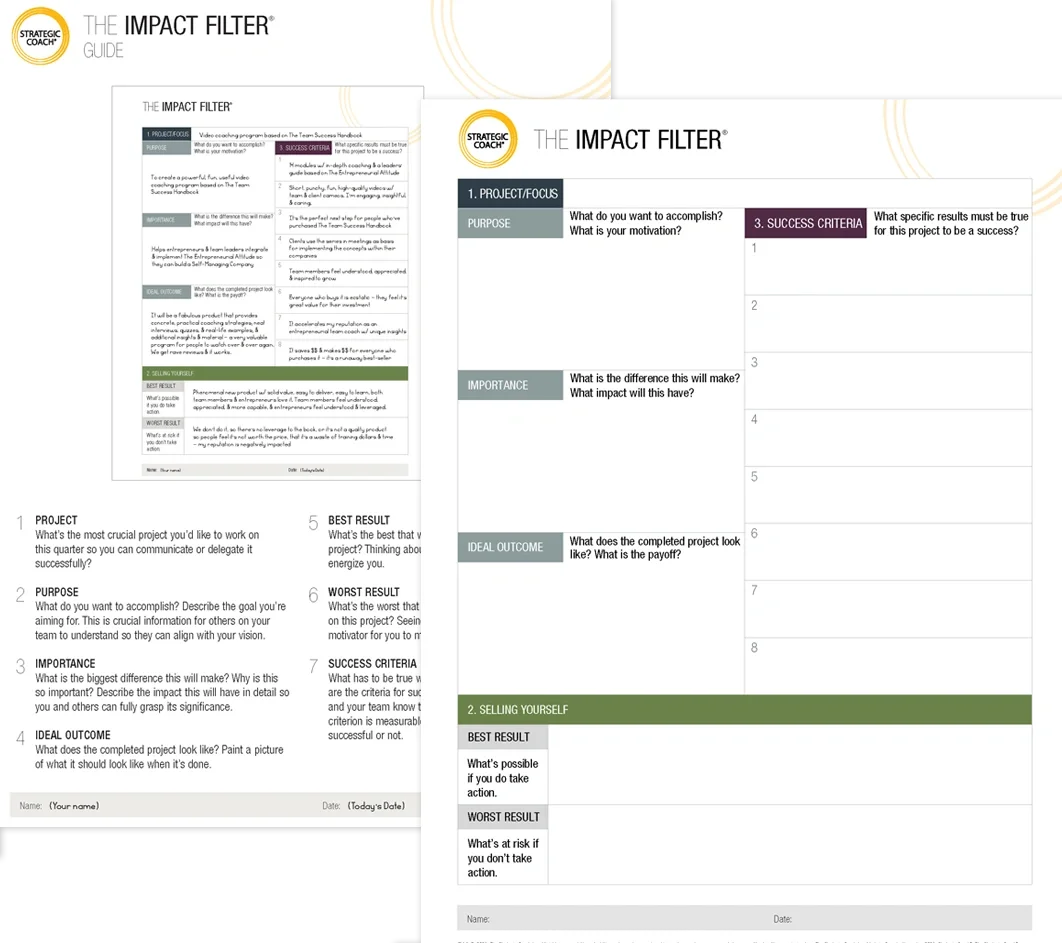
The Impact Filter®
Dan Sullivan’s #1 Thinking Tool
Are you tired of feeling overwhelmed by your goals? The Impact Filter is a powerful planning tool that can help you find clarity and focus. It’s a thinking process that filters out everything except the impact you want to have, and it’s the same tool that Dan Sullivan uses in every meeting.