The Entrepreneur’s Playbook For Mastering AI Without Anxiety
July 14, 2026

Hosted By
 Dan Sullivan
 Shannon Waller
AI can do a lot of tasks that used to take human effort, but it can’t think about its own thinking. In this episode, Dan Sullivan and Shannon Waller explain why the right response to AI is to become more conscious, discerning, and intentional so you can use technology with clarity and purpose.
Here’s some of what you’ll learn in this episode:
- Why so many people feel confused and overwhelmed by AI.
- Why the way most people are reacting to AI is completely normal.
- How new technology has increased both personal freedom and global complexity.
- Why AI isn’t the cause of big changes in the world, but the result of them.
- What “mechanical thinking” means, and how it explains what AI actually does best.
- What humans can do that AI will never be able to do in the same way.
- How The Strategic Coach® Program helps you access your own experience and get clear about your thinking.
Show Notes:
AI is doing work that people used to do manually, but that doesn’t make it original thinking.
A lot of everyday thinking is repetitive and mechanical, which is exactly the kind of work AI can handle well.
Every interaction with technology that we take for granted now might have been a troubling experience when it was first introduced.
AI isn’t new. It's just entered the realm of cognition.
Most people think about only three things: things, people, and other people’s thoughts. The fourth level is thinking about your thinking.
If you think about your thinking, you’ll become very discerning and masterful in how you use AI.
Everyone uses AI for different reasons.
A lot of AI’s capabilities probably don’t serve your purposes.
To use AI effectively, you need to be clear on your reasons for using it.
AI is trying to keep up with humanity, not the other way around.
Resources:
Shannon Waller’s Team Success Podcast
Episode Transcript
Shannon Waller: Hi, Shannon Waller and welcome to Inside Strategic Coach with Dan Sullivan. Dan, we've been having some very interesting conversations about thinking about your thinking and about AI. And you recently said there is a right response to AI and that is thinking about your thinking. And a lot of people are confused by AI, feel overwhelmed by it. Lots of reports in the news about all the jobs being lost to it. So I think actually having the right response to AI would be very helpful to know. So I'd love to know your thinking on that.
Dan Sullivan: Yeah, well, first of all, you know, it depends upon how you're looking at AI. And my sense is that it's technology. You know, it's things that you used to have to do manually or, you know, it was your effort. Something is being done for you. And I think where the confusion lies is that it used to be manual. You know, I mean, we have an enormous amount of technology which takes muscle out of the equation. We don't have to carry things. We don't have to move things. Things will move us. Things will carry us, you know, and I'm sure when these things first happened, they could have been a troubling experience to people, you know, like elevators. You know, it was kind of interesting when elevators changed from having an elevator operator to being automatic self-elevators. They found there was about a five-year period where, even though he was usually a man, wasn't needed. They had somebody on board the elevator because people wouldn't get on the elevator unless there was an elevator operator.
Shannon Waller: No way.
Dan Sullivan: Yeah, and we probably will go through the same experience. For example, Waymo, the limousines that don't have a driver, I'm still not comfortable getting in the car and have it drive itself. And part of the reason is I always interact with the driver. Drivers hear a lot of very, very interesting things, where people in the back seat are talking, but they're not recognizing that there's a listener. I remember when Trump was competing against Hillary Clinton, I was in Chicago, and there was a woman there who claims that she's the first female limousine driver in Chicago. You know, she was about 60, so it was possible. We were going along, and it was about a 45-minute, 50-minute trip, and you could tell she was doing a poll. And she was saying, so how do you think the election is going to come out? And this is an election where at 7 o'clock on election night, The New York Times said it's 90% that Hillary Clinton is going to win the election. And then you had an evening of network depression as the hours went on.
I said, no, I think Trump's going to win. And she says, so do I, so do I. And I said, so where are you getting your information from? She says, it's just really remarkable the number of passengers that I've had over the last two weeks, oftentimes two people talking in the backseat. And they said, you know, I can't talk about this in the open, but I think Trump's going to win. Some of my friends, I won't bring it up in the subject, but I think Trump is going to win. And she says, I have to tell you, it's like 80 percent of the people I've had last two weeks say they have to be careful about talking about it. They think Trump's going to win. Anyway, I like that kind of information because limousine drivers are like street-level pollsters. The whole point is that they're not asking someone a question or anything. They're just overhearing people being in a space where they feel comfortable talking about how they're actually feeling or thinking about things. But I'm sure five years from now when almost all limousines are automatic, but my preference would be that they don't have a driver's seat and a steering wheel, because I just get a feeling something's missing.
I was talking to Peter Diamandis, who's a great forward explorer of technology breakthroughs. He was saying, how would you feel taking a plane ride where there was no pilot? And I said, give me the creeps. Actually, it would give me the creeps just thinking about it. And he says, well, it's going to come. And I said, yep, but I'm not going to be the early experimenter with it. So my sense is that we have this thing of new technology that we used to associate that human beings had to do this, and now a machine is doing this. So from that standpoint, AI is not new. It's just that it's entered into the realm of cognition. And we associate the things that AI does that this actually belongs to human beings. But a lot of thinking is mechanical thinking. You're not inventing anything new when you're thinking in this particular way.
Example of that would be social chit-chat. And as you become more of an adult, you learn that there are certain neutral subjects that you can talk to people about. Why do people always talk about the weather? And I says, because it's safe. Right before you check out somebody, what's acceptable to them, not acceptable to them, whether sports, sometimes television used to be, but it's so fragmented now. But music is another thing, you know, so we have these topics, which are not our topics. Geography is another one. Where are you from? Oh, is that near such and such a very safe topic? okay. Well, it's kind of mechanical thinking and there's nothing original about it.
Shannon Waller: Yeah.
Dan Sullivan: So we already have those things. And the other thing is words mean certain things. You know, we have mechanical thinking there. You know, we have mathematics, and two and two equals four. And if you think it equals five, it's a short conversation because there's something wrong with you. So my sense is that there's a lot of what we do as thinking, which is repetitive and mechanical. And my sense is AI is based on that, which is repetitive and mechanical, but it's not original thinking. You know, talking about things, talking about people, talking about other people's thoughts. You may be very articulate, more articulate than other people. You may have a bigger vocabulary than other people. Your grammar is really, really good, follows the rules, and you have a knowledge base, historical knowledge base and everything else, but it's not original thinking. It's memorization. And among humans, there's vast differences being really good at that and really bad at that. And we have a tendency to make judgments about the intelligence of other people based on their memorization or their training.
Shannon Waller: Or their grammar.
Dan Sullivan: Yeah, and there's some legitimacy to it. You know, I mean, I don't think it's worthless, but it's not original thinking. It's not thinking about your thinking. So my sense is that, you know, there's this saying, you know, how mother eagles teach their baby eagles how to fly. They throw them out of the nest and the ones that don't hit the ground can fly. And the ones that hit the ground are no longer a problem. And I think that what AI is, it's throwing us out of the thinking nest. And if we don't hit the ground, it means that we're thinking. And if we hit the ground, we're no longer a problem.
Shannon Waller: That is interesting, Dan. I have not heard you say this before.
Dan Sullivan: Yeah, so you want AI to not be a problem, start thinking about your thinking. Because you'll become very discerning how you use AI. You'll become very masterful of how you use AI. And they say, yeah, but it can do this and this and this. I said, yeah, but it doesn't serve my purposes. I mean, nobody does AI the same. Nobody uses it for the same reason. Okay, so the only question is, know what your reasons are and use AI in a very, very masterful way to do your purposes. And I think that's what we're finding right now.
Shannon Waller: Dan, we recorded a podcast which ties into this on metacognition and how the Program, Strategic Coach, is really all of these thinking exercises, thinking tools, not forms, be clear, really help you access your own experience and bring what was just below the surface above so you can be conscious and aware of those things. And that really strengthens your own ability to think your own thoughts, just not other people's. I love that out of the nest example. It's really powerful, because if you don't have your own sense of who you are, what you're up to, what's important to you, what your values are, what you're striving for, it's overwhelming. People could get caught up in, oh, I should be using AI for this. I should be using AI for that. But truthfully, to your point, use AI to expand your own thinking. If it's this amazing capability, which I consider it to be, it can help me reflect my own thoughts back to myself. I used it to give some background data for some podcast yesterday that I was recording for Team Success. It helps expand my thinking, but in no way, shape, or form replaces it. If I didn't have my own thoughts, I'd have nothing to ask it.
Dan Sullivan: Yeah. And the other thing is that I think what's really happening is there's some demands being made that's a function of population and it's a function of communication. And that is that we have the biggest population ever on the planet, somewhere between 8 and 9 billion people. And they've been equipped with the means to communicate with each other. You know, about half the world's got a cell phone now. And they can do anything with a cell phone. And it creates on the planet an enormous amount of complexity. Because everybody wakes up in the morning with a different plan in mind and a different set of actions and interactions happen as a result of what their plan is, I would say they have a great deal more freedom than they've ever had to kind of design their own lives. That comes with a great deal of unpredictability of how they're going to exercise their freedom.
And my sense was that the organizational institutions of societies, government being a big one, but just how all the capabilities of moving people from one place to another, that there's food, that there's water, that there's everything else, it was designed for a previous age when you didn't have this number of people and they couldn't connect with each other. And a new technology had to be created to handle the complexity, to handle the unpredictability. And my sense is that AI is not a cause of something. AI is the result of something.
Shannon Waller: Oh, I love that.
Dan Sullivan: Yeah. AI is trying to keep up with humanity. We're not trying to keep up with AI. Technology is always trying to keep up with new things that humans are doing.
Shannon Waller: And if we're thinking about our thinking, that is how we stay ahead of it.
Dan Sullivan: Yeah. And that's the thing is that we have this ability to think about our thinking and AI does not.
Shannon Waller: Yeah.
Dan Sullivan: You know, government doesn't have the ability to think about its thinking. Corporations don't have the ability to think about their thinking. They're primitives. They're big, bulky, dinosauric primitives. It takes them forever to adjust as an institution to new things that humans are doing. But the vast majority of people who now have greater freedom to do what they want and greater freedom to want what they want aren't thinking about their thinking.
Shannon Waller: So they get overwhelmed, Dan?
Dan Sullivan: No, they overwhelm the system because they say, I want this, and then they become demanding and then they organize into mobs and it causes a problem.
Shannon Waller: So what action step can people take to think about their thinking? I mean, if you're in Coach, you do this every quarter with numerous thinking exercises that we have, thinking tools. But just for someone listening to this conversation, interacting with AI, not at the level that you're talking about, what are some things that people can do to actually put this into play in terms of thinking about their thinking?
Dan Sullivan: I don't know what people can do.
Shannon Waller: What can one listener do?
Dan Sullivan: One individual who's interested in doing this is very, very interesting. I just tried this out for the first time. The way I did it as a child, when I could figure out that I could think about my thinking, or I noticed that I was thinking about my thinking at eight years old, one is, children were worthless. Children just had no experience. But what I did is with adults. So I had a recent experience of a tremendous entrepreneur who had his 10-year-old son with him. This was in Arizona about six weeks ago. Very bright. You could tell, very smart, very, very bright. His name's Otis. And I said, Otis, I want to give you a tip. You don't have to do it. I'm just going to suggest to you. But one way to get really, really smart really, really fast is to approach adults and say, I'm 10 years old. When you were 10 years old, what was going on in the world? And then just listen, and every time they say something, ask questions about it. And then when you're finished, go to the internet and look up all the events that happened. Say it was 50 years ago, then go up and look at it.
What will happen is that the adults will get very, very excited because it's the first time they've actually done this thinking. And you'll get a lot smarter. First of all, here you are, a 10-year-old, and you can get an adult talking for half hour, hour, and they're very, very excited about it. What an impact that you have. And it's not based on what you know. It's just that you asked a question, and now they're tapping into something that they didn't know. You do this once, and you'll learn something, and you'll see something about your own thinking. Here you are, you're a 10-year-old, and a 50-year-old is totally excited about talking to you. But not only that, they're directing you to knowledge that you didn't know about, and you'll go and learn history and everything. Do it once, it's a great experience. Do it 100 times, and you're a genius. Because every time you do it, you begin to realize that you're helping other people think about their thinking, and now you're thinking about your thinking. Every time you get another adult to think about their thinking, your ability to think about your thinking will increase. And then become an entrepreneur and then write a big check and come to Strategic Coach and we'll show you what it looks like when you mainline this.
Shannon Waller: And I think his answer to you wasn't that he was gonna do that and report back.
Dan Sullivan: No, he did it right on the spot because he had an adult that he and his father were traveling with and he did it right on the spot. And there was just a profound change in this man. And he talked, he says, boy, I've never thought about this before. And he started thinking about it, you know, happened right on the spot. It was very, very magical. And then he was sort of reserved and then he got really, really happy and bubbly over that. I think Otis is smart enough to know that this is a real trick.
Shannon Waller: I love it. It's cool, Dan, because figuring out how to think about your own thinking is actually, you can get there by helping other people think about their thinking, right? And then what's your response to that? And it's every conversation by definition will be completely unique and very individual. So there's no generalized anything. This will be very specific and again, special to each person. And that's true.
Dan Sullivan: Well, the other thing is that AI can't do any of this.
Shannon Waller: No. And the other thing you talked about, Dan, in our previous conversation, was that it's all about reflecting back on your own experience. And you've said this numerous times, numerous ways, and it still hits me. When you start to take yourself and your own experience seriously, it's this endless repertoire of opportunities to think about your experience, think about your thinking back then, what is it now, what's shifted, what's changed, where do you wanna move forward? It's not that it's not there; we're just not dipping into it, and you have a million tools to be able to help to do that.
Dan Sullivan: The other thing about it is that, you know, there's lots of conversations about, is artificial intelligence conscious? And I said, not in the way that we're conscious, because the way that we're conscious is not measurable. There's no outside detection technology that in any way can know what an individual's experience is. I mean, they can measure your blood pressure, they can measure your heartbeat, they can measure everything, but they don't know actually what the experience is that's causing this. And therefore, it's 100 percent subjective experience. Consciousness is 100 percent experience. Technology, you know, AI would be one of the furthest reaches of science. It's one of the furthest reaches of technology, but it's completely objective. And it's measurable. I mean, there's quantifications which measure speed of computing. That's measurable. You know, the amount of electricity that's squared. You can take everything that artificial intelligence does and nowhere in the performance of artificial intelligence is it subjective. It's completely objective. So objective cannot measure subjective. But I will tell you something: subjective can measure objective.
Shannon Waller: So let me see if I have this right. Consciousness is 100 percent subjective, right? And AI, which is the furthest reach of technology, is 100 percent objective. Objective can't measure subjective, but subjective can measure objective. That's awesome. What a great summary of that.
Dan Sullivan: Yeah. Yeah. So the more you're operating within your own experience and subjective, you're completely independent of what any technology can do.
Shannon Waller: Completely independent, and therefore not subject to whims and wherefores.
Dan Sullivan: Yeah. I mean, you have billions of experiences that, you know, you're just thinking about this and thinking about that, and you're seeing it in full color. It's in Dolby Sound and, you know, and everything else. And nobody outside has the foggiest idea what's going on in Shannon's head until you choose to put it in some sort of communicative form so that they can pick up on it. The one thing I've really looked at, because I've been studying technology basically since I started coaching, because the microchip was just becoming a big impact in all of experience at that point, and you know, I was reading books, I was reading articles and everything else. And then when the internet came along, it became so much easier to do this. The one area that's of great frustration to science is that it's no closer to understanding what consciousness is today than it was 50 years ago, 60 years ago. They've created a lot of metaphors to kind of describe what they think is going on, but it has nothing to do with what you're experiencing. Spend your life where you're unmeasurable and undetectable.
Shannon Waller: I love that. And I think that's very reinforcing and really validating that there is a whole realm of human experience, your own thinking about your thinking, your own subjective experience that technology cannot touch almost by definition. And so anyone who's worried about being subsumed by that, do more thinking about your thinking and you'll be completely and totally fine.
Dan Sullivan: The other thing is psychology and psychiatry, which purports to understand what's going on in the inside. All the knowledge of psychology and psychiatry is based strictly on social situations, how people interact. And we're all actors. I mean, we have a back stage and we have a front stage. When we're back stage, we're doing anything we want to do, but when we go front stage, there are certain rules in how you interact. And all of psychology and psychiatry is based on what we're doing front stage, but it has no notion of what's happening back stage.
Shannon Waller: True story.
Dan Sullivan: Yeah. And we're mostly back stage, you know, I mean, when you're sleeping at night, you're totally back stage. I mean, there's eight hours right off the bat when you're not being social.
Shannon Waller: You're right.
Dan Sullivan: Shouldn't be social in here. Historically, this is a major transformation point. It's a big deal. In 82 years—I'm 82 right now—I think this is the biggest of deals that I've had in my entire life. This is a game changer. Biggest game changer. But we've had others in the past. But the big thing is that where humans have stayed the same is someone from 3,000 years ago where we have the record of their thinking. They could think about their thinking. Probably they were a rare bird in their setting, but they could do thinking about thinking, and they were just as smart in relationship to thinking about their thinking as people are today. People who can do thinking about their thinking communicate across centuries, so there's something timeless and universal about thinking about your thinking that other people pick up on, regardless of the culture, regardless of the customs and everything else. People who can think about their thinking can spot someone else who can do thinking about their thinking.
Shannon Waller: So in this new age of AI, that is the thing that will keep you grounded, clear, focused, contributing to think about your thinking.
Dan Sullivan: Yeah. People say, well, you know, this is a huge problem. This is really, really interesting. This AI is producing big problems. And I said, but if it didn't bother you, what would you be doing?
Shannon Waller: Yep. Going about the things that are important to you.
Dan Sullivan: Or you'd say, well, where is it useful tomorrow?
Shannon Waller: Right. Exactly.
Dan Sullivan: I'll use it for tomorrow.
Shannon Waller: Perfect.
Dan Sullivan: Yeah.
Shannon Waller: Dan, thank you. As always, a grounding and interesting conversation.
Dan Sullivan: Thank you.
Related Content


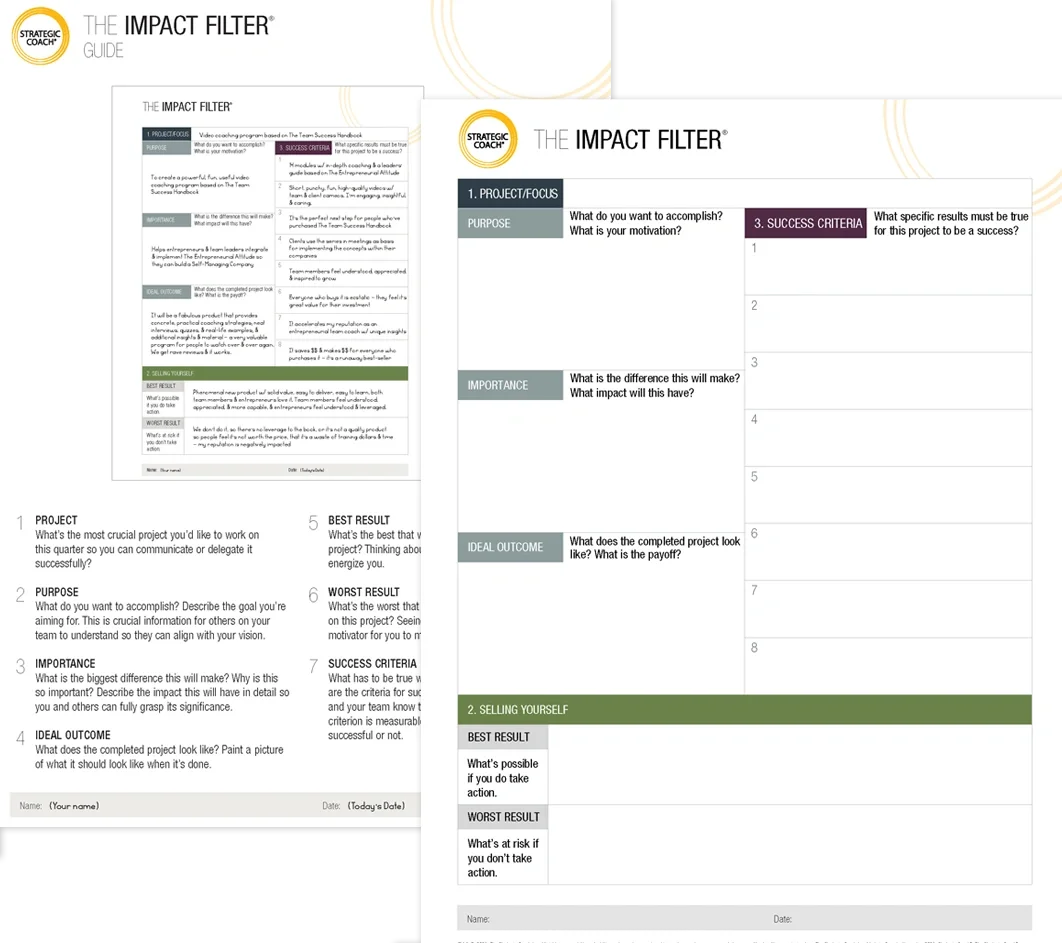
The Impact Filter®
Dan Sullivan’s #1 Thinking Tool
Are you tired of feeling overwhelmed by your goals? The Impact Filter is a powerful planning tool that can help you find clarity and focus. It’s a thinking process that filters out everything except the impact you want to have, and it’s the same tool that Dan Sullivan uses in every meeting.