Who We’re Looking For
August 11, 2026
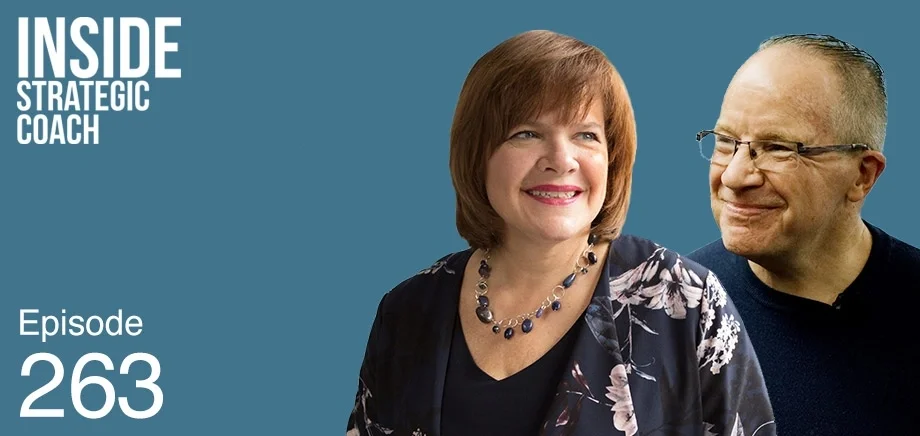
Hosted By
 Dan Sullivan
 Shannon Waller
For over five decades, Strategic Coach® co-founder Dan Sullivan has been coaching talented, successful, ambitious entrepreneurs. In this episode, Dan shares insights from his new book, Who We’re Looking For, as he and business coach Shannon Waller define the kind of entrepreneur who gains the most from joining The Strategic Coach® Program.
Here’s some of what you’ll learn in this episode:
- How Dan discovered and describes the coaching instinct he was born with.
- Why The Strategic CoachProgram is designed exclusively for entrepreneurs.
- How Strategic Coach structures and processes can support an entrepreneur’s lifetime growth.
- How an entrepreneur’s ambition can create isolation—and what to do about it.
- How Strategic Coach and its members create a true collaboration, not a transactional relationship.
Show Notes:
Who you are is often easier for someone else to see, especially when they’re watching you in action and noticing what consistently works for you.
Your life is made up of hundreds and thousands of experiences, and the patterns of what works and what doesn’t reveal your real talents and direction.
The entrepreneurs who thrive in Strategic Coach are the ones who have chosen to base their income on their own effectiveness in the marketplace.
Entrepreneurs have the strongest connection to their ambition because they’ve taken full responsibility for creating their own opportunities and results.
Strategic Coach has coached over 25,000 entrepreneurs, and some members have been in the Program for more than 35 years, treating it as their entrepreneurial home.
The ideal Strategic Coach member is talented, successful, highly ambitious, and never wants to stop growing their freedom and impact.
When the right-fit entrepreneur hears about Strategic Coach, they recognize it immediately as the structure and community they’ve been looking for, which makes getting started simple and fast.
In the Strategic Coach community, entrepreneurs collaborate rather than compete, contributing their experiences and insights so everyone grows faster.
The biggest danger for entrepreneurs is loneliness, especially when they feel like no one around them really understands their ambition or experience.
Most entrepreneurs have had to prove themselves on their own without a process, structure, or environment designed specifically for people who think the way they do.
Strategic Coach gives entrepreneurs a space where they can be unabashedly ambitious and surrounded by peers who want them to think even bigger.
Fundamental entrepreneurial thinking is different from knowing your industry; it’s a way of seeing opportunities, taking ownership, and creating value regardless of the business you’re in.
There’s no point in being a successful entrepreneur unless your success continually increases your sense of personal happiness and agency.
Resources:
My Plan For Living To 156 by Dan Sullivan
What Is A Self-Managing Company®?
The Entrepreneur’s Guide To Time Management
Thinking About Your Thinking by Dan Sullivan
Episode Transcript
Shannon Waller: Hi, Shannon Waller here, and welcome to Inside Strategic Coach with Dan Sullivan. Dan, you have recently published a fabulous quarterly book. We have recently published, but you authored it, called Who We're Looking For, which is a really interesting, provocative book title in my estimation. I always want to go dot, dot, dot is you; who we're looking for is you. And how you talk about entrepreneurs in that book to me is so incredibly wise and enlightening. And I just wanted to share that message a little bit more with our listener today. So tell me a little bit about who we're looking for. What provoked you to write this book?
Dan Sullivan: Well, I started coaching entrepreneurs in 1974, so big decision in my life. I had been an advertising copywriter for a pretty good-sized company, and I was good enough at it that it could have been a career, so I had the skills. But all my life, I've had an instinct towards coaching people. I have a really, really good sense of when I'm with somebody, where their real talent is, where their real ability is. You know, I can just talk to people and I can tell what they're excited about and what they're not excited about. And at a certain point, it became obvious to me that who they are can be seen better by someone outside of them than by themselves, because when we see someone performing, we have more of a sense of what the complete picture is of what they're really good at, because they have hundreds and thousands of experiences and memories, and some of the experiences work and some of the experiences don't.
But when I decided to be a coach, it wasn't purely for entrepreneurs. I had to test the marketplace, first of all, to see who would appreciate having a conversation about what they do best and where they want to go with the thing that gives them the most energy, the thing where they have the greatest skill. And I very quickly, within about a year, realized the only people that it was worth doing were people who had already made a decision that they were going to base their income on their own in the marketplace. In other words, they were going to be entrepreneurs. I could tell that people who were employees didn't have a lot of connection with their ambition. That's just my personal experience. And since I had put myself in the marketplace where I was depending on my own ability, and I was an entrepreneur, I decided to make it practical to actually be successful. I would just focus on one kind of person.
So I've been at it now for 52 years. I'm at the point now where I'm starting to get a feel that I've got a bit of a handle on it. I was a coach for 52 years, but then through my partnership with Babs Smith, we started a company and really went full-blown with it in 1989. So this is now 37 years that we've been at it. It's become big. It's a full-size company. Now we're in three countries and we have 2,500 active clients. We've coached 25,000 entrepreneurs and we've got levels of the Program and we have people who have been with us for 35 years, 36 years. We have one entrepreneur is actually 39 years from my one-on-one coaching and also with the workshop coaching. So I'm at the point now where I got a real feel for who is the person that, when we talk to them about Strategic Coach, this matches the type of structure and type of process that they would like to have for the rest of their life. And because I already have those entrepreneurs in the Program who feel naturally that just being part of Strategic Coach and interacting with us on a continuous basis, it really works for them and it really works for us.
So it's sort of like a collaboration between their ambition. First of all, they're ambitious. They're very, very ambitious entrepreneurs. They're talented, they're successful, but they never want to stop growing their greater freedom as an entrepreneur. These are entrepreneurs who never want to retire. So that's what I would say. And I have enough experience with them to know them when I see them. And I have enough experience to know that when they see us, they know that we're what they're looking for, which really, really makes the connection much faster, much easier, and more productive right from the start.
Shannon Waller: I really love how you talk about it, Dan, as a collaboration.
Dan Sullivan: Yeah, it's a collaboration.
Shannon Waller: Because the word partnership was coming up, but collaboration's far more multidimensional. And it's true. This is their entrepreneurial home. They're our entrepreneurial community. Everyone's doing really interesting, cool things. And it's the opposite of transactional. And it's the opposite of teaching, receiving. It's not school in any way, shape, or form. This is where you come to think about your thinking and not be bored, per a previous podcast. Everyone's talented. Everyone's successful. Everyone's ambitious. But that collaborative nature means that they're not protective, they're not scarcity-minded, they're actually open. Once they know they're in a trusted environment where they can trust other people are there for them, not just to take anything, it's so creative, is what I want to say. So everyone contributes to other people in such a dynamic way.
Dan Sullivan: One of the things, because I've had more than 50 years’ experience with entrepreneurs, and I've personally interacted and engaged with more than 7,000 entrepreneurs, you know, vastly different industries, vastly different marketplaces, I have an instinctive feel of what's just right for the person I'm talking to. I just know the kind of questions to ask and to show them what the results of my half-century experience that we totally comprehend entrepreneurs. We totally understand what's unique about them as an individual, but also what's different about them compared to people who aren't entrepreneurs. And the one overwhelming insight I have since 1974 is that the biggest danger to entrepreneurs is they're lonely. And depending on the circumstances that they grew up in and how they went about being an entrepreneur and everything else, they've had to do so much of it on their own, which is necessary, because you gotta prove that you can do it on your own, but they haven't ever really had a structure, a process, an environment that's just for them, where they actually feel normal.
It's strange to say, but there's got to be some place in the world where you're normal. Most entrepreneurs, many of them for their entire life, they're in circumstances and they're in environments where they're odd, they're eccentric, they're annoying, you know. They're frustrating to other people, and they have to have their guard up to a certain place. They don't know who to talk to and they can't talk about their experience in a way that's really useful for them. They would like to be part of something much bigger than themselves, but at the same time, they're independent. So how do you pull that off? How do you absolutely retain your sense of unique independence, but at the same time you feel that you're part of something that's much bigger than you, where you're totally understood by everyone else? So I think that's the really neat trick that we've pulled off.
Shannon Waller: It's so true, Dan. And it's one that you're a part of, I'm a part of, like we participate in it. You've also created it for yourself, which is really cool. I wanna circle this back to what you said about ambition. And you've said this in another conversation, is that entrepreneurs get isolated from and with their ambition, right? They get isolated from other people because they're so ambitious. And I think that's a really interesting fact for entrepreneurs. You've said this about Coach since I joined, which is more than three to 35 years, 35 years ago, a couple of days to actually tomorrow as of when we're recording this, but this is where entrepreneurs can be unabashedly ambitious. And it's not crab in the bucket. Someone's going to pull you down and be like, hey, cool. How's it going? Do you need any help? And when I would come back to my workshop, they're like, hey, did you do it? Sometimes yes, sometimes no.
So there's just this fabulous positive accountability with your peers that is so wonderful to be a part of. And it's not weird, to your point. It's normal. And people are for you. And it's so refreshing to not have to play defense. Clients in the Program can just be their, what to other people are radical selves. And that's cool. I've actually seen entrepreneurs be challenged. It's like, you know what? You could be thinking bigger. Oh, okay. And then they do, which is really kind of fun. So there's this generosity, I think is the word I'm looking for in that community.
Dan Sullivan: Yeah. So to go back to why we've written this book, the whole point is that people are at different stages of growth in their entrepreneurial career. So we have different levels of growth in The Strategic Coach Program. The first level is really basic entrepreneurial thinking, okay? And basic entrepreneurial thinking or fundamental entrepreneurial thinking is radically different from knowing what your business is. It's radically different from what's the particular profession you're in or what's the particular market that you're in. And there's many conferences and there's many ways of getting in touch with knowledge that's industry-specific or profession-specific. That's not what we do. What we're talking about is that there's just a fundamental entrepreneurial way of thinking about things.
And in our world, that starts with that you have a Unique Ability that you're born with. It's unique. You're the only one who has this. And you're so unique that there was only one way in life that you could actually go and that's to be an entrepreneur. Okay. That means that you're willing to go out into the marketplace and face the marketplace head on. The vast majority of people have to have a lot of protection between them. They have to be given a job. They have to be given a structure. They have to be given a schedule. Entrepreneurs take it upon themselves that they're going to do all that for themselves. And the reward they're going to get from that is that they get to have greater freedom They want to own their time, they want to own their own purpose, their own activities, they want to choose the relationships.
You can have someone who's a really successful entrepreneur, and they're very smart, and they're very creative, but they missed a lot of the basic mindsets. that would allow them to be not only very, very successful, but be very, very happy as an entrepreneur. And my sense is that there's no point in being a successful entrepreneur unless it constantly increases your sense of personal happiness. Yeah, and there's many stories of entrepreneurs who from the outside look like incredible successes, but on the inside, they're not happy with themselves.
Shannon Waller: Very true. Dan, can you also tie in something you talk about all the time, and therefore I do too, and that is the tie-in to agency with happiness?
Dan Sullivan: Yeah, I think more and more we're beginning to understand that happiness is actually a result. Happiness is a result of taking ownership of your entire life, basically. So again, who we're looking for, we're looking for the entrepreneur. We live in a world where entrepreneurism is sort of going to the center of society. This has a lot to do with technology, has a lot to do with the availability of financing and the communications that you can create markets for yourself. I have a weird way of describing this, but entrepreneurs have to realize that being an entrepreneur is a life sentence. This is it. You're not becoming an entrepreneur to get to someplace else. You've become an entrepreneur because this is it. And now let's take complete and 100 percent ownership for being an entrepreneur.
Shannon Waller: Because you're no longer employable.
Dan Sullivan: Yeah. The other thing that happens when people take ownership completely for being an entrepreneur, with the result that they're constantly energized by their growth, they're constantly energized by being even more ambitious, they want to extend their lifetime. So we're in non-entrepreneurial society, you wanna work really hard in your twenties, thirties, forties, and fifties so that you have a certain amount of money that you don't have to work anymore, because it wasn't work that necessarily energized you, but it was necessary. Entrepreneurs, it's just the opposite. They're constantly experiencing the growth of freedom, freedom of their time, freedom of their money. Money is so well taken care of that anything that they think they want to do, money is not the issue. Freedom of relationship.
The other thing about entrepreneurs, they're not doing it on their own. They're creating a company. So the vast majority of entrepreneurs, these aren't the entrepreneurs we're looking for, have actually just created a job. Most people have jobs working for someone else. They've created a job for themselves, but they don't actually have a company. So we're a company right now. We have 120 team members. We don't call them employees. They're team members. You know, we're not a small company. We're a medium-sized company. And that is great because you're not just thinking about yourself as the entrepreneur; you're thinking about giving really great roles to dozens and hundreds of other people who together produce a massive impact out in the marketplace. And as they go along, they become so good at what they do and they have such great relationships in the marketplace with their customers or clients who, for the most part, are also entrepreneurs.
So what you notice about really great entrepreneurs is they tend to have great entrepreneurs as their clients and customers. So it becomes much more of a collaborative transformative. It's not transactional as they go along. And then they also notice that there are other entrepreneurs that they can collaborate with and create even bigger unique value creations in the marketplace. And we call that the Free Zone. So because I've worked with people who I've been the coach and our other coaches—we have many more coaches than myself. We have the experience of what growth really means after 10 years, after 20 years, after 30 years.
And for the first time next year, we have a client who's 40 years. He's been inside the Strategic Coach process and structure for 40 years, and he's free. He's very, very free. So that's who we're looking for. We're looking for the person who has that picture of their life that is going to be just constant, never-ending growth. They're going to get healthier. They're going to get more energetic. Their impact is going to get greater. The work gets more interesting. The relationships get more productive and creative. And that's who we're looking for.
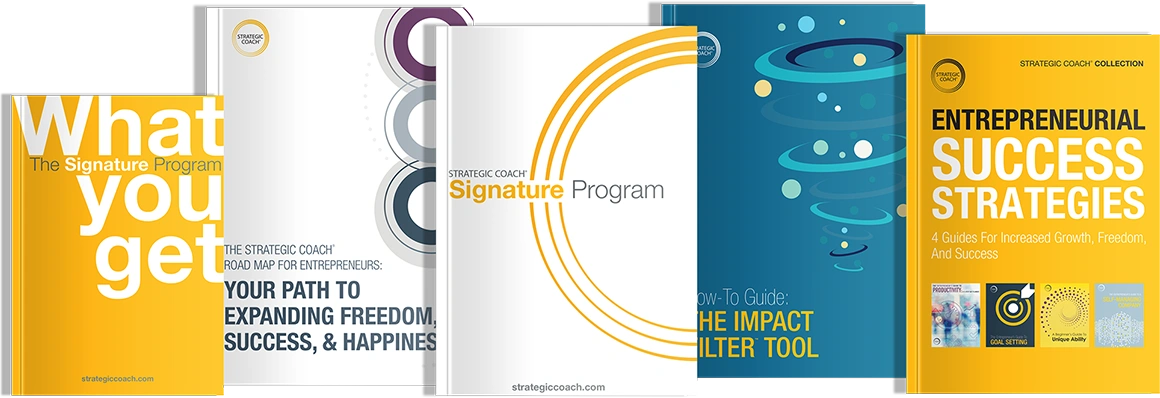
Shannon Waller: So well articulated, Dan. I love it. An insight I had actually, which is surprising—maybe not after 35 years; that's why I like hanging out with you—is that entrepreneurs can be very successful in their specialty, in their area of expertise, but they may not have the fundamentals of entrepreneurial thinking. And that's really what the Signature, and it's going to be called the Signature Accelerator Program, which I love. And that's really what Coach does. It inculcates you in that thinking so that you can keep expanding those freedoms of time, money, relationship, and purpose, which is so powerful. And then once you've mastered those, we call that self-managing, then you can accelerate it even more with 10x. And then as you said, you get to the point where you're working, your own company is in its own Unique Ability and you collaborate with other 10x companies and then that's Free Zone. So that's the path through strategic, which is so powerful. You're never alone or isolated with your ambition. You're very independent. Everyone's goals are so unique and so personal to them, but that expansion of agency, you can be in a community of other people who are also pursuing that same aim.
Dan Sullivan: Just to get sort of an idea of the kind of thinking that we do in Strategic Coach, the way we structure it was with thinking tools. We have hundreds of thinking tools that we do. But in the very first workshop, when people come, they're in a group, 30 or 40 people, and they're all successful. We check income statements to make sure that they're real players. In the very first day, we'd establish how long you're going to live. You know, the first question, at what age are you going to die? And we take people through experience. It's called The Lifetime Extender. And the net result of this, after about two hours of thinking, is that generally they had a vague notion of how long they might live. You know, they're using actuarial tables or they're using family history. And they said, you know, I was figuring I'd live to 75 or 80, and I would say in 19 cases out of 20, at the end of two hours, they're very clear that they're going to live to 100 years old. and they're going to be active. There isn't going to be any slowdown.
In the first hour or two hours of Strategic Coach, you've extended your notion of your lifetime to a very clear goal of 100 years old, 105 years old. And medical science today makes that possible. The other thing is we show them that there's a completely different time structure. You have a completely time structure. We don't think of weekends and weekdays. We think in terms that you have certain days which are Focus Days, which are all those activities that you're working on that they are the ones that produce the greatest profitability in your company. Not only great revenues, but great surplus income, because you have to have surplus income.
And then we have another day, which is called a Free Day, when you don't do any work-related activity whatsoever. And that keeps expanding. We find that when they come into Coach, their personal lives expand, their personal relationships, what they're doing with their free time expands. And then the third day is a Buffer Day and their back stage days. You have days when you're creating your team, you're developing new technological capabilities in your company, you're simplifying things, you're bringing on new team members, and those are Focus Days. So you're growing your company on Buffer Days. So that happens in the first day that you're in Strategic Coach.
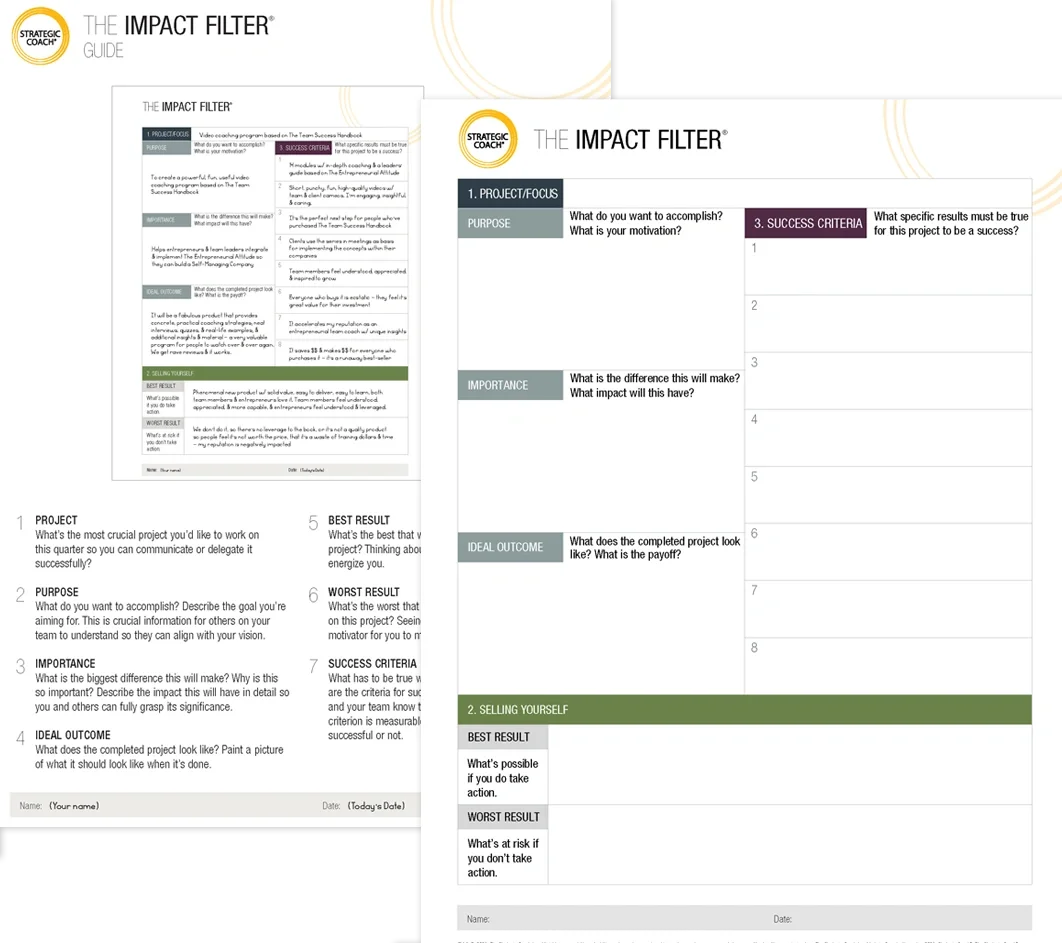
And then the third thing, we show you a tool on how to organize any project, which is called The Impact Filter, where you get an idea of an improvement that you want to make in the company, and you do it in such a way that when you show them the plan, everybody in your company is totally clear about exactly why you're doing it, why it's so important, and what their role is in it. And that happens on the first day of the workshop. So that's the first day. And I am giving a workshop right now to people who have been in the Program 10 years, 15 years, 20 years. And I'm taking them through three exercises, thinking exercises. And that is, what have your biggest money jumps been in your entire entrepreneurial career? And we show them that since they began being an entrepreneur, they've taken a series of jumps. And we show them that when they take a jump, these conditions are always the conditions that they need to take the jump.
So they begin to get a clear picture on their entire history as an entrepreneur. And then they're talking to everybody else about this.
In the first workshop, you're talking about your Lifetime Extender, you're talking about your Free, Focus, and Buffer Fays, you're talking about how you plan projects and how you make your team members more and more self-managing and more self-multiplying. And then further in the Free Zone, you're talking about how you make money jumps, how the whole company makes money jumps. And then we're showing them how the failures that you have had as an entrepreneur have actually been the setup for great breakthroughs. So we take all the most important failures you've had, and we show you how they're directly connected to the greatest breakthroughs you've made as an entrepreneur. This was disorganized information before you do it, but now it's all organized. There's an actual formula.
And the third one would be your best yeses and your best nos. So we talk about every time when you said yes and you got a great payoff for it, you got a great reward for it. And then there's times where you said no and you got a great payoff for the no. And we showed you why both yeses and nos are necessary for you to have a great sense of clarity and simplicity in your life. And these are very universal things that we're talking about here. This is just how entrepreneurs think about things. You could have a workshop and you've got 25 different industries in the workshop, and everybody gets it. So cross-border, cross-discipline, cross-profession, people all get it. Then they begin to realize that entrepreneurism is a central, universal skill.
Shannon Waller: That is so fun, Dan. The by-product of this is that as you examine those previously unexamined, disorganized is a great way to categorize those experiences, some feelings get resolved. Like a lot of people have a feeling of failure or frustration or even shame and blame and all the not so fun things. The Failures To Breakthroughs exercise, which I've done three or four times now, each time I keep coming up with new ones, it's transformative to recognize, oh, if that hadn't happened, I wouldn't have done this. So it knits together this experience and what before was this kind of patchwork disorganized mess, all of a sudden becomes integrated. And integrated means to make whole, which is kind of cool. So you actually end up going, oh, all the pieces do fit in my life and they do make sense.
But it's through this thinking process, questioning process, and we don't tell you how it knits together. You're the one who figures that out. But it's by asking these questions, the connections become really, really, really clear. When we say thinking about your thinking, what you described, Dan, exactly. I love how you've contrasted the first workshop to the tenth or fifteenth or twentieth workshop, which is really special. So someone for whom these thoughts are like, whoa, this is the kind of thinking I never get to do. I'm just trapped in this other world. Coach is a phenomenal fit. I love how you described who we're looking for, Dan. It's very motivating.
Dan Sullivan: And the big thing is that it's really fast. You don't have to do a lot of research on it. It either connects with what you've been looking for or it doesn't. And what we're looking for now, because we're almost four decades into doing this, that we can tell almost immediately who the right person is just because of the picture that we paint of what takes place. You know, you make progress where the progress is most needed, where you make the jumps that you most want to make. But you're in a community where your experience is valuable to everyone else and their experience is valuable to you.
Shannon Waller: I love it. And Dan, I think what you're talking about is resonance, right? Like if this resonates with you, how you're thinking, then, and I used to say this when I was doing one-on-one sales, it's like, if this resonates with you, you can be really confident that the Program is the right fit for you. And if it doesn't, don't. Right. It is kind of binary. We talk about that a lot. So I love this conversation, because my goal is to have us articulate what the experience is enough for people. They go, oh, that's me. Not me. Right. Both answers are great. What we don't like is that.
Dan Sullivan: No maybe.
Shannon Waller: No maybe. No maybe.
Dan Sullivan: Yeah.
Shannon Waller: Awesome. Well, Dan, thank you, as always, for painting such a clear picture. And I hope this galvanizes the right people to come and join this incredible community. And I look forward to meeting you. All right. Thank you so much, Dan.
Dan Sullivan: Thank you, Shannon.
Related Content

The Impact Filter®
Dan Sullivan’s #1 Thinking Tool
Are you tired of feeling overwhelmed by your goals? The Impact Filter is a powerful planning tool that can help you find clarity and focus. It’s a thinking process that filters out everything except the impact you want to have, and it’s the same tool that Dan Sullivan uses in every meeting.