Rewind: When The Performance Ends And The Next Act Begins, with Mike Koenigs
September 14, 2026
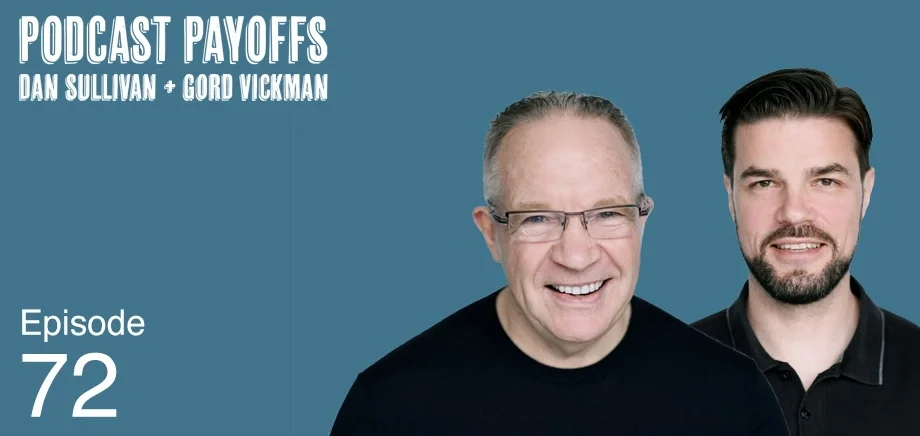
Hosted By
 Dan Sullivan
 Gord Vickman
Everybody has met someone who people are drawn to for reasons they can’t explain, and being one of those people comes with serious challenges. Dan Sullivan, Gord Vickman, and guest Mike Koenigs discuss the “X factor,” how celebrities view themselves, and different ways of being who your audience wants to see.
Show Notes:
- There’s a certain level of stardom where the celebrity can separate themselves from the business and know where they are.
- A key for some performers is to maintain a complete separation between who they really are and who they are onstage.
- People fall in love with who they interpret you to be, not necessarily who you are.
- Enormous complexity in the world means that people like having someone who has simple, basic principles that work forever.
- Some young people want to be filmed and admired, not necessarily for what they’ve done, but just for who they are.
- Gen Zs want to hear from other Gen Zs because they don’t trust anyone else, and outsiders don’t understand their value system.
- Every generation wants to differentiate themselves from generations that came before them.
- An act of life isn’t required to make an act of art.
Resources:
The Capability Amplifier podcast
Episode Transcript
Gord Vickman: Welcome to the next episode of Podcast Payoffs. Gord Vickman here with Dan Sullivan and our special guest, Mike Koenigs. So first of all, Mike, welcome. Thanks so much for being here.
Mike Koenigs: Yeah, no, this is a ton of fun. Definitely an engaging conversation. And there's so many little rabbit holes to pursue.
Gord Vickman: For sure. Dan, you had some thoughts as well of someone you had met that had that X factor and the way it translated into her life and then, you know, carried on basically indefinitely until she passed.
Dan Sullivan: Yeah, well, my original thought when I left high school and I got out into the college world and the employment world was to go into theater. And I had enough experience that it actually did me good because I was drafted into the military right at the start of the Vietnam War. And through some luck and some really good strategy on my part, I ended up the entertainment coordinator for about half of South Korea. One of the duties, one of the responsibilities, was to handle the USO shows when they came in. So for those who don't know what USO is, it's a private organization that raises money and creates entertainment tours for American military personnel overseas. Vietnam was the big deal. So you had Bob Hope, you know, you'd have all the big entertainers. And South Korea, you would get people who were second tier. Okay. And I always say they were kind of somewhere between never was and has been sort of in there. They were more talented than all their audiences. Let me say this. They were talented enough to be better than all their audiences.
Gord Vickman: That's the bare minimum you need.
Dan Sullivan: Yeah, but one of the people who came over, and it was a great treat because, you know, I had gone through my teens in the 1950s, and I remember when the Mickey Mouse Club started. And I remember, you know, that a lot of those early entertainers became famous. Nat Funiciello, who was probably the most famous, became a movie star, and there were other people. But the one who was most popular, both with the audience and also with her fellow Mouseketeers, was Doreen Tracy. She had been on stage since she was two years old in London. She was like a dancer at two years old. Her parents were entertainers, they were actors. And so, you know, she's 12 or 13, and she's at the top of her game. You know, I mean, she could dance, she could sing. She was a total extrovert. I mean, just totally extrovert. Didn't have a shy bone in her body.
But this is 10 years later, and this is the ‘60s. So I got to know her over about a three or four day tour that she did to about five or six spaces, where we kind of did the organization and the logistics. She kind of took to sitting in the back of the bus with me because I was talking, and there was a group with her and they hung out and she came back and she said, you know, this is actually an interesting trip. She says, “This is the last time in my life that I'll be an entertainer.” I said, “Really?” She said, “You know, I'm not more talented than I was 10 years ago. I'm probably less talented because I'm older. And she says, I peaked at 13 and I was as good as I was gonna get at 13.” And she said, “So I decided to do this because I believed in the cause and it's not well paid, but I really admire the military people and I wanna contribute something.” But she says, “When I go back, I've gotta start over.”
So we talked and everything like that, and that was it. It was just an interesting three or four days of conversation. She was telling stories, and I suck experience out of people, so I just asked her all sorts of questions. And then what happened? And then, you know, so I …
Mike Koenigs: And how old was she then? At this point?
Dan Sullivan: She was 23. She was the same age as I was. We were the same age. And then, you know, one thing leads to another. I get out of the army and I forgot totally about her, but I was, you know, it must have been about seven, eight years ago. I was saying, Doreen Tracey—or I was telling this story to someone—I wonder what happened to her. And true to her word, she went back and Warner Brothers had this apprenticeship program, how you become an entertainment manager for other entertainers. And she went through the apprenticeship and she became one of the most successful managers of other people like Frank Zappa. She had Frank Zappa when he first came along and she was the manager of, you know, kind of his career and everything like that. But she had gotten to the end. I mean, I was 70, she was 70. And she had retired from Warner Brothers and she had started a jazz and blues nightclub in Beverly Hills. And I said, you know, if I'm ever there, I'm going to drop by.
And then I, in ‘19, I read that she had died of cancer, so she was 75. But I always remember the story of how someone who was just surrounded by the glitz and glamour of the entertainment world, from the time she could walk, could at a certain point just assess herself and say, you know, I've topped out. I'm not gonna be any better. Because we have all the tragedy stories that are made into movies, stars, you know, Sunset Boulevard and stories like that, stars who are constantly trying to relive what happened 20, 30, 40 years ago. And she was just clear cut about it. And from what I was able to read about her history, she just went on to another career. She understood entertainment. She understood what's it like to be a new entertainer, and she became sort of a guiding coach for other people. And I just thought it was an unusual case of someone who was incredibly self-aware.
Mike Koenigs: That's great.
Gord Vickman: What percentage of those with the X factor do you think have that self-awareness, Mike?
Mike Koenigs: Wow. That's a good question.
Dan Sullivan: Well, I mean, Britney Spears was a Mouseketeer. You know, a lot of them have heard of this career. She was great. You know, I mean, that was a great talent ramp for a lot of people. Justin Timberlake was Mouseketeer.
Gord Vickman: Ryan Gosling. Christina Aguilera. They were all in the same troop, I think. I saw pictures of them as children.
Mike Koenigs: Yeah. And you look back at the, they called it The Breakfast Club Gang, trying to think of the producer who made all those 80s movies. There were a lot of kids, but I think what happens, and there's also a Val Kilmer documentary that just came out and I was avoiding watching it. I watched it. It's quite good. And he's another one of these guys who was classically trained actor. He wound up doing, you know, his big break, of course, was Top Gun. He was in some other movies and then Batman. And then from there, he had a bunch of other movies he made, but he had a breakdown. A whole bunch of disasters happened in his life. And he ended up getting labeled as a difficult actor. Part of it's because he wanted to act and the industry changed and they really wanted people who had less acting experiences, who just stood in the right place and said their lines because CG did the rest. And he was angry and frustrated about it. And I don't think he learned how to compartmentalize.
So the answer to your question, Gord, about how many realize it. In my experience, and I've talked to a variety of celebrities about this—I had a really long conversation with Todd Rundgren, who had a big run and he's still back out playing music again. And I just read an article that he played on Kanye's new album, which is horrible by the way, but none of his stuff ended up on the album. And he ended up walking away from Kanye saying, this thing's going nowhere. I'm not going to have anything to do with it. I also had a brief stint interacting with, I don't know if you remember John Tesh, who is another really fascinating performer, Entertainment Tonight. We created a product for him. And then believe it or not, David Bowie, we worked with a record company and he was a client of ours. And Bowie, I think, was a true, incredible rock star, but also just fought and fought and fought and wanted to be a star so badly. And then the industry happened to him.
So with all that in mind, what I've noticed is there's a certain level of stardom where that individual has their dark night of the soul, their grand awakening, and separates themselves from the business and can have that honest conversation and know where they are and know when to take a back seat and say, I'm going to focus on the business because I'm not going to be that great. And, you know, one person in our vicinity is Joel Zadak as an example. You know, he's an entertainment manager.
Dan Sullivan: He's working with some of the biggest … Yeah, it's almost like the Doreen Tracey story.
Mike Koenigs: Yeah, yeah, exactly. He said, I will never be a great entertainer. I know the mechanics, but here's a better place for me. And I think that having that real conversation, when you see yourself as a character in a movie and you know when it's time for the character to be removed from that stream and find some purpose somewhere else and not disappear, you know, and have the OJ disease, for example, you know, or whatever. I'm not talking about the killing part, but I'm talking about when you start fading and becoming irrelevant and you cannot manage yourself.
Dan Sullivan: Running through airports.
Mike Koenigs: Yeah, right. Bad commercials or whatever it may happen to be.
Dan Sullivan: Hertz or Avis. Yeah. I forget one. I mean, it tells you how good a commercial was. I don't remember what the product was. But one of the things that I mentioned, you know, in our first part of this discussion, that I had the opportunity to spend a couple of hours talking to Alice Cooper and his wife. I asked him how he'd done it, because he had some side issues, but he's been away from them since his thirties, so it's been 40 years. And he said, the big thing is that you maintain a complete separation between who you are as a person and what the act is on stage. And he says, that's not you on stage. That's an act. And I was asking him how he got the Alice Cooper act. And he said, well, it was actually his manager who said, “You know what? Rock and roll is lacking as a villain act. There's no villain act. Everybody's earnest. Everybody wants to be popular.” And he said, “All we need is a good villain act.” And so they came up with the snakes and everything. And I said, “Who are you a villain to?” And he says, “Parents and teachers.” He said, “If you're the villain to parents and teachers, you got the kids for life.”
Mike Koenigs: That is absolutely true. Van Halen did a great job of that. ACDC, for sure. Kiss were probably the greatest example of that. Oh, yeah, yeah. Sex Pistols. Yeah, for sure.
Dan Sullivan: The whole thing. Alice Cooper was the first one.
Gord Vickman: And Cooper's probably the greatest example in the history of entertainment, because he's walking around with boa constrictors and, you know, grinding in his leather pants on stage. But all he wants to do is golf.
Dan Sullivan: Well, first of all, he's a good golfer. I mean, he's been a Callaway spokesperson, Callaway balls and clubs for, you know, 25, 30 years.
Gord Vickman: I read that Cooper was playing like 200 rounds a year or something. He just loves golf so much.
Dan Sullivan: Oh, yeah. Oh, no, that wouldn't be a lot. That wouldn't be a lot for him, you know. He does that, but he's a scratch golfer. He was a good high school baseball player. He was a college baseball player. He's got good skills and he didn't ruin himself. I mean, the whole thing is that he looks in great shape. He's really smart, super smart. And he's got this internet radio station where he tells the history of rock and roll. He made a comment and I said, “I kind of get a handle on your whole career.” He says, “You know what's great about Alice Cooper in 2018? Telling the whole world about the history of rock and roll.” He says, “Everybody else is dead.” He can make it up.
Mike Koenigs: That's great. When you were talking just a moment ago, there was something that popped up. There's a book by Todd Herman, The Alter Ego Effect. And what you were talking about, Dan, is precisely it. These folks know how to inhabit an alter ego, bring it to stage, turn it off when they're off and not let that enter into the rest of their lives. I know Beyonce, she has her own alter ego she slips into. I think crafting a character, that's what your audience does fall in love with. And it can still be you, but a variation, an idealized version. And this is one thing I've noticed about any kind of a guru is people fall in love with who they interpret you to be, not necessarily who you are.
Dan Sullivan: Well, the other thing is that they've created someone that they kind of want to have in their life, and it kind of coincides with what you're delivering. But I think technology creating enormous complexity and confusion and disruption that having someone who just has simple basic principles that just work forever is something that people want in their lives today. It's not that I tried to fulfill what they want, it's just that I wanted that for myself. And I try to practice what I talk about. And it kind of clicks with a certain kind of entrepreneur.
Gord Vickman: I wonder if there's a bit of a generational divide here, gentlemen. And I'm thinking about people, let's say your son's age, Mike. Okay, how old, Zach?
Mike Koenigs: He's 19.
Gord Vickman: 19. So 19-year-olds right now, the people that are getting famous in that age bracket, they're getting famous on YouTube, they're getting famous on TikTok, they're getting famous on social media, but the division that you were talking about that Cooper perfected and the Beyonce practices where I have, you know, Beyonce on stage and then I have Beyonce at home and Cooper on the golf course and Cooper on the stage, people around that age, 19, 20, 21, not only do they not want a separation, but they almost want like a Truman Show type situation in their life where they're being filmed and they're being admired, not necessarily for what they've done, but just for who they are. And it seems to be working, because some of the biggest celebrities in the world right now, for that age bracket, don't have a separation, probably don't understand what it means. They don't want it.
Dan Sullivan: Mr. Beast.
Gord Vickman: Mr. Beast as well. There is no separation. So is this the shape of things to come? Is that dual persona a thing of the past, Mike, or is this a blip?
Mike Koenigs: I've spent a lot of time talking to Zach about this because he has a few friends who are incredible musicians and he's been writing music with them. And I'll be the first to say, I want to be the most supportive father ever, but his music, I can't stand listening to it. I mean, I really try, but a lot of it's just like, ugh, it's horrible. And some of his buddies are playing with some big-name celebrities in his space. And what that generation loves, and I'll give you two examples of this. One of them are people who have made it by themselves and are exercising the fact that they don't care about celebrity and fame, but they cannot get caught for a second trying to be it or do it. In other words, the authenticity bar is so high that anything will destroy their career in a moment. And this isn't everyone of his age. There's so much diversity.
And that is, you know, unlike the old days when you had ABC, NBC, CBS, you had three channels and it was linear content. And that was that no VCR. So, you know, why did the Beatles take off like they did? Because there were no other choices, okay? And for his generation, there's infinite choices, infinite channels, and no linearity whatsoever. And you can build a relationship with a celebrity. So we were working on a project together. I got Zach involved. We ended up spending a bunch of time in Hollywood. I can't talk too specific about it, but the net is there were some big celebrities present and he got first access to it. And these people who are managing the celebrities turned to Zach because he was the youngest person around and they asked his opinion nonstop in multiple meetings. We didn't even prompt it.
And one thing that I will say is our generation and all the way into the thirties, even millennials are trying to figure out how to crack the generation Zoom, as they call them, and how to get their attention, how to build their trust and how to create momentum. And it is very delicate. And it's like, you've got to have a Gen Z speak to the Gen Z. They don't want to hear from any of us. And it's not that they don't respect us. It's just, they don't trust us. And we don't understand their value system.
Dan Sullivan: Right? Well, what I notice is that there's kind of a pendulum swing between generations. For example, I have clients who have 15-year-oldx, and he says, as far as I can tell, he's going to grow up to be a conservative and all his friends are conservatives. They don't have any liberal values at all. They're saving money. They know they're going to have to work hard and everything else. So it's, I think there's a pendulum swing and you know, I'm not a Boomer. I'm before the Boomers. So I'm two years before Baby Boom. And I don't have a Baby Boom instinct in my body. It's not that I dislike it. It's just that those are not my instincts. I was born two weeks before the Normandy invasion, you know, a big world event. So my life is about where are the big world events.
And by the way, we're in the biggest world event of my life. Nothing like the global COVID thing. Never in history. Eight billion people and they're all affected by the same event. Nothing like this. This is a unique thing. But my sense is that generations have their own rhythm, and part of it is they want to differentiate themselves from the generation before them. A lot of life is just about differentiation. Oscar Wilde said, “Be yourself. Everybody else is taken.” I mean, there's just this fear thing. I'm a fifth child, and I just totally differentiate from the old. They fought with my parents, note to self. Be useful to parents. Don't fight with parents, don't argue with parents. There is no reward for arguing with your parents.
Gord Vickman: I've always thought one of the things that differentiates, you know, people of your son's age, Mike, the 19-year-olds, imagine taking him back in time, because people of that age, they've grown up digitally. I'm ‘77, and there's a weird distinction, people born around ‘77. They're calling it almost like a different little sub-generation if you're born …
Dan Sullivan: Well, first of all, the generations are an arbitrary distinction. You tell me that someone born 18 years apart is still in the same generation? Come on. People born in 1946 are Boomers. People born in 1964 are Boomers. You telling me there's anything that these people have in common? So it's an arbitrary distinction. It's like having a good year or a bad year. It's a 12-month period that's arbitrary.
Gord Vickman: Yeah. And people born late ‘70s were sandwiched between Generation X. We don't quite fit in with that, but the stereotype of those, and then definitely don't fit in with the stereotype of millennials. I think the word was centennial. They were saying that I had an analog childhood and then a digital adolescence. And people born when I was born, late ‘70s, were the only generation that started out analog. And we were there for the flip, basically.
Dan Sullivan: Yeah. Plus the fact that you're just personally weird, Gord.
Gord Vickman: I am quite weird. Yes.
Dan Sullivan: Yeah. Yeah, you gotta throw that in the mixer, too. So are you, Mike. I mean …
Gord Vickman: I don't trust people who aren't weird.
Dan Sullivan: Well, first of all, people aren't trying to stop you. They don't even really care. I mean, the first thing you have to accept, no one's trying to stop you. As a matter of fact, no one's paying any attention to you whatsoever. They're busy. You know, it's like you're standing on the edge of a curb, and it's raining out, and a car comes by and just drenches you, and you say, he was late.
Gord Vickman: And you just were standing in his way.
Dan Sullivan: Note to self, raining, don't stand next to the curb. Back up as far as you can so you don't get splashed. I mean, a lot of life is just getting splashed by someone who is late. And I think probably, Mike, we're talking here about people who have it and it's a special thing and there's no alternative to it. But the one alternative to it is, at a certain point, don't take it personally. It's the cards that you were dealt with and you just gotta play the best hand you possibly can. Yeah, and timing. Yeah. It's not like anyone's trying to do anything to you. You know, people are busy.
Mike Koenigs: The way I resolve this in my mind with all these factors is you can have a perfect it, you can have all kinds of things going for you. You can be a genius, the perfect it, and there's two key distinctions. Sometimes it's just timing. And then the other part is, I hate the word luck, often because I think it's giving up control. That's what historically I get. I'd be like, I don't like the idea of luck because I was like, you make your own luck. But the truth is right place, right time, right people is absolutely a factor. There could have been someone with the sound of Nirvana and it just sounded like noise. You know, the grunge generation needed to go through its thing. And I think there needed to be the right kind of political anger and the right kind of social angst in the world for that sound to be meaningful. You know, art is that way.
And I tend to believe that life imitates art more than art imitates life. If I were going to pick a 51/49 meaning, I think you can control the behavior of humans with art forms and storytelling and visuals and auditory. And I think proof of that is just watch what certain bands and certain artists and certain movies do to an entire generation and creating a conversation. And that comes from a creative spark that could have come right out of someone's dream state, for example. It doesn't need an act of life to create an act of art. But I do think an act of art can create a completely different social movement. You know, when we tie all this back to momentum and audience building, that is another key distinction that I see is someone who can capture a certain spark of a certain something, create a meme, whether it's an auditory or a visual one or a storytelling one. And boom, you know, it's 50 Shades of Gray captured an entire audience of women. And it changed publishing. It changed a lot of rules.
Gord Vickman: Mike, I know you got a hard stop, so we want to let you get onto what you have to do today. If I want to learn more about you and your work, where's the best place for me to look?
Mike Koenigs: Well, first and foremost, it's the podcast with Dan. It's Capability Amplifier. Subscribe to that for sure. These kinds of conversations is what we love to have. And there's always something new. So if you want something that'll just stop your brain, I think joining that show is a great one. And then of course, hit my website at MikeKoenigs.com. Or if you want to see a video that gets into some storytelling that I really enjoy doing, it's MikeKoenigs.com/funnel. Man, this is a blast, guys. I hope we do another one soon. Gord, you're really a great host.
Gord Vickman: Thank you. Appreciate the compliment. Dan, Mike, always a pleasure. I've been looking forward to this for many, many, many weeks since we first booked it. And I really had a great time. Thanks so much for joining us. And Dan and Mike, thank you.
Dan Sullivan: Thank you, Gord.
Mike Koenigs: Yeah. Let's do more. See ya.
Related Content

The Impact Filter®
Dan Sullivan’s #1 Thinking Tool
Are you tired of feeling overwhelmed by your goals? The Impact Filter is a powerful planning tool that can help you find clarity and focus. It’s a thinking process that filters out everything except the impact you want to have, and it’s the same tool that Dan Sullivan uses in every meeting.