The Greater Game: Chapter 7 – Greater Autonomy
July 22, 2026

Hosted By
 Dan Sullivan
 John Bowen
It’s time to stop being indispensable and start being invincible. In this episode, Dan Sullivan and John Bowen explore Greater Autonomy, the seventh of the 10 Multipliers, and show how entrepreneurs can design self‑running companies, boost valuations, and free themselves to focus on their Unique Ability® while their businesses grow bigger and simpler.
Show Notes:
Gaining greater autonomy is all about moving from being indispensable in your business to being invincible because of your business.
Many companies are founder‑dependent, and buyers don’t want to acquire an expensive job. They want a business that runs without the key principals present.
When a company can operate smoothly without the owner, valuations jump from low single‑digit EBITDA multiples to double‑digit multiples.
The laws you set for your business should protect your uniqueness and still work even when you’re not in charge or in the room.
Greater autonomy gives entrepreneurs the confidence to start new ventures, travel more, and design companies that grow while they’re away.
Dan’s self‑law of “I don’t rescue” keeps him from stepping in to fix problems so his team can learn from failure and become truly capable.
Investors want as few complications as possible, which means no dependence on the founder, no unnecessary family on the payroll, and clear operating systems.
The biggest motivation for autonomy is owning your time so you can spend it on your Unique Ability rather than getting pulled into daily operations.
Resources:
The Greater Game by Dan Sullivan and John Bowen
Episode Transcript
John Bowen: I am excited to welcome you. Dan and I are both excited to, podcast seven: “Greater Autonomy.” And this is all about moving from being indispensable, because most entrepreneurs, we're going to grind it out. We're going to make it happen. Because you're now already successful. We want you to move to being invincible. And Dan, this is one of the tougher journeys for many entrepreneurs is, you know, how do you create this greater autonomy? And it's so important. It's probably one of the biggest of the 10 on valuations.
Dan Sullivan: Talk about that a little bit, because a lot of people don't know that.
John Bowen: I have done 50 transactions I've been a part of. And as you start doing M&A, it becomes blindingly obvious, so many businesses are founder dependent, and as someone acquiring, you don't want to buy an expensive job. You want to have the company run without the key principles there. That's where the valuations start taking off like crazy, moving from founder dependent to really the enterprise dependency, and that's where the invincibility moves up. And to everyone listening, this is millions of dollars moving from a three to five times EBITDA for a standard valuation, really closer to three, to as many as 15. I grew up in the wealth management financial advisor, and we had one of the early successful wealth management, and we had a couple billion under management. I was CEO, and we sold at 16 times earning. Why? I wasn't needed, and nor were either of my partners. And we had the machine working. And this is where the difference between 16 and three is a big number on multiply.
Dan Sullivan: Yeah, it's interesting. The word autonomy, it comes from a root word of auto nomos. That's Greek and auto means self and nomos means law. So an autonomous person is a person who has their own laws about how they conduct themselves. First of all, do you have your own laws for yourself? But it's how your company operates. And these laws are good laws in the sense that if you're not the person in charge, the laws still work. When you look at an investor, he doesn't want any complication. If somebody buys your company, he doesn't want to see relatives on the payroll. One of the first things you have to do is get your family off the payroll, unless the family are going to be the ones who are buying the company.
But the big thing is, how do you operate? And I can remember a very interesting article, I think it was Fortune or Forbes, one of the magazines, and it was Steve Jobs. He wasn't sick yet, but he was right at the top of his game because Apple almost went under when Steve Jobs wasn't there. He was fired, came back. He came back with all sorts of new technologies. He had helped create Pixar. He had created Next. He had created a completely new operating system. And he came back and he was introduced—I think it was the head of Nike, a new CEO of Nike, asked him, “What are the 10 best things that you ever did with Apple?” And Steve Jobs thought about it. He says, it's the 10 no's, where we were offered an opportunity where I said, no, it didn't fit in with the simplicity that we were operating with at the heart. So my 10 no's guaranteed that it was still simple. Even when we got bigger, it got simple.
And we're going to have further podcasts on this topic. But the big thing is that your laws as an entrepreneur—you're a unique individual. You took a unique risk. You created unique value in the marketplace. There are laws that support the uniqueness of what you're doing. And it's interesting to listen to what other people are doing, but those are their laws. They're not your laws. One of the things, John, I think that made you a believer was AI; that first of all, if you allowed this new capability into your life, and instead of just making something up, you said, let's just check this out and see what the best practices are out there before we get going. So I've observed it over the last two years that you've become far more autonomous than you were when we started this project.
John Bowen: Well, and it's given me tremendous confidence. I think I shared with you, I started three more businesses on my seventieth birthday type thing. And here's the paradox that we're going through is, you know, we're talented, each of us, you know, as entrepreneurs and, you know, our presence is a multiplier. But here's where it becomes really important. I want everybody to think about your absence is your exponential. So if you can create systems with all the other multipliers, the team, the community, what we're talking about here, you can build amazing businesses that deliver tremendous value and do well by doing that and take those 100 days off too.
Dan Sullivan: Yeah, you know, it's almost like Zen, you know, it's almost like there's a philosophy here that as you get bigger, you have to get simpler. You're very, very crucial at certain, very specific times with very specific projects, but you're not in everything. My biggest self-law is that I don't rescue. If a project is falling apart, one of my team members is falling apart, I said, I just want you to know, I'm not going to interfere with your learning from failure here. I'm going to allow you to fail, and I'm going to support you as you go through your failure, and I want you to get maximum learning out of your failure, and I'm not going to rescue you. And that's one of my biggest, and everybody does.
John Bowen: And that's one of the hardest things for most entrepreneurs to do, because we're heroic.
Dan Sullivan: I want you to know, Dan will be very attentive. He'll ask you all sorts of questions, but he's not going to rescue you.
John Bowen: Well, Dan, let me share, as everyone who's been watching the podcast knows, I love to share a little statistics. And I want to go to, as we think about this greater autonomy, what we have is, again, it's not everybody, it's not totally universal, but 47.3 percent, and it's single digit for the 96 percent. But this is really important for each of us to get free from the daily operations. And I want you to think about that. This is something we all want. And I want to share two stories, Dan. One, Gino, I'll start it and have you add, because you have obviously a great relationship with Gino. But Gino, he's got 850 EOS Implementers.
Dan Sullivan: Yeah, Implementers out there. They're kind of coaches, but this is actually a system, EOS, Entrepreneurial Operating System, that was created by someone who is inside Strategic Coach. He's been in Coach for 28 years. He said, you just focus on entrepreneurs in Strategic Coach. I said, yeah. He said, but you don't focus on the entire management of the entire organization. I said, no, I'm not interested in that. And he says, is that always going to be true? And I said, yeah, that's always going to be true. But at the same time we're the operating system for the entrepreneur, you're the operating system for the entrepreneur's company. And we did that, and he's grown and grown. It's up to 1,000 now. I mean, we have to update our numbers. They're up to 1,000, and they're all over the world. I do a podcast series with the two central owners of EOS. They're, again, and we say, make sure you get EOS into your company. I mean, they're not competition with us. They're a great addition, but Gino's the one who started this.
John Bowen: I'm going to touch on a little backstory because Gino and I are both in Strategic Coach together and sit together very often every quarter. And Gino at 28 was running a family business, co-running a family business, and he was successful. He was exhausted. He was indispensable, you know, total operator. It took five years and he figured out the freedom architect and then approached Dan just in that conversation and he built EOS as a licensed system. It was the idea of really moving entrepreneurs to success and he was doing it himself first and then he brought in consultants and coaches and he just saw that he could really make a very good impact. He was very successful and he decided to sell 87.5 percent at about a 10x multiplier. And this is where he went from 200 to 1,000. And today, I don't know the exact number, but I know it's over 300,000 companies are being globally served. And you think about that, the impact and the value creation, but it took Gino to step away from it.
Dan Sullivan: Yeah, but he stepped back into what he's really great at. You know, what happens is that entrepreneurs start off, before they're successful, they're great. Actually, their best abilities are before they're successful. And then when they become more successful, they're pulled more and more, not into the creation of the future, they're pulled more and more into the management of the present. And they're not good at that. And that's where things get really complicated. But it's a set of rules. You say, I don't do this anymore. I really use the Steve Jobs story a lot because it's the power of no that really establishes what your laws actually are, your self-laws actually are.
John Bowen: Well, and particularly as you're successful, you get no shortage of opportunities where people bring ideas to you, and if you like shiny new things, you can create an amazing amount and get distracted. Dan, let's talk about Evan. He grew five times while traveling 300 days, an absence multiplier. Why don't you give a little background on Evan?
Dan Sullivan: Yeah, well, Evan was the first and most prominent 20-year-old that I ever had in the Strategic Coach. Another Ohio boy. I enjoy the ones from Ohio. But when he was 19, he said, there's this new thing out there called artificial intelligence. And he said, anything else doesn't really interest me. So by the time he was 26 or 27, way before ChatGPT, I mean, he was already thinking about, what is the thinking that you have to do to be great with AI when it really arrives? So, you know, there's the AI, which is artificial, but there's actual intelligence. So what Gino did is, who are we going to approach first when this becomes a major capability? And then, of course, by the time that OpenAI, on November 30, 2023, when they brought it out, it created enormous cognitive disruption in the world, okay? And I think we're still in the midst of that.
So Evan said, you know, I'd like to see the world. So he and his partner, they decided that every week they'd be someplace else in the world because of technology. COVID helped a lot with that because it brought everything virtual in a very short period of time. He was able to go, this week I'm in Mexico City, this week I'm in Rome, this week I'm in Tokyo. And he said, I can run a company from everywhere. And that's a very, very important thing, that it's only the entrepreneurs who have real autonomy that can run their business from anywhere. And I know, John, you do that now. You have a totally virtual company.
John Bowen: Yeah, no, we have no physical offices. And, you know, my global headquarters is in Silicon Valley. It's my pool house. You know, I got a hundred-foot commute from our main house and I love that. And my team loves that too. And however you design it, it's amazing what you can build today. You know, the technology allows us, and it's so easy to get confused on this, Dan, this greater autonomy. You know, the goal is to work less, and that's not the case. What it is, is to make your presence optional so that growth accelerates, and then you can focus in on your Unique Ability, and that's where it really starts coming together. And what's so powerful, and this is—I'm 70. I'll be 71 this year, Dan.
Dan Sullivan: 82 last week.
John Bowen: Yeah. So, I mean, one of the things I think the two of us are having as much fun as we've ever had, you can design your business so that you can have this greater autonomy, love your business, and then really be focused on those things that are important to you, but have your team really multiply everything else. And Dan, you've been doing that for a whole bunch of years.
Dan Sullivan: 30 at least. Yeah. I'll give you the counterexample to this, and this isn't entrepreneurism. This is corporate. I met a person first, and he was the CEO of a 50,000-person corporation, and he had a phone with him that had to be with him 24 hours a day. And it was in an industry where there were emergencies every day. So this is a person without autonomy in terms of their operating, you know. And of course, they don't last long. They last five or six years. You retire or leave. You're forced out. Yeah, it's a public corporation, so it's controlled by the quarterly reports, and they could call at any time. Anybody who's influential in what the price of your stock is, it doesn't matter if it's three o'clock in the morning, it doesn't matter whether you have committed family time, but it doesn't really matter. So people become entrepreneurs not to be involved in that type of life. But then they only go halfway. And I said, if you're gonna be an entrepreneur, go all the way.
John Bowen: You know, Gino Wickman has created a number of other IP projects and businesses out of it. And one of the things that really resonated when I was interviewing him for the book, you know, he said, real world, I could probably help maybe a couple hundred in the beginning. You know, my multiplication. Maybe if I did it, you know, really perfect 10,000 and you know, he's now over 300,000 companies that are being touched by his IP, which is the intellectual property, which is so important. And then Evan, I mean, he created the dashboard. I want to talk about our dashboard a second, but he had the dashboard. So wherever he was in the world, he knew what was happening with his company. One of the things in the book that I thought was so powerful when I was reading Evan's story was he would, on average, get five crisis calls a year. And he was working hard to have none.
But, you know, you talk about your corporate example where probably a good day was less than five in a day. And this is where we as entrepreneurs, we can build great lives. You know, this greater game is not just about, you know, I mean, we have as the headline on this, 100 blueprint for exponential growth, freedom, and legacy, and we're not talking about an enduring legacy that you gotta die off. Both Dan and I are working on active legacies during our lifetime, and this is where you can make a big difference in the world. We'll go back to Steve Jobs, when he's asked, what do you wanna do in life? Make a little den in the universe. Each of us get that opportunity to do that, but as entrepreneurs, we have the ability to frame that, and this greater autonomy is so important to make that happen.
Dan Sullivan: Yeah, my sense is, because I've been working with entrepreneurs now for 52 years, and my sense is that this desire for autonomy starts very young. I'm so happy I have a research company as part of my partnership now, because most of my research is anecdotal. But I talked to people, I said, when did you know you were different? When did you know that you were going on a separate path from what the other members of your family were doing, or the children that you went to school with? They were more of a collective, and you were out here as an individual doing something. That's nine or ten years old. You can see a very, very strong pattern. But the big thing is, I want to own my time. The biggest thing is, I want to do what I want to do with my time. And I think that's the central motivation for autonomy. But you have to have rules. And if you don't want to follow other people's rules, you have to follow your own rules.
John Bowen: Very much. But one of the things we have that we've done for you in both the book and if you're listening to this while having the show notes, the link for The Greater Game Dashboard … I'm going to just touch on this real quick. We make sure to do it every podcast and the reason for it is that is so important. You're already successful. Now we want you to play The Greater Game. You can go in if you haven't yet gone in. Take the assessment, 10 Multipliers, see where you are. We're talking about autonomy now. The next podcast will be agency, which is really important. But the ability to go in and see where you are on each of the four stages, how you're doing relative to other entrepreneurs, check your financial, where you are relative to having the confidence, that Greater Security multiplier, so you can do exceptionally well.
Scores, areas that you need to focus on, what would be the three things based on the research that you should be doing, whether you should get a second opinion on your financial side, whether you should accelerate it, explore Strategic Coach, be part of that community. I love the valuation. You can see as you change and you start implementing these, your multiplier is gonna go up dramatically as well as your EBITDA. And then the peer benchmarks, where you are relative to everyone else. And you can compare. And every month, Dan and I, with our teams, are going out and looking at 500-plus entrepreneurs, where we're surveying them. And then we're having, obviously, the community that's reading The Greater Game go into the dashboard. So there are all kinds of insights. There'll be a publication there monthly called The Entrepreneur Polls that will share the confidence level and what the most successful entrepreneurs are doing. Dan, let's wrap this one up here.
Dan Sullivan: Yeah, well, I think the big thing, and as you explained right at the beginning, John, is this is a conversation that you're having with yourself. I think the question you're asking, are you willing to follow your own rules and stick to your own rules? And what are your own rules? What are your own rules when you're at work? When you're not at work, what are your rules regarding your schedule? What are your rules regarding who does what in your organization? It's unique. It comes out of your Unique Ability. But to the degree that you don't say what's true for you, it's not true for anyone else either.
John Bowen: Very much. And where we are, Dan, in The Greater Game, we built the foundation for freedom. So that's stage one. We've gone ahead. We've got the energy for expansion. That's two. We've now just completed stage three, collaboration and multiplication. And as you build these, and these are in the order for a good reason. We've got three more multipliers. And this is where it becomes exponential. So please join us as we move forward. I tell you, you're going to be really excited about this. In podcast eight, we're going to go ahead and talk about Greater Agency. This is all about creating your own markets, you know, move from reacting to markets to making them. We'll see you there.
Related Content

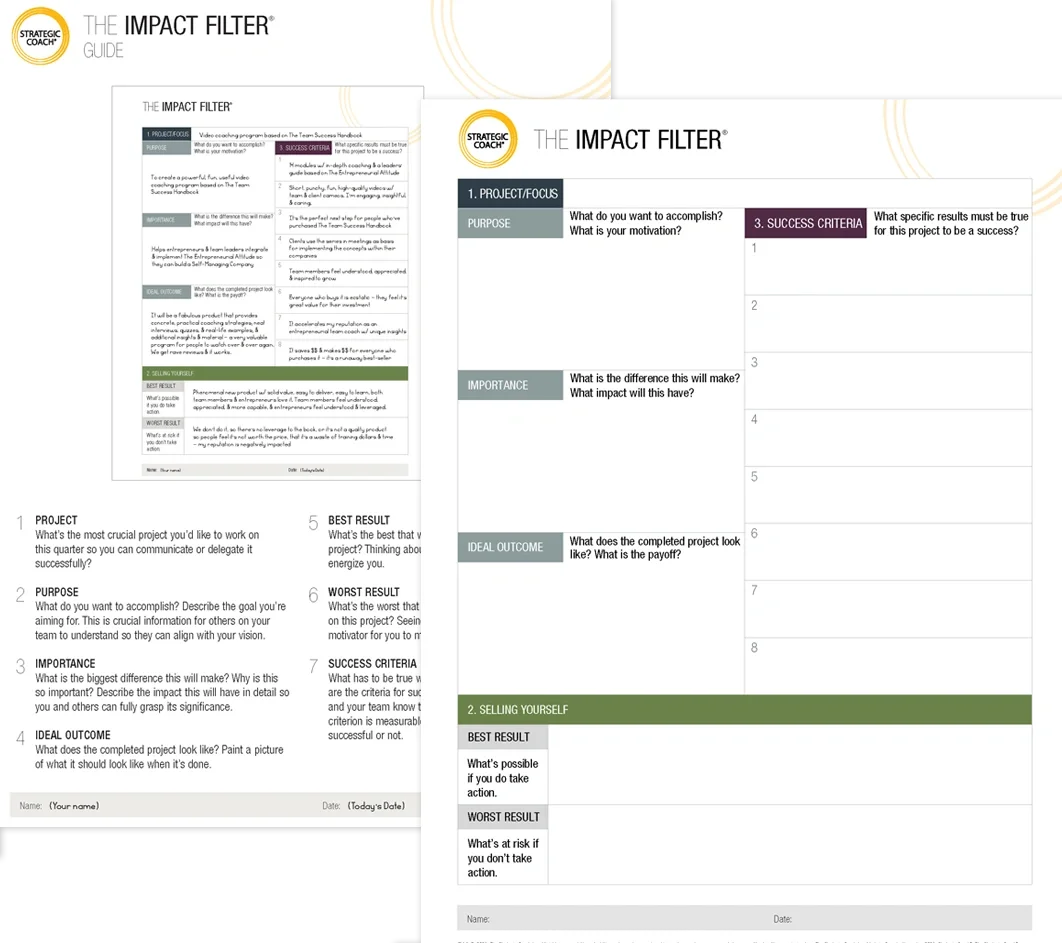
The Impact Filter®
Dan Sullivan’s #1 Thinking Tool
Are you tired of feeling overwhelmed by your goals? The Impact Filter is a powerful planning tool that can help you find clarity and focus. It’s a thinking process that filters out everything except the impact you want to have, and it’s the same tool that Dan Sullivan uses in every meeting.