From Self Employed To Real Entrepreneur, with Jessica Christy
February 04, 2026
Hosted By
 Dan Sullivan
Many entrepreneurs are technically “in business” but still trapped working for a relentless, 24/7 boss: themselves. In this episode, Dan Sullivan and Jessica Christy unpack what it takes to build a true entrepreneurial company instead. Hear how a painful team exodus became Jessica’s biggest growth catalyst and how clear core values, better leadership, and greater control over your life create a company you never want to retire from.
Here’s some of what you’ll learn in this episode:
- Jessica’s original “entrepreneurial moment” while she was still working for someone else.
- How her medical aesthetics company, Beauty Culture, helps clients far beyond surface-level appearance.
- What makes her company stand out in a crowded, diluted industry.
- How to build the confidence to step into big, scary opportunities.
- What Jessica has gained since joining Strategic Coach®.
Show Notes:
Most entrepreneurs aren’t running true companies yet; they’ve simply created a demanding job where they work for themselves.
When you’re self‑employed, your “boss” follows you everywhere—24 hours a day, 365 days a year—and is often tougher than any previous employer.
Being your own boss doesn’t automatically make you a good boss, especially for your team or for your future self.
The Four Freedoms at the heart of entrepreneurial motivation are freedom of time, money, relationship, and purpose, and true entrepreneurial companies are built to expand all four.
If you’ve designed a life and business you truly love, the desire to retire largely disappears because work is an expression of your purpose.
When entrepreneurs get together, the most valuable conversations are about how they transformed failures and crises into breakthroughs, not just about their wins.
The more you learn as an entrepreneur, the more aware you become of how much you don’t know, which keeps you curious, humble, and growth oriented.
People rarely leave “bad jobs” so much as they leave a lack of leadership; team members crave clear vision, accountability, and support from their boss.
Strong core values act as the navigating compass for your entire company, guiding who you hire, fire, promote, and partner with.
Resources:
The 4 Freedoms That Motivate Successful Entrepreneurs
The E-Myth Revisited by Michael E. Gerber
Episode Transcript
Dan Sullivan: Hi, this is Dan Sullivan. I'd like to welcome you to the Multiplier Mindset Podcast. On today's episode, it's a real pleasure to have Jessica Christy. And Jessica comes from Bloomfield in Michigan. The moment I saw the interview with Jessica, and I've also had her on one of our introductory Zoom calls where we have panelists and they're entrepreneurs who are already in Strategic Coach talking about their experience in Strategic Coach. I was enormously impacted on two or three subjects that she brought out in the video that we have right here. And the first one was about a company, having an entrepreneurial company. Now, a lot of people are entrepreneurs, but the vast majority of entrepreneurs, you can identify them by their tax status. In other words, that there's a difference between when you file for your tax, IRS in the United States, CRA in Canada and UK, where we also have Strategic Coach, they have their own tax thing, is that there's a big difference between whether you're self-employed and whether you're employed by someone else. It's more complicated if you're self-employed.
So that's where you begin to understand that someone has entered entrepreneurial territory, is if they have a different type of tax return, their accounting is different, they have different legal structure, and they have to pay attention to all this stuff to be a successful entrepreneur. But the vast majority of entrepreneurs don't have companies. What they've created for themselves is a job. Frequently, they work for someone, namely themselves. That's a tougher boss than they ever had when they actually worked in some other company, okay, because in another company, you leave work and leave your boss at five o'clock, six o'clock in the afternoon and don't see him till the next morning. You have weekends off, you have holidays off, but when you're self-employed, your boss is with you 24 hours a day, 365 days a year, and you may not be a good boss.
So the big freedom, we have Four Freedoms Jessica mentions, in Strategic Coach, and these are the Four Freedoms that really are at the very, very heart of what really motivates entrepreneurs to keep growing throughout their life. Greater freedom of time. If you have greater freedom of time, it allows you to buy greater freedom of money, okay? And that's more money, quantity of money is greater, but also quality of money. In other words, it's money that you're earning from doing what you love doing, which introduces the third freedom, which is freedom of relationship, and that is you feel much better about how you're using your time, you're making money the way you love making money, but you're surrounded by relationships who are helping you do this. This is your team members in your company, but it's also the clients, the customers, okay? And all that is really good, and that really gives you purpose in life. People can really sense that you've created this vehicle called your entrepreneurial company and it has an enormously positive impact on you, on everyone who meets with you, all the clients and customers.
So this is a huge creation in your life. And one of the things I've discovered more and more as I've gotten older, I'm in my eighties now, I've been doing Strategic Coach first as a one-on-one coach, and then we have a company that has 120 team members, we're in five cities, we're in three countries. But it's so good, you know, and what I find with a lot of Strategic Coach is that, why would I ever retire? Why would I ever stop working? I mean, I've created the life that I want to create. And Jessica really brings this home, and she's in her early days, but I think she's sort of an old soul. You know, she's sort of an old spirit. I think Jessica is in a great deal of wisdom. One of the things that tells me that she has a lot of wisdom is her talking about the really bad experience she had.
And I'm going to tell you what really different entrepreneurs from everybody else who aren't entrepreneurs and who do other things in life. And that is what entrepreneurs do with really negative experiences. I'm going to share a personal experience here. So I started coaching in 1974. I was in a marriage who, as things went on, sort of indicated to me that people who are business people are really the cause of all the bad things that are happening in the world. So it was tough. You know, I was just starting my business. I used to say the really tough part of my daily life was not being rejected and failing in the marketplace, it was going home at night where I faced my chief critic. So, on one day in 1978, August 15th, I was both divorced and bankrupt. I was divorced in the morning and I kind of arranged it so I could keep my credit card so I could celebrate at lunch before I went bankrupt. I had to hand in my credit card.
One of the things when you have an experience like that, people give you a lot of privacy. They don't say, hey, Dan, we're having a party, and I just wonder, 20, 30 people, and I wonder if we can just spend the evening, you talking about your divorce and bankruptcy. People don't do that. They let you alone, you know, so you're alone with your experience. But what you do with your experience makes a huge, huge difference. And what I see from Jessica's recounting of that experience, that was a major flip in her life. She turned what most people will see as the most negative thing that can happen to you into something that was actually the cause of great motivation to increase their freedom. Now, here's the difference that I see between entrepreneurs. When you get a whole bunch of entrepreneurs together, they don't talk about their successes. They talk about how they transform their failures.
And everybody wants to know, you took a hard hit, you got knocked down, it looked bleak, how did you come back? And then they sit there and they listen because they've done this and they've done this and they've done this. And there's this great sense of strengthening that happens in everybody's mind. No matter what happens to you, you can turn it around and turn it into a breakthrough, okay? And it's always a surprise breakthrough, you know, because if anything, you would have tried to avoid the bad experience, and you do in the future. When a bad thing like this happens to you, you take a lot of pains to make sure that this doesn't happen enough. One lesson is enough, okay? But the real reward of it is how you use the energy, which was negative energy, and turned it into positive energy—innovate new things, you invent new things, and one of the big things you do if you're a growing entrepreneur, you make sure that you now have skilled people around you that protect you from being in that type of experience.
What I love about Jessica's experience is that she's zeroing in, probably the greatest source of growth that all entrepreneurs have, and it's as a result of transforming bad experience. And I just think this is a real gift to everybody who's an entrepreneur, and I encourage you to use it for your own transformation, but also to distribute it to other people who are having bad experiences.
Jessica Christy: My name is Jessica Christy, and I am actually a physician assistant, but I more so identify with being the CEO of Beauty Culture, which is a medical aesthetics practice, and Cultured Wellness, which is a functional medicine practice. I have been in business since 2019, right before good old COVID, so that was very interesting. And I'm located in Bloomfield Hills, Michigan currently, but definitely looking to expand. I started The Strategic Coach Program a little over a year ago. I just completed my first year of Signature. At the last meeting, it was just very clear to me that I needed to sign up for the next year and keep going. So I'm now in Signature year two, and I also added on the 10x Program as well. I was really excited when I graduated from PA school to get a job, a conventional Western medicine job. I became a surgery PA, which was very run of the mills, where everyone goes, everyone's looking for jobs, either in internal medicine or family medicine. I got a job in surgery. And essentially, I realized pretty quickly that we were brought on as a service to the surgeons so that they would bring their big cases to that hospital.
I quickly realized there were so many areas to improve and I started bringing books like Tribal Leadership to my bosses and I hate to say that they were kind of like, just let's not talk about that, do your job, keep your nose down, you're not going to change the system. From there, I went into private practice. I learned dermatology really well, medical dermatology. And from there, I expanded into a love for medical aesthetics. And I think that the very quick before and afters, that improvement on how someone could look in a moment of sitting in your chair, was really attractive to me. I loved to see the outcomes right away. So I really started to develop a heart for medical aesthetics. From there, I realized that I was in an office where the culture wasn't necessarily the fit that I was looking for. I was yet again feeling innovative and treating the business as if it were my own, just like I would want one of my team members to do at my practice. But that wasn't something that was really rewarded. And even though I didn't have all the words to put to it then, I had kind of that entrepreneurial seizure where I thought, gosh, I think I could do this better, and I became the technician in my business.
And, you know, like Michael Gerber's E-Myth book, I really love that book because it so eloquently paints the process of having that entrepreneurial moment, becoming the technician, and then all that has ensued after. When we look at the medical aesthetics practice for actually so long, I asked myself, why do I love this so much? Obviously everyone wants to look their best, but I look so much deeper in everyone that I encounter. I want to know more about them, what makes them get out of bed in the morning. I remember when I was a young girl, like going out and about with her friends, I would meet people at bars or restaurants and I would ask them the question, what makes you get out of bed in the morning? And so, I would sometimes even look at my own profession and something that I enjoyed so much and question, what is it about this field that makes me really love it? There's something deeper than just the surface superficial changes that we are creating in someone.
So I think that sometimes people think it could be a superficial field of medicine or that it doesn't matter. But something that I really started to tap into is the difference in the confidence that it created in someone. When we can kind of take away that lack of confidence on the outside, it almost allows you to take that energy and turn it inward and start to improve on self a little bit more. And that's really where things started to turn for me, where I created more of a niche of not just we sell Botox or we sell filler or we do lasers here. It was more so we sell confidence and that allowed me to have a platform and a brand to then help other businesses umbrella underneath that same mission and that same goal. In the medical aesthetics community, it is very unregulated and a lot of people can just open up a business. And so with that, there's both beautiful autonomy and there can be amazing businesses like ours that are built on the right foundations and really have the patient in the forefront of how we're serving. But there are also a lot of places that do not do it the right way, are cutting corners, maybe don't have adequate training. I mean, really, you can take a weekend course and do what I do, really, which is kind of scary.
So we do see a lot of fear around having natural looking outcomes, having safe outcomes. You know, another part of that value proposition is like, how much is this going to cost me? Am I going to have a ton of downtime? And so really what we've done is we've created a niche around educating our patients, around our proven process being the elite patient journey. That is something, you know, when we talk about intellectual property, I was like, wow, I have some intellectual property that I need to protect in this elite patient journey. It's the way that we do things here at Beauty Culture. And it really helps the patient join in a journey where they feel seen and heard first and foremost. We prioritize what they're wanting to work on and then it's up to us to yield that appropriate plan and then break it down into bite-sized appointments that they can handle and really set the expectation about what the outcome is going to be.
From there, the outcomes are always so great because we first of all marketed to that niche clientele that's going to appreciate that. We have the most appropriate people working on our team that are aligned with our core values, know what our vision is, they're bought into that vision, are trained adequately, and then we can give them all of those things, that dream outcome, high likelihood of getting it and then minimize all the downsides too and we can offer really high value to our patients. So even in a very diluted industry, we have something that really separates us and our patients really trust us and actually through Strategic Coach, I have asked myself that question a lot. What makes me trustworthy, not only as a leader, but as I've kind of stepped away from patient care, but how do we make sure that trickles down to our patients? And so a lot of that comes into that authenticity, that transparency, that relationship. And so a lot of those things have really, really helped me separate out from the competition.
So we started Beauty Culture in 2019, and I essentially brought one person with me that was working at my dermatology office. And I really saw a lot of good in her. I saw someone that was really committed to the outcomes as well, someone that was committed to the patients. And I really had no idea what I was embarking on. I thought it was going to be this tiny little business, just the two of us, her doing lasers, me doing all the injectables, and we were going to just really bring the best to our community for all the women seeking these treatments. Well, a couple years down the road, something kind of shifted in her. It maybe didn't shift, maybe I just didn't see the writing on the wall, but she decided to take half of my team and start a competing business right down the road. It wasn't done in a way that I would celebrate now. If one of my team members came to me and said, I want to be an entrepreneur, I would say, okay, let's look at what that looks like. I'm really excited that beauty culture was the vessel for you to discover this in yourself.
It was done in a really hurtful way, and I had a lot of shame admitting that at first. I thought, okay, now this person is gone, these other team members are gone, and gosh, I really have to just buckle in and work myself to the ground because I need to make sure that this company stays afloat. And at that moment, I made that decision. But through the process of kind of, you know, going through all the stages of grief, I realized so much that that technician that I had signed up to be needed to actually then become the entrepreneur. And I think it's really common for there to be something like that in the crossroads that makes you either continue to grind and be a really high paid you know, self-employed person or someone that actually chooses to build something bigger and chooses to embrace all of the freedoms.
And I actually remember being on an airplane and I don't remember if I was reading a book or listening to one of Dan Sullivan's podcasts, but it was talking about the Four Freedoms and that really rang true for me. And I thought, gosh, I really don't have a lot of freedom of time. I'm saying yes to everything. I am being a really high revenue producer. The business depends on me and I was really at a time where I was evaluating those vulnerabilities because I had just had one really smack me in the face. So that moment of something that seemed so hard and something that I didn't know if I could get through and something that I initially felt a lot of shame and vulnerability around has become my most favorite thing that has happened in my business and something that I can embrace and see the good because it pivoted me into who I am. And now I'm sitting in a position where the more I learn, the more I know I don't know, and the more I'm seeking those groups of people to teach me the things that they've learned and collaborate and mastermind so that I can actually continue to bring more of what we do to more women and 10x our business.
So initially, when all of that happened with that departure of all those team members, I thought, why would anyone leave me? I pay the most. It's such a hands-off approach. I give a ton of autonomy. Again, I was in my own treatment room five days a week. I wasn't really bothering anyone. And when I shifted my mindset from, okay, it's not bothering someone, they're craving leadership. People don't leave bad jobs, they leave bad bosses. And I wasn't intentionally or maliciously trying to be a bad boss. But when I looked in the mirror and really looked at, how do I play into this whole scenario instead of just like, why did this happen to me? I really realized that people that actually should be on your team, and they probably should not have been on my team long term, they were not those right people in the right seats for sure, not a good core values fit. But I wasn't even putting the time into thinking about what our core values were. I wasn't driving the bus on a mission. I wasn't making sure that I was holding everyone accountable and making sure that that vision was shared by everyone.
And so when I look back on, you know, that moment, you can either choose to kind of be the victim of what's happening to you, or you can choose to say, okay, I'm not picking up those things. I'm not going to, you know, engage in the negative. I'm going to look at, how can this benefit me? And how can I really have this be a pivotal moment to propel me forward? And now, gosh, whenever anything hits me hard, like it will, I asked one of my entrepreneur friends, does this ever get any easier? And he said, actually, no, but that's part of the journey. And if you don't embrace the journey, then you shouldn't be an entrepreneur.
So there was an aesthetic conference that I went to and I had signed up for a workshop of women in business. And I was kind of reluctantly going. It was like extra money that I had to pay in addition to the conference. And I was still like just getting into really stepping into that business mindset. And so I showed up and the woman that was teaching the course ended up being my very first business coach. And she really has a niche in coaching women, females in the aesthetic medicine industry that are business owners. It's really hard for a lot of us medical-minded people to switch into that business mind. And she was talking about core values and she was writing some on the board and I was just writing them down like, okay, I don't have any, I'm just going to steal these. And she was like, and just so you know, no one can steal your core values. And I was like, oh crap, I can't steal these from her. And she went on to explain that core values really are the navigating compass of your entire company. Not only do they help you identify with who should be on your team, who should not be on your team, and also it's that navigation for what aligns with the future and the goals for the company.
Those seem so elemental, but they have really, really become something that we exercise in our practice on the daily. We reward by them. Like I said, we hire and fire by them. We promote by them. There's five that we have. They are integrity, impact, being fully committed, having a growth mindset, and recently we added grit because you do have to be a little gritty to be in this job. As fast-paced as I, you know, jerk everyone around being a visionary, everyone has to be just a little gritty. So a couple of years into beauty culture, after kind of the mass exodus of all these people leaving, I was just continuing to see my patients, meeting their needs, really listening deeper, listening to my patients, listening to my team. And I kept on hearing women over and over say, you know, I feel like I look good now, but I'm still like, the whispers of struggling with weight gain or depression or not sleeping well, or their skin's changing. And I started to try to find them different medical providers that I felt would listen to them. The traditional medicine doctors were not spending the time, nor were they offering the solutions that I felt like these patients needed.
And so at that time, I was really having trouble finding someone that would treat these women the way that I would want to be treated. So I made this decision to add another business to my list of things to do. And I created a wellness business, a functional medicine practice called Cultured Wellness that was really aligned because beauty culture sells competence. And this is another layer of offering competence to patients. So now I have these two businesses, I really started to understand, you know, SOPs and KPIs and processes and pulling myself out of the business to work on the business and starting to learn how to be a better leader. And I had this amazing business coach that I mentioned I was working with, but I felt like I was craving how people were doing things better outside of just my industry.
Ironically, one of the people on my team, her name is Heidi. She is one of our patient care coordinators. She used to be a patient a long time ago at my old derm practice. And when we hired her, she came into my office and said, one day, I really have this goal for you to join this coaching group called Strategic Coach. I hope you make enough revenue to qualify. And you should really start listening to this podcast by Dan Sullivan. So that was a seed planted. And as I continued to crave this kind of level of diversity within entrepreneurs, I circled back and had an introductory call with one of the team members on Strategic Coach. And I thought about it, it wasn't a decision I made lightly, but it was something that was doable, it was quarterly, and I knew that I would learn some tools that would propel me into the future. And so that was what really was the discerning factor in joining Strategic Coach, but I just think how cool that one of my team members, you know, that could be looked at as you know, quote-unquote employee, was the one that gifted me such an amazing experience and something that has pivoted my business, and I'm only at the tipping point of really what can happen.
Year one was very comfortable. I think that it's a very comfortable setting to come into a room of all these people that you don't know. Also, just pointing out the obvious, I'm a female and there's a lot less females than there are males. I think when you pick up a business book, it's not necessarily tailored to females. Most of the men in these groups never had to take a break to go breast pump for a nursing baby that's at home between podcast interviews or whatever it may be. So I really love adding a little bit of diversity to the mix, and I've loved sitting there and absorbing all of the different viewpoints. The thing that I've really loved about year two was that, gosh, these people all meet a criteria to be there. Of course, it's very filtered and they're making sure that you're in an environment that's actually going to foster you, but the diversity of everyone starting at year one really offers so many different viewpoints, so many different businesses, so many different systems.
And I remember walking actually into the last meeting for year one before I signed up for year two. And I thought, gosh, am I going to do this again? Like, is it time for me to entertain something else? I've gotten all these tools out of here. You know, I was really trying to make that decision. Should I go on to the next year? And it wasn't probably an hour into the session four where someone delivered such an important little data piece that changed how I operate that I was like, oh my goodness, if I even got just this out of the next year, it would be worth it. And then now that I've started year two and added the 10x Program, it's like the veil is lifting of, okay, tools are great to learn, but now when we're putting them into practice and those actionable steps are kind of forced upon you, you can go brainstorm anywhere. But when you're given the tools to actually take it to the next level, that to me is where this Program stands apart.
One thing that I really have appreciated about Strategic Coach is not just talking about Unique Ability, but exercises that really pull that out. And one thing that is really important to me is branching out now into regenerative medicine. We have the medical aesthetics rolling. We now have the functional medicine programs. And now there's this exciting field of regenerative medicine. And as a visionary, I often am early to the game and early to the table, and with regenerative medicine, especially in the United States, there's a lot of regulatory issues. I feel like with Strategic Coach, I have such a network of people that not only want to see me succeed and are excited about those innovative technologies, but also that have the connections to really show me and point me in the right directions of what I need to do next or how to protect myself.
The more you can create those armies that are fired up about where you're going next, the more you have the confidence to really step into those maybe scary places. One thing about Strategic Coach is you're in this room of all these other entrepreneurs that are willing to go where a lot of people are not. And it's just such a unique culture and community to be able to be in every 90 days. And I always come home feeling really invigorated and really brave to take the next steps in what my dreams are and what I want to bring to people.
Related Content

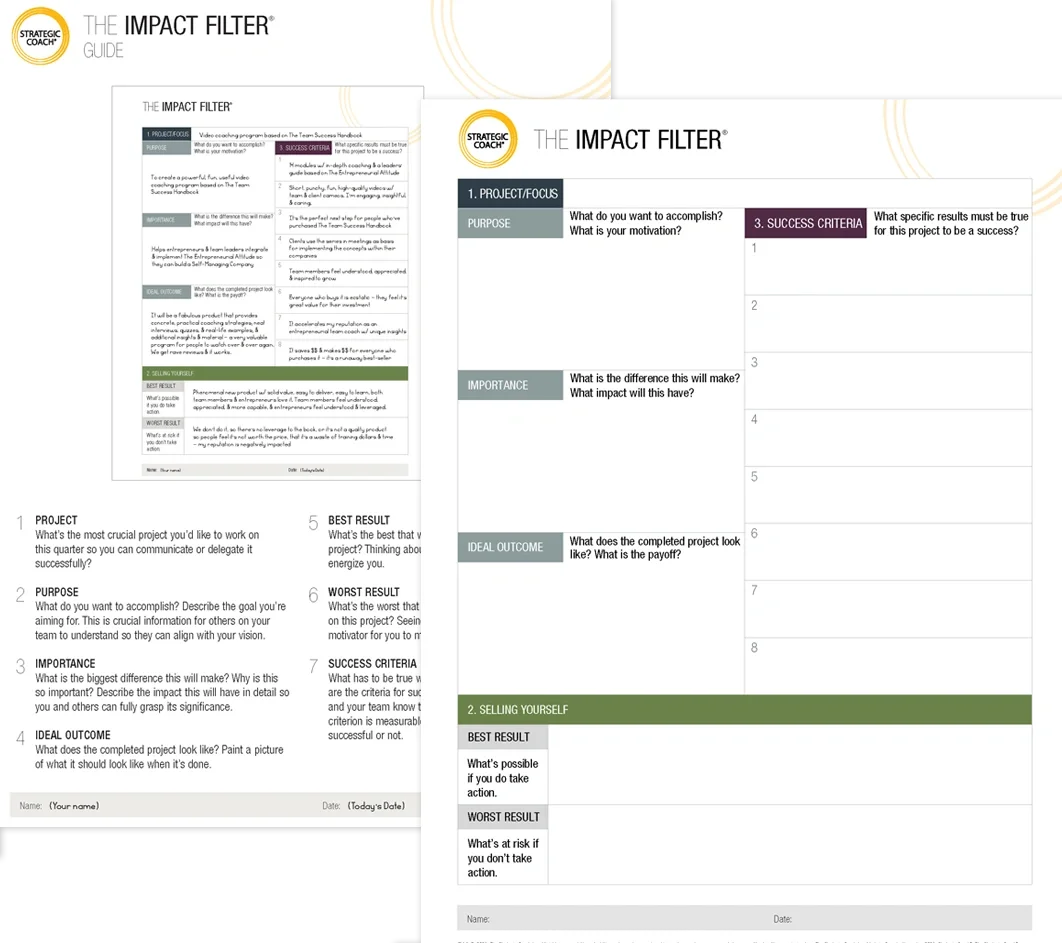
The Impact Filter®
Dan Sullivan’s #1 Thinking Tool
Are you tired of feeling overwhelmed by your goals? The Impact Filter is a powerful planning tool that can help you find clarity and focus. It’s a thinking process that filters out everything except the impact you want to have, and it’s the same tool that Dan Sullivan uses in every meeting.