The Shift That Happens When You Commit To Your Best Work, with Jane Pegg
July 02, 2026
Hosted By
 Dan Sullivan
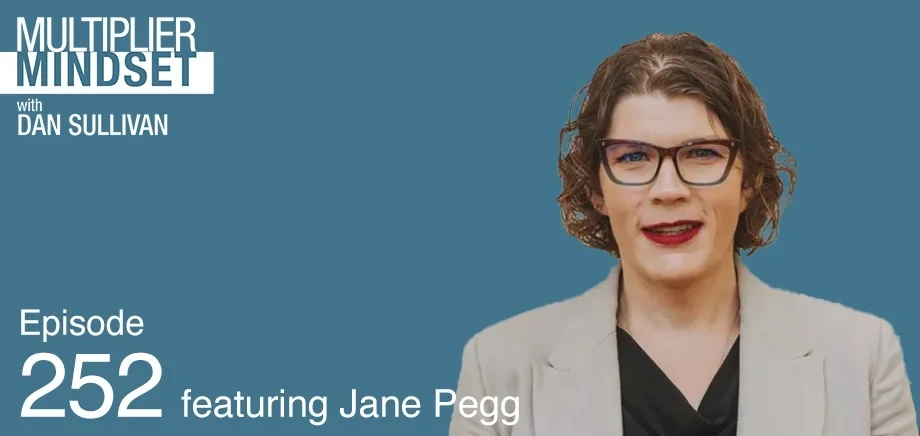
Dr. Jane Pegg is a veterinarian specializing in dentistry and oral surgery, and her ambition led her to build an enterprise that includes both a hospital and a school. In this episode, Jane shares how she went from feeling unhappy in traditional jobs to doing only the work she’s best at and loves most.
Here’s some of what you’ll learn in this episode:
- How you actually grow as an entrepreneur by designing your own future instead of following a prescribed path.
- The number one thing entrepreneurs learn in The Strategic Coach® Program.
- Why Jane’s first year in Strategic Coach® was very different from what she expected—and why that turned out to be a good thing.
- The most valuable part of The Strategic Coach Program for Jane so far, and how it changed the way she thinks about problems and opportunities.
Show Notes:
Entrepreneurs learn at a very early age that they can’t just follow along; they have to create their own path.
Entrepreneurs create their own futures, and the best ones always see their futures as bigger than their pasts.
Problems are raw material for expanding the usefulness of your business.
If you do something only rarely, you have no ability to become truly proficient or truly exceptional at it.
If you don’t know where you want to get to, it doesn’t matter which way you go.
You won’t get any closer to your next goal by sitting still.
Entrepreneurs need the courage to say, “There’s no other option. This is what we’re doing.”
Strategic Coach thinking tools aren’t tied to a particular industry; they connect directly to your unique experience.
Entrepreneurs have to figure out for themselves what they want their main area of focus to be.
Resources:
Your Life As A Strategy Circle by Dan Sullivan
Episode Transcript
Dan Sullivan: Hi, this is Dan Sullivan. I'd like to welcome you to the Multiplier Mindset podcast. On today's Multiplier Mindset, I can teach the whole Strategic Coach off of the recording that we had of Jane Pegg. So Jane is a very specialized veterinarian, and she specializes in oral and dental, so the mouth area. And just like humans, if you have a really great human dentist, what you discover is that a lot of what can go wrong with your body actually starts with your teeth and what's going on in your mouth. So what's true for humans is also true for animals. They can have a lot of issues, and the teeth and the oral health is really the starting point.
But I'd like to back up a little bit. This is just a general human experience that when you're born, you quickly find out that the world wasn't designed with you in mind. And Jane sounds like she comes from a great family. She's got a great generational experience. So one of the things that I think is true about entrepreneurs that at a very early age, they begin to realize that if there's going to be a complete support system for what they want around them so that they can just do what they love doing, then it really becomes interesting because then you have to become an entrepreneur. You can't just follow along and go into the industries and go into the practices that other people do. There's something in the middle that gives you an enormous amount of energy and confidence. And that's the number one thing that we teach the entrepreneurs in The Strategic Coach Program.
For example, Strategic Coach, what I wanted to do was to help entrepreneurs, not anybody else except entrepreneurs. And so it took me a long time to zero in that there was just one kind of person on the planet that I really love working with, and that's entrepreneurs who, in their own mind, have a bigger future than they have a past. You have to create that future. That future you can't buy off the shelf. You can't get it out of a vending machine. You can't just follow in the steps of what other people do. So Jane, when she came into Strategic Coach, began learning a lot of thinking tools. And these are thinking tools that are not related to any industry. They're just you as a person, what you love doing, what gives you the most energy. And very, very quickly you realize that you have a Unique Ability in a certain area, in certain circumstances, and you have to create your own system.
So in Jane's case, first of all, she likes getting things absolutely right. She likes knowing everything about a particular thing, and then she surrounds herself with other people who do other things that she has decided I'm not interested in the other things. It's not for me to do those things. And what I have is a particular ability, and she keeps building on that, what we call Unique Ability right in the center. That's how you grow as an entrepreneur, is that you say, first of all, I have to, on my own, figure out what's the main area of focus that I want to do. And very quickly, you realize that you have to grow a team. And in her case, she had to grow almost an institution. She had to create a hospital. She also wants to inform and educate other veterinarians about where their specialty fits in with that specialty. So she's created a two-level enterprise, and one of them is a teaching enterprise, and the other one is actual surgeries, so it's a hospital and a school.
What delights me about this is that anytime she runs into a problem, she immediately goes outside of herself with other people and said, how would you handle this problem? We're talking about it as a team. So the problems actually become the raw material for expanding the usefulness of her school and her hospital. And this is what happens with every entrepreneur. Jane mentions all the different industries that she's in her Strategic Coach workshops with. And she's learning how they're looking at their business, completely different, not veterinarians, but people from other professions. But in Strategic Coach, we have a vast array of thinking tools. When you run into this type of situation, this is how you think about it. This is where you begin thinking about it.
What I love about this is three things. One is that, first of all, you have to have a mindset that your future is always going to be bigger than your past. And she had an insight, okay, now I got to want what I want. Now I have to come back and I have to actually put together an entirely new system for myself. First of all, I just love the whole notion that she's not a lone veterinarian trying to do everything. She's actually a very specialized veterinarian who, first of all, is an expert at her particular specialty, but then she can have a school for other entrepreneurs where they all talk about how all of this goes together. I'm just totally delighted with Jane's mindset. And that's what happens with every entrepreneur who comes into Strategic Coach, is that regardless of what your specialty is, what the expectations for you were, you have to go back to the zero. What do I actually want? What gives me energy? What do I love doing? And she's built her entire practice.
So I'd love to check in with her year by year as she goes forward, because I bet that hospital and school is going to just expand and expand and expand. And she's actually, in a certain sense, not following what's already known about her practice. She's actually creating an entirely new, unique practice. And I think that veterinarians who watch this video and this interview are going to say, hey, that's kind of true for me too, you know, and all entrepreneurs are going to say, you know, that's true for me too. The system isn't the one that's really going to constantly make me better and better at what I love, but I'm going to be able to discover new ways of going about my particular practice is going to be very useful to the entire industry. So I think she's going to be an industry transformer. I'm making a prediction here that more and more Jane Peggy is going to become very, very influential in the entire development of veterinarian science, veterinarian practice. But it's just a marvelous thing from our standpoint and Strategic Coach to know just by introducing certain thinking tools, or entrepreneurial clients make incredible discoveries about themselves and they start creating new kinds of systems that are good for other people.
Jane Pegg: I'm Dr. Jane Pegg. I am a veterinary dental and oral surgical specialist. I'm located in Newmarket, Ontario. I've been with Coach for about a year. So my first year with Coach has been different than what I expected it would be in a really good way. I don't think I understood fully coming in that it was going to be really about mindsets and about figuring out how to think about your thinking. But honestly, I love that so much more than what I thought it was going to be. I thought it would be talking, you know, detailed business strategy numbers, which might have been useful for me. I do a lot of back-of-the-envelope math and I've been a pretend entrepreneur in my mind for a long time, but formalizing it, I thought I'd get some help with that kind of thing. But honestly, that stuff hasn't really been that hard for me and I've got other people that help me with things when I don't know what to do. But just being able to think differently about problems and problem-solve in a different way has been the most valuable part of it for me so far.
So going way back to the beginning, I grew up on a farm in southern Ontario, and it was kind of a little hobby farm with goats and pigs and sheep and chickens and donkeys, but primarily horses. That was the big thing that my family was into. I have two brothers, one older, one younger, that were both clearly going to move into the horse industry. And the thinking was in our family that I would go to vet school and I would be the horse vets and I would be part of that family business that we've been running for my whole life. So that was how I came to be going to vet school. It was part of a family dynasty. And then once I got to vet school, then I changed trajectory a little bit and instead of going into purely working on horses, I became a mixed animal veterinarian.
So I worked on all species and I spent about five years doing mixed animal veterinary practice before I came to realize that it just wasn't a great fit for me. I tried really hard to make it work, but there was something about it that I had to do so many different things that by necessity I was pretty mediocre at a lot of them, and I just didn't really like that. When you only do something once or twice a year, you have no ability to become truly proficient or truly exceptional at it. And in my heart, and this is a fun thing about Coach learning from my PRINT, one of the things that's really important for me is for everything to be perfect, right, and correct. It's a little bit of that perfectionist bent. And so being a generalist and fixing things with baler twine and bubble gum, while it's kind of fun, you can't really flex that muscle.
So out of that, I came to understand that the mixed animal practice probably wasn't going to be a permanent long-term fit for me. I had a brief stopover as an emergency only veterinarian. That was also not a great fit for me. But out of the experience in mixed animal practice, I found the things that I really loved were dentistry and surgery. And out of those two, when I chose to specialize, dentistry looked like such a great opportunity. It's a tiny micro field and I spent some time with a few people that were boarded veterinary dentists and hook, line, sinker, I was all in on, this was the only thing. It's been a bit of a trial and learning. It's not so much trial and error, but a trial and learning process where, you know, I like this about what I did, but not that part. And I like this part of it, but not that part. And trying to synthesize those things into, well, how do I make this into something where I can mostly do the things that I really love and not do a lot of the other stuff?
It's coming back to that idea of Unique Ability. What am I uniquely suited to do and what is in that realm of things that are motivating and energizing and also that I can be among the best at this version of being a veterinarian is so much better than any of the other versions I've tried out. You know, when you talk about spending years in a career that you don't really love, that was me in mixed animal practice, just trying to take a square peg and put it in a round hole for years. And I just couldn't make it work. And so while I didn't change industries, what I do now, it's just so vastly different. It's almost like I changed industries.
So in terms of where I am today, I currently own and operate a dentistry and oral surgery specialty hospital. And in our hospital, we also have a teaching center where we teach courses for other veterinarians. So in addition to being a dental specialist, I did my residency in an academic hospital, so a university hospital. And in doing that, I did a ton of teaching of veterinary students. And so that's something that is really, really needed in our area. Most veterinarians don't get as much education in vet school on dentistry and oral surgery as they really need to be able to practice proficiently. So, the two things that I do jointly are that we do clinical work and then we also teach courses for veterinarians.
So, in terms of a difficult time or a pivotal moment that really changed the trajectory in a big way, I think the biggest thing has to be when I was a mixed animal farm vet. I was practicing in a small town in northern Alberta, a town of about 2,500 people, and I'd been there for about two and a bit years at that point. And I was slowly coming to realize that this wasn't going to be a great fit for me forever. My partner and I were thinking about starting a family at this point. I had a lot of on-call in my schedule. The boss that I had worked for when I started working there had since retired, and I had essentially inherited the clinic and was training two new veterinarians to help in the clinic, just waking up and having to go to work and realizing that you don't really like to go to work. I'm a person classically that really enjoys work. It's a huge part of my life and I really love it. So realizing that I'm not enjoying getting up in the morning, I'm not enjoying going to work anymore and it seems mundane and doing the same thing over and over again.
I had a few cases that I dealt with, one of which that was just kind of a breaking point that's emblazoned in my memory. I'd been called at about two in the morning to go see a cow, a down cow, post calving. So this is something that's pretty common in farm practice. There's a variety of things that can happen to cows when they're giving birth that makes it so they can't stand up. And so it's about two in the morning, February in Northern Alberta, minus 35, cow out in field, down, can't get up. The problem that she dealt with was something called a prolapsed uterus. Disgusting as it is, sometimes when cows give birth, they can actually push their uterus out of their body. And so you're rolling around in the mud and the snow and your instruments are freezing to your hands trying to put this thing back in. And then between me and the farmer, we got the cow, picked up with some tarps and a tractor and got her moved up to a barn. And over the course of the next week, didn't get better, didn't get better, didn't get better. And a week later, the cow had to be put down. She couldn't get up.
It was like I heard a crack in the universe. And I really thought, gosh, this is going to be a really slow way to die if I have to do this for another 30 or 35 years. At that point, I didn't know where I was going next, and it wasn't a quick move, but the resolve came to me over the next months that, okay, this probably isn't the thing, and it's time to make some sort of a pivot. I think some of the hardest things about dealing with that were, this was my childhood dream. I grew up with being a mixed animal farm veterinarian in a rural location as being the pinnacle of career achievements of what I wanted to do with my life and I had read the James Herriot books when I was in school. For anybody that hasn't listened, James Herriot was a veterinarian in England in the 1930s, ‘40s, and ‘50s, and just wrote a lot of these beautiful stories romanticizing being a veterinarian and driving around the hills and dales and getting paid in pies and, you know, steaks and that kind of thing, and really painted this lovely picture of what it was like to be a veterinarian.
The other big weight was all of the family expectations that I had. This was the thing that I'd been planning to do for my whole life, and everybody had been behind and in support of and really fit with our farm ethos, and coming to the decision that I was going to turn away from everything I had always wanted to do and everything that I was expected to be and figure out something else that I didn't know what it was going to be. So I think that that in terms of a really pivotal time in my journey is probably the biggest one is just a huge trajectory shift, and then it was the process of experimenting—okay, well if this isn't the thing, what actually is the thing.
So in terms of what I did to try and figure out where the next place to go was, I have this habit. It seems like it's a habit of when things aren't going well, we've blown up our lives a number of times where we just stop everything, sell, move somewhere different, and just try something so totally and radically new and different. So from that pivot from northern Alberta, we sold our house, loaded all of our stuff in our vehicles, drove back home to Ontario where we were from, and I was looking for a job in a small animal practice where I could do mostly dentistry and surgery because I was thinking about what I had really enjoyed of mixed animal practice, and those were the two things that just really fit my skill set. I'm neat and tidy and meticulous. I'm very good with my hands. Growing up on a farm, building things, a little bit of engineering comes into my skill sets, not that I'm formally trained, but I just kind of know what's going to work. And so I was looking for a job where I could do mostly those things and I couldn't find something.
So I put myself in an environment where I thought at least I'd be able to learn something new. And this is an emergency hospital. So I took a job as a staff emergency veterinarian. So little experiments, I think, is one theme. So this is a little experiment. It wasn't intended to be a full-time, permanent, forever thing, but just something to do to pass the time, to put me in contact with a bunch of new people to have interactions with. Met a number of colleagues and connections that could then send me to the next colleague and connection. I also started spending some time with some other dental specialists because I'd had this kind of in the back of my mind as something I was really interested in learning more about. And then the last part is, once I saw it, like once I went and spent some time with other dental specialists and I saw what they were doing and I saw what the future could be, basically I committed to it in my mind that this is the only option. There's no need for a plan B because it's going to distract from plan A.
And so I just went all in on, what is it going to take? What is going to be necessary for me to become a dental specialist? Essentially, that included another life blow up, moving my partner and to be newly born baby to Colorado, doing this additional training program for three years at a university. That was what it was going to take. And so recognizing the thing when you see it, and then having the courage to just say, okay, there is no other option. This is the thing that we're doing and we're going to go do it. It was just a case of, you know, if you're a little bit lost in the woods, it doesn't matter which way you go. If you don't know exactly where you want to get to anyway is fine. So once you then see some landmarks or you get an indication or you find a trail of breadcrumbs or you can follow your nose, like the next clue is out there, but sitting still won't get you any closer to it.
One of the things that I really enjoy about the teaching, I think the thing that I enjoy the most, is getting to connect with other veterinarians, often early career vets, but not always—some mid-career, some later career. And just the side conversations that we get into, it's shocking how many times there's a lot of things going really right in somebody's life, but there's something going not quite right in their practice or in something. And I've been able to listen, reflect, and in spite of the fact that I'm teaching dentistry in our practice, sometimes I get to give people the advice, you know, not everybody has to do dentistry. If you're here because you hate dentistry and you don't like doing dentistry, the reason you're taking the course is hopefully maybe you can hate it less. But there's this other thing that you really like and you're really good at and you would rather spend all your time doing.
I've said to people a few times, you know, not everybody has to do dentistry. Your patients need that, but you can send them to somebody else. You can use this Who Not How philosophy and get them the care that they need. But if you really love ultrasound and some other aspect of the profession, you should do that and you should find a way to do more of that and you should find a way to spend more time, because the things that are energizing and motivating are the only way you're gonna stay in this. It'll be fruitless to try and spend twenty years hating something slightly less than you hate it right now. It's much better to try and chase that thing that you really like it is motivating for you. I think one of the most valuable things about coming to the Strategic Coach workshops is every time I walk away, I have this burst of energy that I'm going to go back to the practice and I have new ideas that are different from the ones that I've had before. It's really valuable for me to rub elbows with people that are outside of my industry.
When I go to veterinary conferences, typically we talk to other veterinarians about veterinary things and veterinary ways of doing things. And there's a lot of group think that happens. But getting into a room where I might be talking to an accountant and a lawyer and an artist and a number of other people from totally different disciplines that are all doing awesome things in their domain, it helps me remember there are so many different ways that one can approach different problems. So that's one of the things that's really valuable. And then the other thing that I think is really cool are the different thinking tools as I'm getting further on and as I'm actually using them and implementing them for particular problems. It's not like everything I'm encountering needs a Strategy Circle. But when I've got a project that I keep coming up with, oh, this is a problem, this is a problem, this is a problem, those are the ones that it makes the most sense to actually sit down, dedicate some time, get a couple people that I work with to give me a hand and go through what do we wanna do, what's in our way, and then how are we gonna get through that in a really systematic way, and remember I don't have to do it all by myself.
For a long time, I was mostly what I consider a solopreneur, and now I'm in a position where this is my hospital, but I've got 10 people that I work with every day who are awesome in different aspects of the practice, and that really fill in the gaps of the things that I'm not so great at. So the boost of energy that I get every time I attend a workshop going back quarterly has been really helpful because I get that over and over. And then the actual implementation and the use of the different thinking tools has been really helpful. I think the last thing I'd like to say before we finish up here would just be remembering life at the same time is both very short and very long. It's the longest thing that you're ever going to do. You don't get to do anything longer than your life. But at the same time, especially now, my kiddo is nine. When I was a farm vet, he hadn't been born yet. Time passes by, and I think if you are in a position where you are afraid to make a different move, afraid to do something else, I like to think about what's the worst thing that could possibly happen if you do it and it doesn't work out.
And a lot of the time, it's like, well, I'll go back to doing the thing that I am doing right now. It's not going to be worse. Maybe there's some hiccups and some problems in between there. But eventually, as long as you don't blow everything up and burn all your bridges, you can go back to doing the last thing you were doing. And honestly, they'll probably pay you more money if you leave and come back than they would pay you if you stayed. So being afraid of doing something new or doing something different or not having the confidence to start that side hustle, life is really, really short. If you find yourself thinking that doing the same thing you're doing right now for the next 35 years is going to be a really slow way to die, maybe just consider trying something different. Start the side hustle and you can baby step your way into things.
This hospital and teaching center that I'm in now, it didn't happen overnight and this wasn't the first pass. I left my farm vet career. I started as an emergency vet. That didn't fit. So then I went away and I did a dentistry residency that lasts for three years and then you're done. So I went back to the hospital that I'd been an ER doctor at and I started a dental service there. So no real commitments aside from time, no cost for me. They helped put the service together and then I was the director of it. And then from there, while I was doing that job, I started the teaching as a little side hustle that I thought, oh, maybe there'll be some that's in the community that really are interested in learning a little bit about dental techniques and dental extractions. So I just started it small and I was like, maybe I'll get 6 or 10 or 12 people that want to come and that's fine, and figure out the budget so that it works on a tiny scale. And then hugely successful, overwhelming demand, got to the point that I couldn't do it on my own sustainably anymore.
And by then, I was starting to set my sights bigger and thinking, okay, well, what if I took this teaching thing I'm doing on the weekend and the clinical practice that I'm doing through the week? And what if I put them together in the same space? And that's evolution of getting here. But it didn't happen all at once. And it's a little tiny bit at a time. But I'm so, so, so glad that I did take that leap. And I did sort of say, like, I don't really want to do this thing I'm doing now forever. So what else is out there? And what experiments can I run? And what can I do to figure out the next thing? Because life is too short to do this for the next 35 years. But then on the other side, the amount that one can accomplish in a decade, because that was in 2016 when I left that practice. Now we're in 2026 and it's just a totally different life and lifestyle and practice and career. So the amount that you can accomplish when you give yourself that much runway and don't fixate on what it has to be is just incredible. It's quite phenomenal.
The other thing that I should mention, my secret weapon, I am married to just the most phenomenal, fantastic person that is just as close to perfect match as one can get. We complement each other's set of skills, so we parent together. She also works in the practice. She's a veterinary technician. And in terms of bouncing ideas, I'm the gas pedal and she's the brakes. And I always say it's a great combination because, you know, if you don't have a gas pedal, you don't go very far. But if you don't have brakes, you don't live very long. So it's a good combo to have both of us. So she's my other secret weapon. The Toronto Humane Society does have a low-cost dental clinic, but I know that they have some limitations on what patients are eligible. So I don't know if that's an option.
But the other thing you could consider is there's something called the Farley Foundation—F-A-R-L-E-Y—and it's the name of the dog that was in Family Circus and there's a long story about it, but it works through the Ontario Vet Med Association and they provide subsidies. There's a list of criteria that has to be met, but if somebody is low income or on a pension or a whole bunch of different things that are on the list, they can use money from the Farley Foundation that will help cover the cost of treatment. And I've heard of people in tricky circumstances using GoFundMe or things like that. And there are financing companies that one can use, but it's a pay it back with interest. It's not as good as being able to get a grant or some help from the community.
Related Content

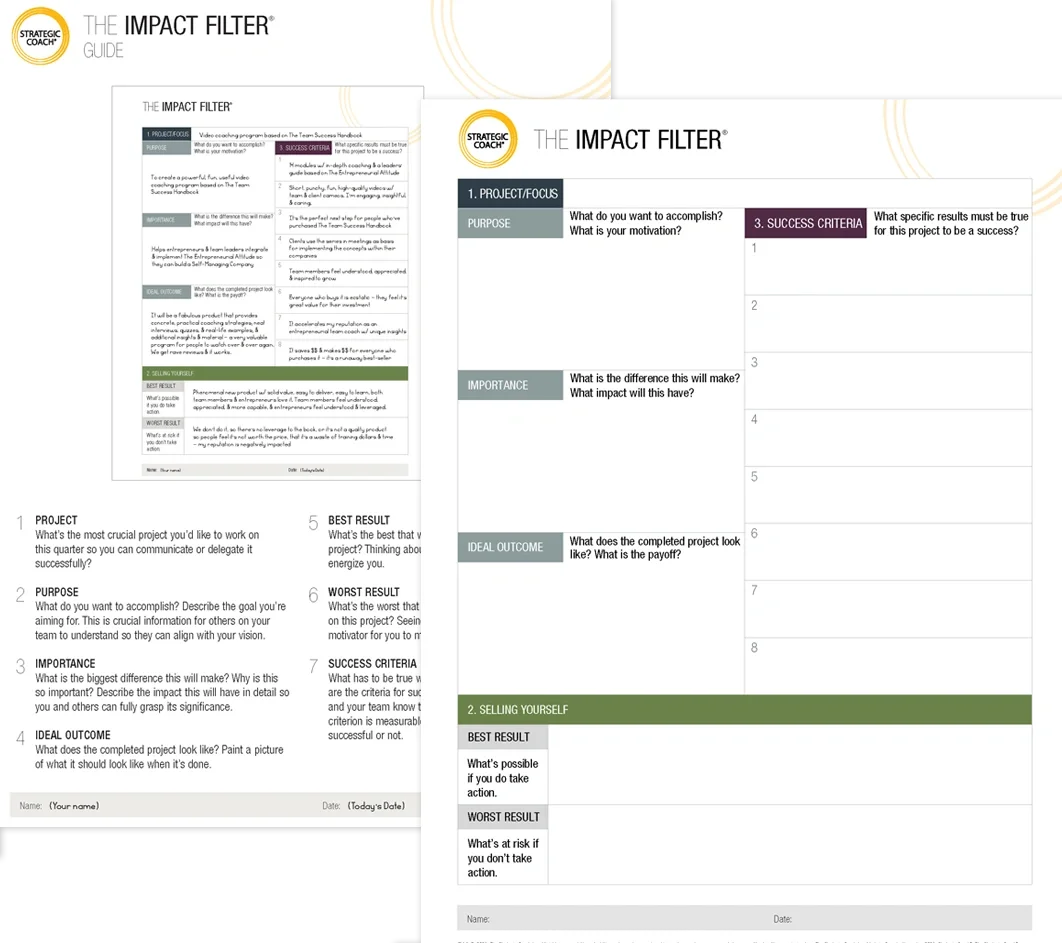
The Impact Filter®
Dan Sullivan’s #1 Thinking Tool
Are you tired of feeling overwhelmed by your goals? The Impact Filter is a powerful planning tool that can help you find clarity and focus. It’s a thinking process that filters out everything except the impact you want to have, and it’s the same tool that Dan Sullivan uses in every meeting.