Why It’s Worth The Entrepreneurial Risk, with Maria Callahan
July 22, 2026

Hosted By
 Dan Sullivan
Maria Callahan owns a tax advisory firm and has redesigned it around entrepreneurial freedom. Here, she shares how shifting from “professional accountant” to “entrepreneur,” pruning wrong-fit clients, and using Strategic Coach® tools helped her build a lean, right‑fit firm where tax season is calm, her time is protected, and the business supports the life she actually wants.
Here’s some of what you’ll learn in this episode:
- How boredom led Maria to entrepreneurship.
- The risks and sacrifices she made to start her own business.
- What first drew Maria into accounting.
- Why she enjoys working with taxes and tax planning.
- How Strategic Coach has been a pivotal part of her life over the past few years.
Show Notes:
Professional accountants tend to get hardwired to believe there’s only one “right” way to do accounting.
Strategic Coach members recognize how their industry operates, but deliberately design businesses that operate in a way that makes sense for them.
Once you’re credentialed, you can choose to be an entrepreneur whose specialty happens to be accounting.
The joy of entrepreneurship is focusing on what you love doing, what you’re best at, and the clients you love working with.
Not every customer or client is right for you, and accepting that lets you eliminate wrong-fit work and stress from your business.
Sometimes the best move is to stop offering products or services that distract you from what you do exceptionally well.
Real leadership involves making time to think about your business, where it’s going, and who will be on the journey with you.
Focus Days™ are for money‑making activities, Buffer Days™ are for setup and support work, and Free Days™ are 24 hours with zero work.
Either you take Free Days intentionally, or your body will eventually force you to take them.
Doing everything yourself is one of the most exhausting and expensive habits an entrepreneur can have.
If you never challenge your own beliefs about work and success, you’ll never step outside the limits they create.
Strategic Coach members learn from each other because they’re in different industries but face remarkably similar challenges.
Resources:
The Entrepreneur’s Guide To Time Management
Who Not How by Dan Sullivan with Dr. Benjamin Hardy
Tax-Free Wealth by Tom Wheelwright
Transforming Experiences Into Multipliers
The Gap And The Gain by Dan Sullivan with Dr. Benjamin Hardy
Episode Transcript
Dan Sullivan: Hi, this is Dan Sullivan. I'd like to welcome you to the Multiplier Mindset podcast. On today's episode of Multiplier Mindset, we have Maria Callahan. And Maria is from Delaware, Ohio. I'm an Ohio boy, so I appreciate where it is that she lives. This is really interesting. She's in a profession, accounting profession. And the professions, and when I talk about professions, I'm talking about where there's unusually long preparation to get credentialed. You have to be credentialed. And that could be a doctor, could be a dentist, it could be an accountant, could be a lawyer, could be an engineer, could be an architect. And what I've noticed is that you get sort of hardwired that there's a way to do accounting. And the big thing, and this is true of almost every accountant that we've had in Strategic Coach since we began the workshop program, even before the workshop program. We're in our 37th year of Strategic Coach. I remember once I had a lawyer and Strategic Coach, and this relates totally to what Maria shared in her interview with us. I said, are you a lawyer or are you an entrepreneur who has a specialty in law?
So in Maria's case, you're an accountant. Are you an accountant or are you an entrepreneur? And you have to learn the basics of your profession or you don't get credentialed. But once you get credentialed, you switch over from being an accountant to being an entrepreneur. The joy of entrepreneurs is that they can just focus on what they love doing. They can just focus on what they're really good at. They can focus just on the type of clients and customers that they love working with. Maria's is almost a teaching video for Strategic Coach entrepreneurs because it takes a risk. You think, well, I have to know everything. I have to be able to do everything because the clients will demand that. And if we don't provide everything, then the clients and customers aren't going to be happy with what we do. But Maria doesn't want everybody. Maria wants just certain clients and customers that she really clicks with. And then she's built a team around what she uniquely does with her clients.
But the one thing she talks about, which is so similar, tax season. I've known accountants who are incredibly good accountants and they fear April because in the United States you have a tax deadline with the government and you never ever want to be in a position where you haven't gotten your customers’, clients’, taxes done by the end of April. You just can't do that. I had an accountant who was in the Program, this was back in the 1990s, and he was finished with tax season by February 1st every year. He took all of February off, but all the taxes from the year, and that's their business taxes, that's their personal taxes. So when you have a constraint where something outside of you has to be done by a certain date and everybody in the industry experiences the pressure and in some cases panic of not getting something done by a certain date in the calendar—that's your constraint that you can look at and say, well, this year 50 percent of our clients were going to get it done way before the tax deadline and then you just keep working at it. And as you're solving that one big problem, everything in your company changes; everything in your accounting firm actually changes.
And I just love this interview. I'd like to send this to everybody that we have, not just the accountants, but all the entrepreneurs, that you can take the biggest pressure point in your profession, in your industry, and you can work with it. And gradually you move it back where, when they're panicking and they're working 18-hour days and they're working weekends to get something done, you keep working with that and you keep improving the specialized teamwork. But more than that, you start changing your client base, your customer base. You keep looking for the ones who are happy to get their taxes out of the way, to get everything that's really necessary out of the way. But the big thing is, Maria's gotten to her Unique Ability, our time system of Free, Focus, and Buffer days, and she's building a team of Who Not How. You know, I don't do that part of the business. I don't do this. I don't do this. This is what I always do. And that's the great breakthrough with Strategic Coach of constantly saying, yeah, I know this is the way it operates in our industry, but this is not the way I'm going to operate as an entrepreneur who has a specialty in accounting. So I just want to thank Maria for this great testimony. This is a great, great teaching video for us.
Maria Callahan: My name is Maria Callahan. I own a tax advisory business. I'm in year three of the Signature session. So I read Who Not How and was like, oh. I think I filled out my application the day I read the book in a sitting, filled out my application that day. And I was like, I've been missing the whole point. When did I realize I was an entrepreneur? Well, my parents owned a business and I started working as a little kid in their business filing papers, because we had papers back then, you know, filing paper documents and taking phone call messages because people still got phone calls. Then fast forward, you know, in my career in public accounting, I worked for people, kept changing jobs, never realized why I wasn't happy. And then COVID happened and I was bored randomly one day. And I sat around the kitchen island with my husband and I told him, I was like, I think I'm just going to start an accounting firm for fun. Extra money. I'm bored. Everything's closed. What else am I supposed to do? Six months later, he sat me down and he's like, Maria, you have a choice to make. You can either leave your job that you have or you need to get rid of some of your clients because this isn't sustainable.
And so I took the leap, left my job, and never looked back, and it was just an incredible journey of, I don't know how it came to be at that point, but that's just how it unfolded. So I started my adult career, let's say, wanting to be a doctor. Went into pre-med first class, and I was like, this is boring. And so I stopped, and I took business classes. And my very first accounting test, I got over 100 percent on the test. And a professor pulled a small group of us aside and was like, you guys should all be CPAs. I don't even think I knew what a CPA was at that point. I was young. I'm like, a what? He's like, an accountant. I'm like, okay, what do they do? I was like, all right. It came so easily to me and it was fun. I ended up liking taxes because it was interesting and it was always changing. I wanted to understand something that could help people actually save money. And then I read this book called Tax-Free Wealth by Tom Wheelwright, and it changed my whole perspective about taxes. And you'll see a lot of my life is all about books, right? I read this book and I'm like, oh, that's really interesting. And I went down this path of I was like, I need to learn how to do this and learn how to make that impact. And here we are.
So I've had a couple pivotal moments over the course of the business. And one really big moment for me was when I realized that I needed to be intentional about our clients and not everyone is right for us. And I'm not the right person for everybody. And once I had that mindset shift of, hey, it's not just about my Unique Ability and putting me in the skill set, it's about finding the right clients for us. And that was a really pivotal change and it led me to prune a good chunk of our clients at one point in time. It led me to change and not offer certain service offerings anymore because it was detracting us from what we were really good at. Things were different because I was less stressed. I had more time, the opposite of what I thought I needed. I thought I needed more. And by getting less, I was able to have time to sit down and actually think about the firm I wanted to build, to think about the direction I wanted us to go in, and to think about who was going on this journey with me.
By having less, we've done more. It's been a less stressful busy season. We were able to be done with the heavy lifting of tax season by April 6th. We were able to go out as a firm and have a glass of wine on April 15th at one o'clock. I knew people that were still working until 7 p.m. that day, and I'm like, y'all are crazy. I'm like, you need to learn better processes and accountability for your clients. It's made me happier, and I have time again. Well, I'd say Strategic Coach has been such a pivotal part of my life in the last three years. My husband and I moved. We were relocated for the Army. I moved to a new city. I didn't know anyone. And I looked forward to going and seeing my coach. I'm in with coach Gina and my group because they were my people. And I was like, someone actually understands me. There are other people that think like I do. I was like, I'm not the weirdo in the room now that people are like, why aren't you just content with where you are? And I'm like, you don't understand. I'm just not wired that way. They're like that. And we would have so much fun. So just getting to connect with my group and make real friendships that'll go with me really for the rest of my life. It's amazing.
And then on the content side, the time system, that was the biggest impact I made pretty much instantly. I was taking meetings five days a week. You can imagine I got nothing done. Didn't know why I was getting nothing done and so I was like, I'm sitting here listening to Gina explain the time system and I'm like, there is no way I can do all my meetings in two days. Well, it's like trying on new clothes. You just have to give it a go and see if it fits. So I tried. And I was like, huh, I don't know what I'm supposed to do on a Buffer Day, because that was really confusing for me. But I was like, okay, having two days of client meetings is a lot better. And now I'm figuring out the Buffer Day. So that was a huge change for me, because my Free Days were never free. I was checking email. I was constantly connected. And I've learned to respect those. I went through this busy season with not working a single Sunday, something I never thought was possible.
My next goal is no Saturdays. So it's going to happen. The time system is every day should have like a classification—Free, Focus, or Buffer. My Focus Days are my money-making activities. My Buffer Days are my setup days and my other stuff days. And my Free Days are 24 hours without work, which something else I didn't think was possible when I started. And after I joined Coach, I was able to take 21 days off to go on a transatlantic cruise out to Europe and stay in London after and it was amazing. And I was like, this is possible. So now life is really different for me. When I first started and I did my Activity Inventory, I needed four pages to write down everything I was doing. Four pages. It's silly. And none of them were things I liked. They were all like competent and incompetent. And I'm now down to under one page. So I'm actually enjoying the work that I'm doing on a daily basis when I work.
I went through all of tax season with one day off a week, something I never thought was possible. I have not worked a weekend in the off season, or I've always managed to have one day off in the off season. I have worked weekends in the off season, but that's changing. I've been able to go on vacations, set up the team to support and structure me. We have systems and processes and structure. And one of the things that's so fun for me about Coach is it's all different industries. So I get to learn from other people who have different experiences I do, but similar challenges. And so that's really helpful because we learn so much from each other. And I have time. You know, my husband and I go camping. We love to travel. All I ever wanted when I started the business was to have my freedom of time. And I know Dan likes to talk about, like, you lose one of those freedoms along the way, and that's what inevitably led me down this path. I did. I lost my freedom of time.
So I'd say words of wisdom to anyone struggling with their time is, you're not going to get this time back. You have to prioritize balance or coach Gina always tells us this, I either take the Free Days or my body will make me take them for you. So you're going to take them. It's just how do I want to spend them? Do I want to spend them in the hospital? Not really. I'd prefer to spend them in Alaska or somewhere else like really cool. The more you think that you can't do something, the more you just continue to live that belief like until you can change your mindset to see that there's a better way. And you have to have someone helping guide you through that path and you can't do everything yourself. DIY doesn't work well for any of us—three most expensive letters in the English language. I've broken a lot of things trying to do it myself. It is much better to get help from someone.
So how does my accounting industry fit into Coach? It fits because it's still a business. At the end of the day, I'm running a business just like the person with a manufacturing plant, just like the doctor's office. We're all struggling with the same things. Not enough resources, whatever the resources is; whether it's money, people, time, it's still a resource. And the beauty of it is I've done many Masterminds with accountants. We all think the same. Or similarly, I like being in a group of people where they experience things different than I do. Because if you never challenge your belief system, how will you ever step outside of it? And for the accountants out there, man, my goal is to get to where tax season's a blip on the radar. And there is no difference between tax season and the regular season. We just work our normal work throughout the year. And it's possible. Anything's possible. Our team is currently five, including myself. You don't hire during tax season. At least that's not something I've ever tried to do.
So we're in the process of looking to fill another one to two roles in the off season. So that'd take us up to about seven. We use technology a lot as a team member as well. Like we develop a lot of systems, processes, and things to make the firm efficient, effective—a lot of different tools and resources there. Our big goals are trying to hit our 10x objective by, let's see … what year is it?
Dan Sullivan: It's ‘26.
Maria Callahan: Forgive me, I don't know what year it is. So it's ‘26. I'd say ‘28-‘29 is roughly my timeline. I don't like too much pressure because I want to be very strategic and intentional about how we hit our 10x goal, because I took any client at one point in time and I now go through a predefined sales process to find the right client for us, because it's a better long-term partnership. So to get to your right fit client, for me it was a lot of looking at what was stressful, what was causing the staff and me undue stress, and what was creating us to not be the firm that I wanted us to be. Why were we having to work on September 15th when we should have been done with stuff in August? What was causing that to happen and identifying those root causes. But the reality of it is, is it comes down to, I found that the right fit client for us is someone who wants to learn, is willing to take action, isn't looking for an easy button to save taxes. They want to do the work. They know that it's work. They understand that they have to be present and talk to me. They can't just submit things. I can't do it for them. They have a business.
I only work with entrepreneurs, so it's really cool we speak the same language. Every client that I have is an entrepreneur. We all go through the same pains, and they know that I understand what they're feeling and they understand what I'm feeling. So it's a good fit for us. But I tell someone else, who's your ideal client? Look at your best clients. Start writing down their characteristics. You have so much data in your systems and if you don't know how to access it, just start simple in a spreadsheet. It's so much fun for me. I love working with entrepreneurs. So how you find the right fit team member is my new focus, actually. It's ironic that you asked me that.
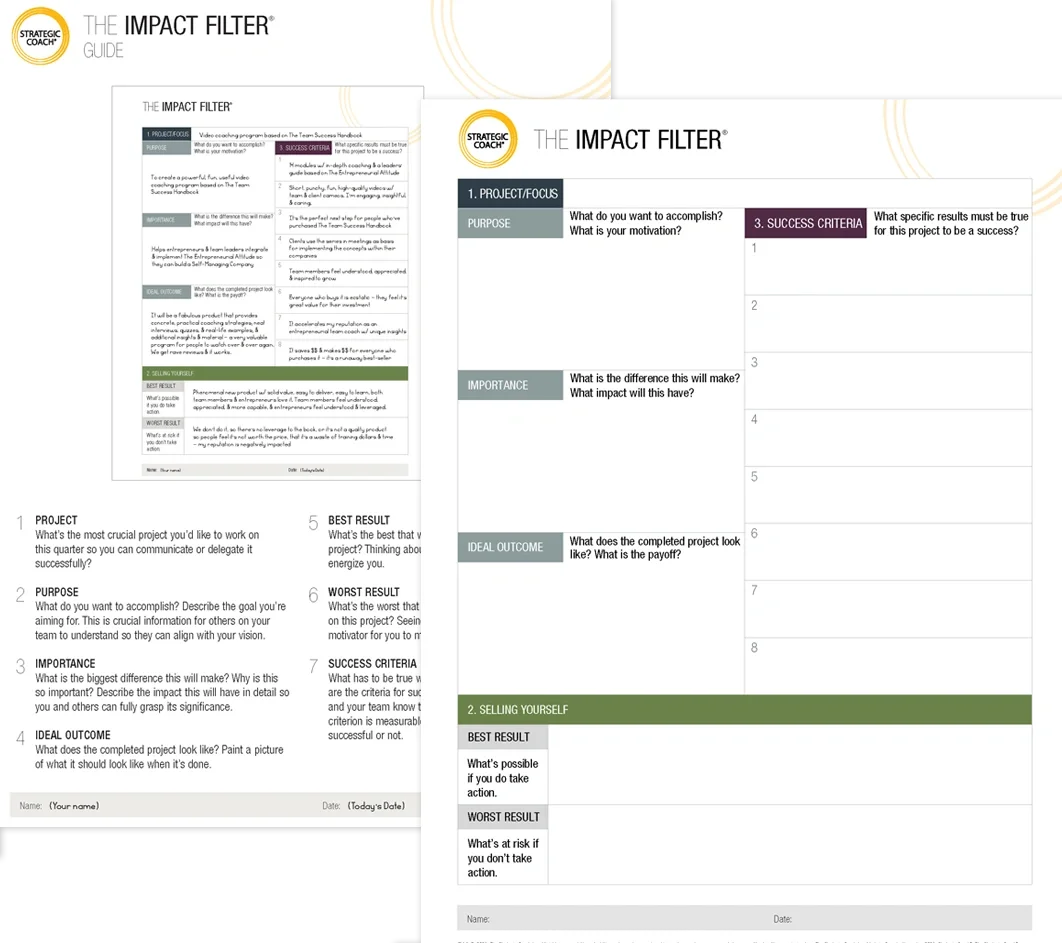
So I did my Experience Transformer after tax season. I do every major tax season ends and I do my Experience Transformer. I have my team fill them out. And I was like, I need to develop a hiring process and a way to find the right fit team member. And so I was looking at what I did with my sales process and trying to come up with parity between them of like, okay, I know what my ideal client is. How do I determine my ideal team member? Okay, and then how do I use some of that same material that I have in context to help develop the content for the hiring process? So that's under the works now because it is the hardest thing. So advice I'd give to looking for your right fit team member is get clear on what it is that you need. So before I hire, I do an Impact Filter on the role and then I do my 4 x 4 casting. So it's clear to me how they win and then each person gets their how to win blueprint. That's the whole point. I mean, so that was a really big aha moment for me as I was like, everyone wants to know how to win. No one takes a job wanting to fail.
I think the biggest thing to look through is don't just hire someone because you like them. I think that's the trap we all fall into. Oh, I like them. They feel like they're like me. Yeah, but should they be like me in that role? And I know that's where Kolbe can come in, whether it's the Kolbe C analysis, like we get Kolbe A after everyone's hired. But this time around, I'm looking at trying to integrate that before, you know, what should their Kolbe be for this role? Then once I narrow it down, because I have some pre-screening criteria that I'm working on developing to like, basically see how serious someone is, so they self-select out. And then once I'm down to like my top two candidates, I want to get their Kolbe A so I can compare it to the Kolbe C and see how they work. I don't know if that will help me. I am just learning how I go, but I'm trying to develop a process.
So, when we have a prospect come to us, they have to fill out a questionnaire. If they don't fill out the questionnaire, they don't get to continue on forward. After they fill out the questionnaire, they have to upload documents. If they don't do that, they don't continue on forward. If they meet our criteria when they do those two things, then they get to meet with me and discuss the potential to work with us. And it saves me a ton of time. So The Experience Transformer is my favorite tool because it's reflecting back on any experience. So for me, I just did mine on this past tax season. It was January through April 15th. What went well? What didn't? What can I learn from it? What are my key outcomes to change to make it better? And the 4 x 4 casting is the one I'm learning the most from as far as like, everyone wants to be a hero. No one wants to drive you nuts. And this form tells them what drives you nuts, what makes them win. Everyone wants to win. And once you accept that no one's intentionally underperforming at their job, no one wants that.
And I liked the shift from hiring to casting. Like that was a big mindset for me of like, I don't just want employees. I want people who want to be in their role and it's the right role for them. And if it's not, how do I get it? So the Kolbe profile tells us how we naturally operate. Like I'm a 6383. So I have a very low Follow Thru, which is a challenge for me sometimes. And I have to remind myself, like, it's not your excuse to not do things. It's just something I have to be aware of because my 8 is a Quick Start, which is my, hey, let's go do this. This is a good idea. Let's go try this out. The 6 is my Fact Finder. And that's how much you like the details. I like enough details to understand something, but I don't want inundated with details or it'll drive me nuts. And then the Implementer is not me. I'm not an engineer. I'm a 3. It says in there I should not take apart small objects and reassemble them. And I was like, that's very true.
And it tells me a lot about my team. I think that's what's super cool about it. My team, every single one of them's taken a Kolbe A analysis so I can understand them, they can understand me. And then a lot of my clients take it. I get it for them too because I found that most entrepreneurs have some combination of either a high Quick Start or a high Follow Thru and then paired with some moderate Fact Finder. So it's fascinating. It's just really interesting. I think the other big growth piece for me within Strategic Coach was understanding how much I lived in The Gap and never realizing that I was always chasing the horizon and never celebrating my wins. The first change I made, even before I started going to Signature session, because I had some context to it before, is every night before bed, my husband and I go through our three wins that day. And some days we're grasping, right? Like you're like, oh, this day was rough. My win is that I had a good dinner. And other days you're like, I had so many wins.
And just having that Positive Focus and having a word to use when I'm just going down a rabbit's hole of gapping out and just not accepting where I've been and taking time to celebrate my wins has just been huge for me. Because I feel like all of us as entrepreneurs, we're so success driven and motivated that we get through something and we're like, well, okay, done. What's next? And we don't take time to celebrate that we just did this really great thing that two years ago, we didn't think was possible.
Related Content

The Impact Filter®
Dan Sullivan’s #1 Thinking Tool
Are you tired of feeling overwhelmed by your goals? The Impact Filter is a powerful planning tool that can help you find clarity and focus. It’s a thinking process that filters out everything except the impact you want to have, and it’s the same tool that Dan Sullivan uses in every meeting.