How Entrepreneurs Can Publish Books Without It Being A Chore
August 12, 2026
Hosted By
 Dan Sullivan
Dan Sullivan used to write books the hard way: long, lonely hours at the keyboard. In this episode, he explains the small‑book production system he created in 2014—focused ideas, a repeatable structure, and an editorial team that lets him produce a new book every quarter—and shows how entrepreneurs can adopt the same approach.
Here’s some of what you’ll learn in this episode:
- What first got Dan writing books over 30 years ago.
- The commitment he made at 70 to write a different kind of book every quarter.
- Why his new book project stalled just four weeks in.
- Who the books are for and how they’re meant to be used.
- How Dan selects each quarter’s book topic.
Show Notes:
You can choose to write only about ideas your clients have already paid you for and that are proven in the marketplace.
Long-term creative goals, like a book every quarter for 25 years, keep you active, productive, and future-focused.
Advertising taught Dan to write succinctly by getting a complete message across in just a few seconds or inches of space.
Strategic Coach® books are written specifically for Program members and for their associates who may want to join.
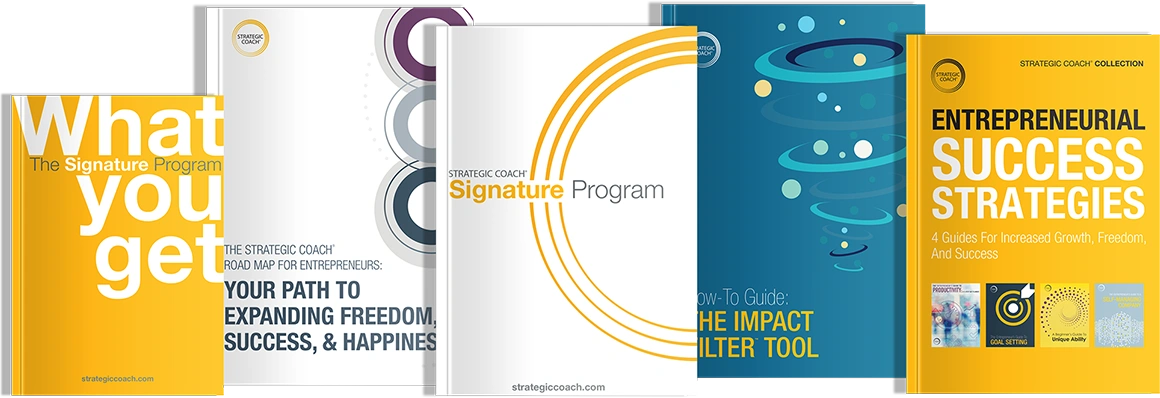
Every quarterly book follows the same structure, with eight chapters, an introduction, a conclusion, and a consistent layout.
Short, focused books can reveal which ideas deserve to become bigger, mass market books.
Writing a book entirely on your own is often slow, lonely work that doesn’t suit most entrepreneurs.
If you maintain your health, you can keep doing meaningful creative work for your entire lifetime.
When a company pays you to advise its people, your recommendations can be constrained by the organization’s agenda.
Most entrepreneurs get better results by collaborating with an interviewer or editor who can draw out their ideas.
When you’re stuck on a project, asking a capable team member to take over the “How” can instantly create momentum.
Resources:
The 21st Century Agent by Dan Sullivan
The Entrepreneur's Guide To Time Management
Wanting What You Want by Dan Sullivan
Who Not How by Dan Sullivan with Dr. Benjamin Hardy
Episode Transcript
Dan Sullivan: Hi, this is Dan Sullivan. I'd like to welcome you to the Multiplier Mindset podcast. Since 1994, I've been writing books. The Coach program started in 1989. A lot of our early clients were in financial services. I had been a one-on-one coach for 15 years, and about half of my one-on-one coaching clients were in life insurance, or they were financial advisors of one kind or another. They were what were called stockbrokers, you know, in the old days. So I had a lot of experience there, but I had developed some thoughts about the industry, especially life insurance industry, and I only made my money from people who are selling life insurance. I didn't have any contracts with companies or anything like that. So I've been pure all along, you know, forever as a coach is that I never accept money from an organization that a salesperson—someone who's a salesperson, services or products—and I never have any contracts with the company that they may sell for, just with them, because I have observations about whether they're working for the company, makes any sense, or being associated with the company, and I don't want to be inhibited in my advice by the fact that I'm getting money from the company. So, you can't buy me.
But I had developed some thoughts about the life insurance industry, which was radically changing over a 15-year period. And I wrote books there, and then I started writing books. And it was a big hit. It was called The 21st Century Agent. I read it today, and that's as true today as when I wrote it in 1995. So I really nailed it. But writing a book was always a real chore. And I found it was a lot of lonely time for me. Do it at night. I had to do it on weekends, which violates our concept of Free, Focus, and Buffer Days. And I said, you know, there's got to be a better way of writing a book. Long story short, I got to my seventieth birthday. So that was 2014. I got to my seventieth birthday and I had 13 books under my belt by that point. But it had been done the very, very hard way—hours, lonely hours with me on the computer. And ADD, I'm clinically diagnosed with ADD. And then my Kolbe is 2 2 10 4, which kind of tells you I don't like fact-finding. I'm not really good at following through, but I'm really good at coming up with new ideas.
And I said, why don't I just write small books? I take a single idea that we've already tested in Strategic Coach. People have already bought this idea. So only write about things that people have already paid you for and you've already tested it out with entrepreneurs, because the books are all for the entrepreneurs who are in the Program. I'm not doing this for the general world. Or it's for friends of our clients that our clients can use to kind of tell them what Strategic Coach is about and they get interested in Strategic Coach and they end up as participants in the Program.
So I was 70 years old. I've got plans for living a really long time, and I want to keep being as much of a producer, you know, 25 years down the road as I am now. I said, you know, a real good trick that would keep me really active and really creative and really productive, I'll just commit that, for the next 100 quarters—so this is age 70, so from 70 to 95, it's 100 quarters—and I'm gonna write a book every quarter, okay? So I just launch into it. The first one was called Wanting What You Want, but I was approaching this new project in the old way I'd done projects. I have to tell you, I got about four weeks in, and I said, I just jumped into the deep end of the pool, and I don't even know how to float here. And I said, help, help.
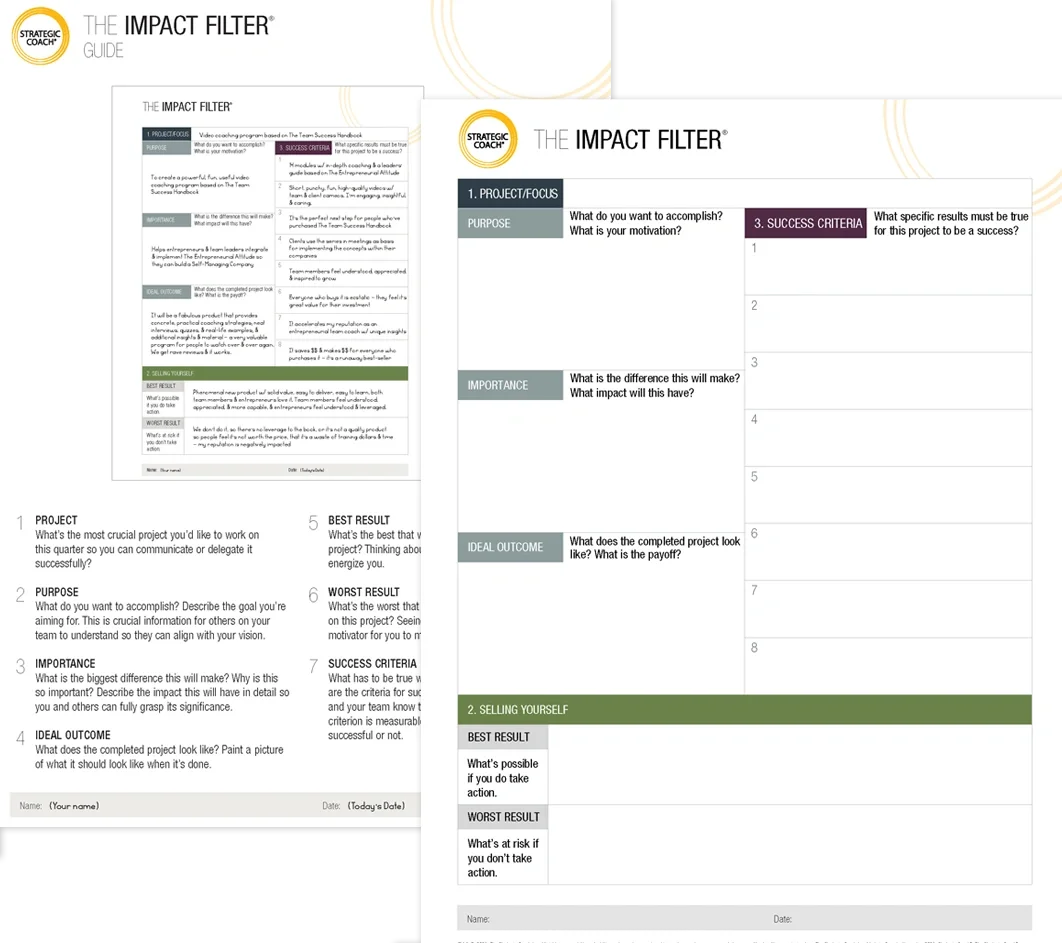
Fortunately, Dean Jackson, who's a great friend of mine, and we have a podcast these days, he had created a little company where, if you wrote up your book idea in an Impact Filter and you sent it to him, he'd have an editor interview you on the Impact Filter. It's a great process, because they interview you for 90 minutes, then they send you back a structure of the book and everything. I says, well, I'm going to have to get a Who, you know, they're the Who who does the How. I think that for most entrepreneurs, it would be good, you know, go back and forth. But it just opened up all sorts of deeper ideas that I could develop. Kerri Morrison, who is my personal editor inside of Strategic Coach, I said, Kerri, what do you think about this? And she came back and she said, I can finish this for you. She said, I know how you talk. And she says, it'll require some organization. But she says, I'd be happy to work with you to finish this book.
I'm feeling oxygen coming into my system. And we did.
We have artists as strategic coaches. So what I established—this is an old trick if you're in the advertising business. You don't write a lot and then fill up the space, because advertising, you have to get whole stories over in six inches or you got to get a whole story over in 30 seconds or 60 seconds. So I had been an advertising writer before I became coaching. Advertising really teaches how to write succinctly. So what I established was that every book with The Impact Filter is just going to have eight chapters. So the success criteria of The Impact Filter is the eight chapters of the book. I'd have an introduction and a conclusion. And each of the chapters would just have four pages, and we could lay that out ahead of time. So every one of the hundred books for a hundred quarters would be exactly the same size, laid out exactly the same way. We designed a cover that would be really good.
And the other thing is, I had worked with our great cartoonist, Hamish MacDonald, for a number of years, and I said, we'll have four pages of copy, and we'll have two pages of cartoons. So that became set, so pretty well worked out in the first two or three books. We experimented a bit, but then we got it, and now it's just set. And then what I do is I use the things that just pop up in the workshop, either a new thinking process for The Strategic Coach Program, or it's an idea that suddenly gets identified in the Strategic Coach workshops, and I say that's the next book. And we've added team members, so there's now 10, 11 team members. And each of us has a part of the book, and I launch it, and I'm the one who comes up with the idea. And I have a file, and I have roughly about 25 titles, feature titles, that I've already thought about. And I look at it at the beginning of the quarter, and I said, okay, we'll do this one this quarter. And it doesn't matter because we're going to get to all the ideas. And it just seems to me this feels like the right idea right now.
So I have a suspicion that this small book process is going to suggest books which can be major market books. It's a real winner. And you can kind of tell in the small book form, you know, if this got big and it had another writer, this would be a real hot number. So it's a nice process. You can take an idea from the workshop. You can turn it into a book. And then some books just want to go big. They want to go worldwide. And I can do this until I'm 95. I don't have any problem with this. You know, I keep myself in great shape. And I said, remember, you have to write a book every quarter ‘till you're 95. By that time I'll think of something else to keep me going.
Related Content

The Impact Filter®
Dan Sullivan’s #1 Thinking Tool
Are you tired of feeling overwhelmed by your goals? The Impact Filter is a powerful planning tool that can help you find clarity and focus. It’s a thinking process that filters out everything except the impact you want to have, and it’s the same tool that Dan Sullivan uses in every meeting.