What Entrepreneurs Can Accomplish With An Open Mind, with Geoff Meyerson
September 01, 2026
Hosted By
 Dan Sullivan
What does it take to build a company that grows without depending on you for every decision? In this episode, biotech entrepreneur Geoff Meyerson shares how failure, clear communication, and continual self-investment have helped him build a global business, empower his team, and create greater impact with less effort.
Here’s some of what you’ll learn in this episode:
- Why entrepreneurship may be in Geoff’s genes.
- How experiencing failure led him to an early breakthrough.
- How Geoff discovered he wanted to build a career in biotech.
- What he did to unknowingly prepare himself for entrepreneurship.
- How he grew his company into a global firm.
Show Notes:
AI has had one of its greatest impacts in medicine, especially in pharmaceuticals and drug development.
Growth-minded entrepreneurs take on the next exciting opportunity, then grow themselves to become more valuable to the team they’re building.
Failure is a natural part of the entrepreneurial cycle that leads to breakthrough.
To move from failure to breakthrough, the entrepreneur leading the company must evolve their role.
One way to make an impact is to donate some of the money you make, but meaningful work can create a more direct impact in your day-to-day life.
When your work is meaningful, you know you’re making a difference even on the days that don’t go well.
Knowing what you want early in your entrepreneurial career is an advantage because the sooner you gain clarity, the sooner you can get there.
Whenever people are involved, challenges, misunderstandings, and things going wrong are inevitable.
Clear, honest, and consistent communication prevents small problems from becoming larger relationship issues.
Investing more time in your team enables the company to grow faster and allows you to accomplish more with less effort.
A Self-Managing Company® gives entrepreneurs the freedom to focus on higher-value opportunities rather than being pulled into day-to-day details.
The more entrepreneurs invest in themselves, the more likely they are to have higher-caliber conversations, relationships, and opportunities.
Resources:
Transforming Experiences Into Multipliers
The Entrepreneur’s Guide To Time Management
What Is A Self-Managing Company®?
Episode Transcript
Dan Sullivan: Hi. This is Dan Sullivan. I'd like to welcome you to the Multiplier Mindset podcast. Our guest today is Geoff Meyerson. I was thinking as I saw everything that Geoff had to talk about that I started coaching in 1974, and I was thinking it was worth the 52 years that I'd put in just to have someone like Geoff in the Program. He just says everything that gets me excited about coaching entrepreneurs. And I think the big thing is emphasis on investing in himself. You know, the original definition of an entrepreneur, and this is an old definition, but it's the best definition, is by a French economist in 1804 by the name of Jean Baptiste Say. And he put a definition that an entrepreneur is someone who takes resources from a lower level of productivity to a higher level of productivity. And when I was listening to all the ways that he's expanded his company in the United States and Japan and China and the Philippines, I began to realize that all that expansion was possible because Geoff has constantly moved himself. As the owner, as the founder of the company, he's investing in himself and getting Geoff always in the right place inside of his company so that he can have a great team.
There's a lot of talk these days about scaling. How do you scale? Especially in the world that Geoff lives. My impression of AI so far is the place where it has had the greatest impact, and this didn't start just three or four years ago. This started probably around 2010. The place where it's had the biggest impact is in the medical field, especially in the area of pharmaceuticals and drugs. It's kind of interesting, he makes it seem like, well, this is where I went, and then I found out this, and I made this mistake, and then I had this failure, and then we had this breakthrough. And this is just the perfect description of how growth-minded entrepreneurs actually grow. They do the next thing that seems to be exciting, and then they discover that they have to change themselves to be even more valuable to the team that they're actually building around them, and it's step by step.
As a matter of fact, I just started a new book yesterday, and it's called From Failure To Breakthrough. The point of the book is that my experience with entrepreneurs is there's a cycle, and the cycle consists of a failure. If you properly understand why you had a failure, you begin to understand that there are some great parts about it. You were able to get into the failure situation because of all your previous growth. And then if you're willing to step back from the failure and say, okay, what really worked about this failure? We call it The Experience Transformer at Strategic Coach. Then the first thing you say, this is everything that worked about the failure, which is hard to do, you know, because failures are emotionally negative. You don't like failures. Failures don't feel good. But if you're willing to step back from the failure and say, first of all, what worked about it?
And this takes a lot of emotional, psychological, intellectual muscle to say, well, it's a failure. Nothing worked about it. Yeah, something always worked. And you understand what you're really good at because of the failure. And then you're willing to actually look what didn't work good about this. Geoff talks a lot about the clarity of communication that has to be there, that wasn't there, that actually caused the failure. It's usually a failure of communication, the purpose of what you're doing, what you're trying to achieve. And everybody in the team is on the same page.
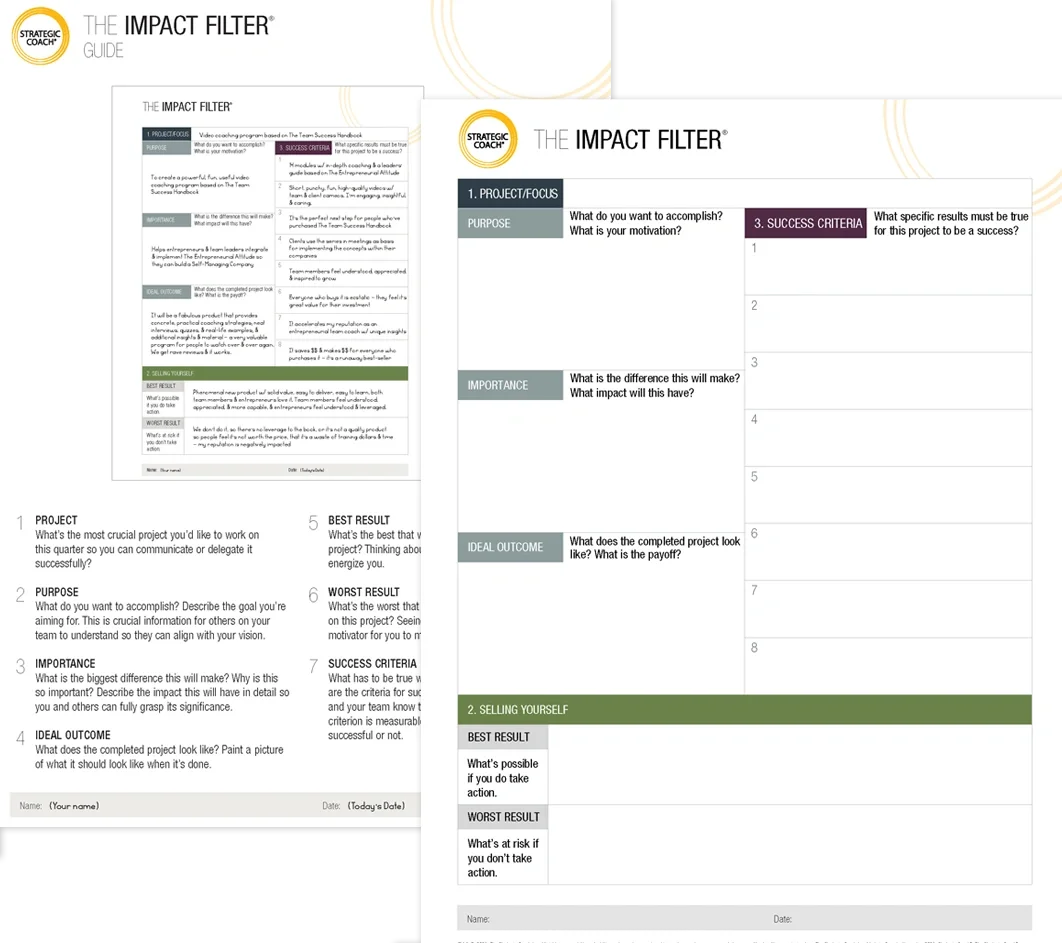
And we have a tool called The Impact Filter, which is just dynamite. You learn it in the very first workshop of Strategic Coach. And then you begin to realize that the number one thing that has to change to move from failure to breakthrough is actually the role of the entrepreneur who's leading the company. And you can just see step by step where Geoff was the salesperson when his company was really small. He was the lead salesperson. But now he's the salesperson who is selling other people on being on the team. He's selling other people and creating greater value for their clientele. And it's just a beautiful story. And entrepreneurs are the most action-oriented people on the planet. They want to take action. They want to increase the results that they're getting every time they take on a new project, every time they take on a new relationship.
So I'm sitting here and I say, you know, the 52 years that I've spent developing with Babs Smith, my partner, and then our great, great team, it's all worth it just so that we can be attractive to someone like Geoff Meyerson. You know, hiding beneath all of his business skill is a first-class stand-up comedian. You know, he really, really has a tremendous comical sense about who he is, what his company is, and what this whole business of being in the biotech industry. Now he's at the point where he is creating massive funds where other people can invest in the great work that he's pioneering in this field. And my take on it, where AI has had the biggest difference in the world is exactly in the field that Geoff is. And he's the perfect person to be doing it just because of who he is skill-wise, but who he is just as a person. Totally love it. I just met him in the very recent past because I don't coach at the Signature level. I don't coach at the 10x level. I coach at the Free Zone level. And he said, I was bitter that it's taken me this long so that you could notice me. And I said, got another two workshops to do and then you can be in the Free Zone. So what a marvelous person.
Geoff Meyerson: Hi, I'm a drug dealer. That's what I always tell people. My dad was a doctor and he always said, Geoff, don't be a doctor. You'll hate it. I said, okay. So I thought, well, maybe if I deal drugs, it's kind of like the next layer up. You'll be helping people while not having to do patient care. So that's kind of guided my kind of career choices. And so I work in the deal-making side of the biotech business. So I actually am a drug dealer, just business to business drug deals. So helping biotechs with licensing and M&A. And actually, as of about three months ago, we launched a new investment firm that is basically creating new biotech companies from scratch based upon drugs that are in clinical testing. So that's been an awful lot of fun. I've been doing this my whole career. I don't know if I should say that on the air, but it's been more than 20 years that I've been doing this.
And I started this journey on my own, doing it on my own, actually, 18 years ago when I co-founded Locust Walk. I get asked this a lot about, you know, what's your lifeline when I do some of these forum things. And my grandfather was probably one of the worst businessmen ever to walk this planet, really a smart guy. He had two chances to be a very, very successful guy. One, he knew the founder of IBM, Tom Watson, and was offered a chance to invest either privately or at the IPO, I forget which, and he declined, obviously. And the second is he invented the artificial horizon during World War II for airplanes. And he was basically convinced by his business partner and his lawyer to sell his 50 percent share for like, you know, 20 grand or something.
His business partner was Bill Lorenz. His lawyer was Lawrence Alpert. Loral, Lorenz-Alpert, Loral Space Communications at the top of the dot-com bubble was about a 15 billion dollar company. So really smart guy, not that great at business, but frankly very entrepreneurial. So maybe it's been somewhat genetic. My dad, as I already told you, was a doctor and he had his own practice. Also not a great businessman, but both these guys were great guys. So I've always wanted to do something entrepreneurial. I tried to start a dot-com when I was in college. I failed, but that enabled me to get my job right out of school in investment banking. And at that point, I knew I wanted to do transaction work. I liked Wall Street, the idea of that, and I liked health care.
So I've always known I kind of wanted to do something in the biotech space once medicine was ruled out by familial decree. And it took me about a six-year journey from undergrad until I started my company. But I basically was doing everything I could up until that point. I didn't know it at the time, but to prepare myself for being an entrepreneur. And I quit my job the day Lehman Brothers went out of business, September 15th, 2008, when I was 28 years old. I was 15 months out of warden getting my MBA after I got my MBA. And I thought I would be so important and literally it didn't make a difference at all. And you just had to prove yourself basically from the ground up. So that was a very humbling, interesting experience and a very challenging time, but I didn't have more fun than I did in 2009, our first year. That was just so much fun, even though we made pretty much nothing.
And so it's been a ride since then. I have successfully started other events, other companies. Not all of them have succeeded, but a good number have done okay. It's almost part of how I think now, where it's imbued in, well, what about this? What about this? Can I do that? And that's really just become a mindset for me. I'm open. I mean, it's so far so good. You know, as an entrepreneur, the jury, it never comes back. It's always out. And you're always, you know, a year away or a deal away from not having anything. So we always have to be very mindful of that. I always wanted to do something in finance. I was very interested in that as a kid. And again, pulling the healthcare interests, seeing my dad, really saving people's lives. He was a hematologist and oncologist, so really impactful, but on a more small scale because you can only help individual people. And I thought, well, I want to figure something out where I can earn a good living. I can enjoy what I do and actually make an impact through my job and not just make a bunch of money and donate a bunch, which is another way, very effective way. But it's maybe not as impactful along the way for your day to day.
So even if I'm not having a great day, I just know that what I'm doing is actually making a difference in some way. And that's really important for me. So that's really how I, I don't say I fell into it, but when you combine all those different factors together, I did try that dot-com in college that wasn't successful and thought there's not really much of a moat here. At least in the drug space, you have to do clinical development. There's intellectual property. There's things that you have to create some competitive barriers. And so I thought, well, you know, maybe that could be interesting. And then I ran into the brick wall. Well, I was an econ major. You don't know any science. You don't get this job. Hmm. So I actually went back to grad school and paid myself to learn science and did graduate level science without any undergrad behind it. And mom and dad weren't writing the check for that. That was a Geoff check. So I probably cared more and I learned more in that degree program and that's actually served me quite well.
And so knowing what you want earlier on, that's been my secret. I've been zigging and zagging in the same space, which is useful as opposed to zigging and zagging between industries, between role types. And I think the sooner you figure out what you want, the quicker you're going to get there. I was a great student. I'm just going to start there. Actually, ironically, it means absolutely nothing as an entrepreneur how I did in school, but I actually was a good student. So I grew up retired in Boca Raton, Florida, and I did the opposite of everyone else. I moved north, and everyone else obviously starts north and moves south. But I was kind of afraid of the cold, so I thought, you know, maybe I'll go somewhere a little bit nicer. So I went to Duke undergrad in North Carolina. Great weather. Kind of eased my way into the Northeast, frigid winters, where I spent really the last 20, I guess, 24 years or so. I was an econ major undergrad.
I have a brother and a sister. I'm the oldest. Maybe that explains something. I don't know. You can do your own psychoanalysis on that. My brother and I worked together. He's awesome. He worked his way up from associate. I didn't give him anything. He had to earn it. And my mom was actually my first employee helping me with my finance and accounting because she worked in my dad's medical practice helping him there. So I guess you could say it's kind of a family business. And my wife actually works with me now as well. So I gradually moved my way up the Eastern Seaboard, was in New York for a couple years doing investment banking, back down to Philadelphia, did seven years there, two grad degrees, worked at a biotech company before starting my company Locust Walk, and then I went to the mecca of biotech, also known as Boston, where 19 out of the top 20 pharma companies have a place. There's just a lot going on there.
So I was in Boston for the last 15 years, and that's where the business is headquartered. I put my pillow down most of the time, actually back in South Florida now for kind of family reasons, but the business is still mostly in Boston, but also increasingly more in Asia, in China specifically, but also in Japan as well. So we're about 40-some-odd people globally. We are 20-ish in the Boston area, depending on what day of the week, time of day. We have four in Tokyo, where we've been since 2013. That's been a real important area for us. And as of two years ago, we launched in China, where we went from one person originally, actually at the beginning of this year even, to now we have seven people on the ground in mainland China, mostly in Shanghai, a little bit in Beijing. And we have 10 folks on the ops team based in the Philippines, and then one person also supporting us out of India. So truly a global firm. We have to manage time zones, daylight savings versus not. That's always fun, getting calls early in the morning or late at night to accommodate various different clients.
But it's been a trip. As I mentioned, I do go to Asia four times a year. I'm going again on Friday. This is really not the time of year you want to go. It's a little hot there, but I guess I can't complain because I get nice falls, springs, and winters when I go otherwise. But that's the team and that's how we operate. I always like going to places that I enjoy visiting. So that's been really a trip. We used to have a lot more of a presence in Europe. I think the industry has shifted a bit more eastward. So I tend to go there a bunch more. We've done a bunch of work in Israel as well. But the team is really … you have to treat them like people and ultimately get to know them in their own culture. And you have to be culturally sensitive. You can't always get on a call and say, good morning everyone, when a quarter or half of your team is at nighttime. And these are the things that you just don't think about.
Well, maybe there's certain customs that they're used to. You always bring a gift when you go. It's that way. They feel like they're appreciated. You have to visit them. You can't actually manage from afar. I learned that the hard way. I went to Japan for the first time in 2018, five years after we started the business there. And basically the team said, well, took you long enough to come over here. And I said, what are you talking about? I mean, we talk on Zoom and everything else. What does it matter? It matters. And so you have to show up. You have to show that you care. You have to do it in person. You have to invest in the relationship. That's been my experience. I gotta tell you, learning the customs is not just important for your team, it's also important for the clients—how they operate, how they negotiate, how they interact, what they don't say, and what that means. The secret to that is not being perfect, it's having a team that understands that and sharing that with you so that way you could adjust your style.
Actually, I have a secret. I'll just give it out to everyone. I always apologize up front for being a pushy American. It's amazing how far that goes if you kind of disclaim your own rudeness or your own aggressiveness, and then you can proceed to be rude and not rude, aggressive. And actually, it's amazing what that buys you. The biggest challenge and the biggest opportunity is managing people, managing relationships. And that could be internal conflict or it could be conflict with the client. Because when you have people involved, things are always going to go wrong. There's always going to be something imperfect. There's going to be a misunderstanding. Someone's going to talk past you. And we've had—I don't want to say a ton. We've definitely had situations where clients didn't appreciate the work that we were doing. They made some assumptions about the impact of things, and it just starts to spiral if communication doesn't happen effectively.
So that was really the setup that, you know, it happens every so often, and it often happens in my business in deals that are not going well because there's not enough interest. And the client often ascribes blame to the advisor because they're easy, because they said they'll get you a deal and there's no deal. The reality is we reflect the market and the market is saying you need more data or this isn't good enough. And there's nothing we can do to change that. But that has really been a source of conflict over time, depending upon the clients and depending upon the situation. It's hard because, right, when you're selling something, you want to convince them that you're the best and you don't want to say, yeah, this will take a year and a half. And someone else sells, says it can take six months. And they'll say, well, why would I go with you? I can go with these other guys that say I can do it a year quicker.
The reality is it's got to be somewhere in between. You have to be conservative, but you also want to be aggressive at the same time. But you have to disclaim, hey, these are the things that could go wrong. Here's what we're seeing. This is why we like it. But these are the risks. And I think then the question is, well, how do you communicate along the way? Any relationship tends to go sideways when there's a lack of regular dialogue that can be in a significant other. It could be in a business partnership or a client relationship. If that communication doesn't happen regularly with intentionality and honesty, I think that's ultimately where things fall down.
One of my strengths or my kind of pushy American persona that I share with people is I'm very direct. I try to do it in a way that's not rude or too blunt, but I'll often say, I'm gonna be direct with you, or I have to be perfectly honest here, or some kind of preamble, again, to disarm the, where I'm the pushy American. That actually says your data needs to be here or we screw this up and this is what I'm going to do to fix it for you. I think admitting when there's a mistake is far better than when you just kind of talk around it. And that's actually one of my pet peeves is when someone doesn't own up to something and you know they did it and they know they did it and they try to blame someone else. And that's where my head just starts to unwind. But I do think being direct, being honest, and that's also where a CEO might have to pick up the phone and call the client and say, hey, I heard there might be an issue. Let's talk about it. How can we make this right? What can I do or what can the team do? And then just have a dialogue.
One of the things that we've done is we now send an email the second the client signs, comes from me. It copies the senior people on my team and it sends it to the direct client. There is a nice slider that explains our values, how we operate, and it invites them to call me or to communicate anytime for any reason. Even though I'm not on the deal team itself, I'm involved at the right times and they can always reach out to me as needed. And I think that's been helpful. And when I go to China, I always make a note at least every other time to at least visit our active clients. Even if I don't need to be there, there's no new business, it's just to check in, make sure they're happy, make sure they feel appreciated and that we're doing our best. And that's all that I guess I can hope for. And that's been actually very effective.
I would never ask someone to do something that I either haven't done or wouldn't do. And maybe that's silly because the CEO has a lot of things on their plate and they shouldn't be having to do certain activities. But the team wants to know that you're with them, you're in the trenches and that you care and that you actually are not just an empty suit barking orders. You're actually sharing from experience and that you're willing to help. So I try to roll my sleeves up when I can and they see that I'm up late when I'm doing things and that I'm actually invested. I also think a CEO rule of how I show up. I'm always my authentic self. I'm never putting on airs. I'm being direct and being honest. Things aren't going well, I tell the team or I tell the client. And I think it's important to have that level of transparency.
One of our core values is open and courageous communication. And we don't always hit that as a firm, but I try at least as an individual to make sure I'm behaving that way. I'm sure there's a small book, which again, maybe that's another thing is I read a lot. So none of these ideas are truly unique. They're things that I've picked up along the way and trying to integrate into my persona. My problem is, and this is probably a lot of CEOs have this issue, when you're scheduled from 7:30 a.m. to 6:30 p.m. and you get a dinner break and then you're back on from 8 to 10, then you gotta figure out how to do your work. It gets hard not having that break. And I've gotten a lot better since starting Strategic Coach, learning how to time block. My Wednesdays and Fridays are fully booked for myself. I call them think days. It can be a Focus Day, but I've reserved them so I can catch up and I can do deep thinking and work that I need to do. And that's been unbelievably helpful that I really picked up as a result of Strategic Coach.
One other plug—I know you didn't ask this. I used to be the lead salesman at my company. I would be tip of the spear, I'd be driving hard. You know, after 17 years, 18 years, you get good at it. So not surprising. But I made a transition pretty much after the first Strategic Coach session, thinking about, how do I enable the team so I could step out and work on higher value and other activities? Not that selling is not high value, but it empowers them, and then I come in for the key pitch proposals or contract negotiations if they're stuck. I get more leverage, they get more value, everyone wins, and I would never have been able to raise the funds that we just created had I been stuck in the minutia of sales, which at this point, I would consider an excellent ability, not a Unique Ability. So if I can cultivate someone else's Unique Ability to me, that actually unlocks so much, and that's been a huge piece of my own personal growth.
One of my challenges is I do too many fun things, too many shiny objects. I know Dan talks about that a lot. And so part of my team's objective is to keep being honest and focus on the ones that are the most important. So the reality is I have really two objectives. One is to continue or to finish getting the fund that we launched put together, which there is some capital formation pieces to that. And as part of that, obviously, is making sure we're actually able to launch these new codes. And two, is to really fully transition my role at Locust Walk so I can be a true, I'll call it sales manager. Think of me as the guy at the car dealership, and you got your salesman, like, hold on, I gotta talk to my manager. I gotta make sure I get you this price. It's not that bad, of course, but I'm the guy behind the counter. I want to make sure that I empower the team out front to be doing their jobs.
So finishing that transition and making sure that the company runs as much as it can on its own, the Self-Managing Company, I think that's a concept that I didn't fully appreciate. It's not about me taking more time off. It's about me being able to take time away to do other things, like raise this new fund that we just created. So two things, it's finished my transition to truly making Locust Walk a Self-Managing Company and is to really get this fund that we are putting together fully off the ground where we've already have some capital commitments and we're still working on that. I can't say too much because the SEC and FINRA rules bar that, but we're making some nice progress.
I'll take it back to my childhood. I never really understood anything about introspection or thinking about your place or how you can improve yourself until I was, frankly, call it 35, where I started doing something called EO and then Vistage, and then I had an executive coach, and then I got into YPO. I've always been very growth-oriented, but with all those different organizations, they have their strengths, but there's always been the integration of the business with the personal and more of, I'll call it a personal operating system approach. I know that's not how Strategic Coach talks about it, but that's how I put it into words. And so investing in myself was never an issue. I never even think about the money that it costs. In fact, I want to spend more money on myself.
One of my goals that I figured out in one of the Strategic Coach sessions was I wanted to spend 20 days on myself each year. And that doesn't mean just working in the business; it's working on myself, of which I consider one day at Strategic Coach to be one day. So obviously there has to be 16 others and I've figured out how to fill that time. But for me, it's never been about the cost. It's been about, what value am I getting out of it? Are you around the right people to learn from them? I've actually done business already with several people that I've met from Strategic Coach. The concepts that I've learned I've already incorporated into my own work and life. And actually, I led last week a Strategic Coach at Locust Walk session where I'm doing three-hour sessions that I'm going to be not nearly as good as the moderators or the coaches that you guys have as Strategic Coach, but trying to imbue some of those lessons, those frameworks onto my team. So that way they could learn some of the lessons that I've learned, because it's kind of not fair. If only I get to focus on my growth, why shouldn't I be investing into the team?
And actually that was one of the things that Strategic Coach taught me is that, or I should say I thought of during one of the sessions, I need to be spending more time investing into my team in order for the company to grow faster and for me to achieve more with less efforts. It's all kind of self-reinforcing. It was a no brainer from my perspective. So I'm relatively new. I've been to six events. The first year was in Signature and then I went over to the 10x and I think there's a reasonable probability that I'm going to end up going to the Free Zone in pretty short order. Because again, that's just how I think. And I've just found that the more higher up you get on the ladder of people who invest in themselves, the higher caliber of conversation or relationship you get. It's not a value judgment. The judgment is people who invest in themselves more tend to project more and tend to be more effective, however you want to define that. So that's how I found it.
But, you know, I've met people in all the different programs. They're really smart, very impressive. And I really enjoyed them. It's not just about the things you learn there; it gives you the time to think on your own and the people that you meet. As I mentioned, I've done business with a few folks already from Strategic Coach, which I wouldn't have met had I not been in the Program. I would just say that focus on things that will make you happy and things that can enable you to grow and succeed. And that generally involves investing in yourself. It involves finding ways to grow your company faster so you can have more resources, you can invest in more people, and you can have a better, more fulfilling life.
One of the areas where I don't put as much emphasis on The Strategic Coach Program is the Free Day. Maybe that's a fault of mine, maybe it's how I'm wired. My goal is not to take more Free Days, it's to make them more effective when I do take them. So my vision in this whole setup is to optimize all aspects of my life per unit hour that I spend. And I think that that is not just about business; it's about personal, it's about relationships. And I do think Strategic Coach does embody all that, so I'm pretty happy with the way things are going and hopefully a lot more to come.
Related Content
The Impact Filter®
Dan Sullivan’s #1 Thinking Tool
Are you tired of feeling overwhelmed by your goals? The Impact Filter is a powerful planning tool that can help you find clarity and focus. It’s a thinking process that filters out everything except the impact you want to have, and it’s the same tool that Dan Sullivan uses in every meeting.