What It Takes to Go From Pro Athlete to Entrepreneur, with Evan Lindsay
September 23, 2026
Hosted By
 Dan Sullivan
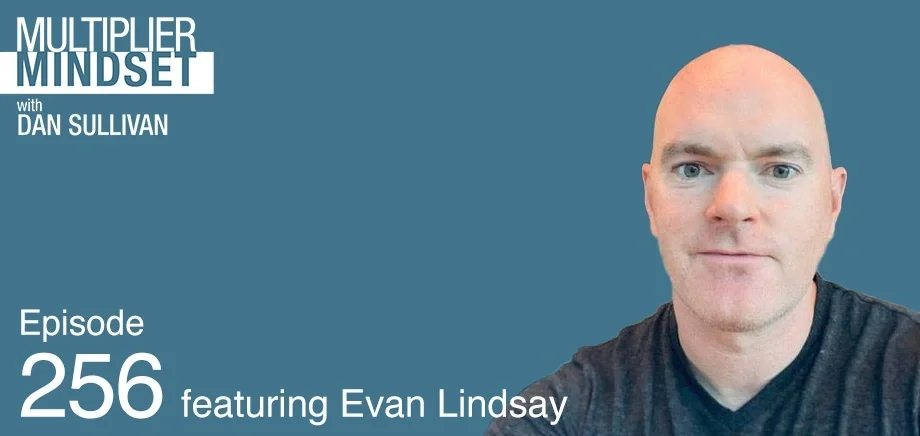
After seven years in the NHL playing for the Calgary Flames and the Montreal Canadiens, Evan Lindsay retired as a professional athlete and entered the realm of entrepreneurism. Evan shares the story of how he went from the National Hockey League to engaging in successful teamwork he’ll never have to retire from.
Here’s some of what you’ll learn in this episode:
- The mindset that’s made Evan both a successful athlete and a successful entrepreneur.
- How Evan’s multi-faceted company works with failing gyms.
- How Evan’s employment experiences always ended.
- The ways in which Evan’s company has grown and continues to expand.
- Some of the most useful tools and experiences Evan has gained as a Strategic Coach® member.
Show Notes:
Being a professional athlete at the highest level means you can be coached and you’re good at teamwork. Those are also the two crucial capabilities to being an entrepreneur.
For a lot of professional athletes, their unusual talent was spotted very early in life.
NHL hopefuls are serious professionals before the end of their teen years.
Many professional athletes don’t prepare for the time when their athletic career ends. And then they're thrown out into the world where they don't have the system that’s supported them.
An entrepreneur’s number one job is to improve themselves in relationship to their team members and then to the business they’re in.
If you consult but haven’t actually worked in the field for a while, you’re coming from a space of theory and ideas.
Being familiar with the nuances and details of an industry makes you a lot more effective and proficient at supporting the people around you.
In professional sports, you adapt or you don’t get paid. And whether you’re leading the team or on the bench, you have to be in service of winning.
When you take over failing businesses, you take over something where the identity is the losing business.
You have to come up against hurdles a few times before you realize what doesn’t work.
There’s no finish line for entrepreneurs. Being an entrepreneur is a life sentence.
Resources:
Who Not How by Dan Sullivan with Dr. Benjamin Hardy
10x Is Easier Than 2x by Dan Sullivan with Dr. Benjamin Hardy
My Plan For Living To 156 by Dan Sullivan
Episode Transcript
Dan Sullivan: Hi, this is Dan Sullivan. I'd like to welcome you to the Multiplier Mindset podcast. One of the things that you'll notice about Evan Lindsay, Evan is very fascinating. Over the 50 years that I've coached entrepreneurs, I can't say I've had a great number of athletes who played at the highest level. Evan played in the NHL seven years. He was with the Calgary Flames and he was with the Montreal Canadiens. The interesting thing about it—it's actually a sad thing—is that there's a huge advantage you have if you've been good enough to be a professional athlete at the highest level, and the NHL is the top hockey league in the world, because you're coachable. You're a very coachable person, and you have to be good at teamwork. And those are actually the two crucial capabilities that you need to have to be a great entrepreneur. So I've often thought that team sports is unusually good preparation for being a great entrepreneur later on, but you have to grow up as a person.
And what I've noticed with a lot of professional athletes, they're spotted very early in their life that they're unusually talented. I would say in their childhood, before 10 years old, that people are already noticing. In the hockey league, it starts very, very early, and they are serious professionals before the end of their teen years. And it's the best thing in the world, or it's the worst thing in the world, because a lot of them, they are special, and they are taken care of, and they have a complete system that supports them. But a lot of the athletes I've seen, especially in pro football—I've had a whole number of pro football players who played in the NFL—but they never grew up as an individual. Everything was taken care of. You know, the higher up they went, everything was taking care of them. But nowhere along the line in their growth as a professional athlete were they really preparing themselves for the moment when their career ends.
And for most of them, it ends just when entrepreneurs are getting started in their thirties. And then they're thrown out into the world where they don't have that system that supports them. The ones who are great in making the transition from professional sports to being a really, really good entrepreneur is that all along they began preparing that someday I'm going to create the team, I'm going to be out in the world, and I'm going to be the person who creates team members around me. And what I get from Evan's story is that he spotted it very early that he had to be valuable to the other people on the team. He had to have his own skills or he wouldn't be a member of the team. But he had this sense that it's all about teamwork. And that's the real gold standard that the best entrepreneurs and Strategic Coach members, they realize that they have to constantly be adjusting their role—one, that they attract great team members, but on the other hand, they have to constantly work on themselves.
And that's the real thing that you see. Your number one job is to improve yourself in relationship to the team members and then, of course, to the business that you're actually in. And he's focused on gyms that were not working. I think that means bankruptcy. He would take it over and then they would turn the gym around. The other thing is that he realizes now that he's got a team and a league where you don't have to retire from. You're just starting to get going in your thirties. The forties are better, the fifties are better, the sixties are better. The interesting thing is this wonderful awareness that the thing that has to constantly improve is myself. I just have to continually get better, and that means I have to be continually shifting what my role is in relationship to who the other team members are.
But then also, we have to shift in terms of the marketplace, we have to shift in terms of everything that happens in the world of gyms. And the thing that I love about it is his awareness that it's actually being in the Program with people who weren't professional athletes, but they have a unique sense of personal growth. And what we've done over fifty years, we've kept looking at what is the thing for the next quarter that we have to create, which is totally new, which supports where our entrepreneurs are now as the world changes around them. And I always tell the entrepreneurs, entrepreneurism is a life sentence. Once you've been out there, first of all, you disappear. You don't have a track record. You can't work for anyone else because you've been missing in action. And the beautiful thing is that you are the game, and you're the game that has to constantly change.
And I think if an athlete has that sense, first of all, in their sport, that I'm the thing that has to constantly change, then that's a very easy transition to move from professional sports to being an entrepreneur. And this game doesn't end. You know, I'm over 80 right now, and I feel we're finally getting somewhere. But I just love hearing this kind of story. And, you know, I'm very proud of my team. I'm very proud of … I have team members 20 years, 30 years, and everything at the beginning of every quarter is brand new. And I just love the mindset that Evan has about this constant change and growth. And that's really what Strategic Coach is all about.
Evan Lindsay: So for a living, I consult with gym owners. I've been doing that for about 10 years. So it's usually gym owners making between about half a million a year to three, four million dollars a year in revenue. And then on the side of that, the last four to five years, we've taken over failing gyms. So we went from having no gyms ourselves to now having four of them. So they all operate four gyms in three states and will probably acquire support in the near future. So that's how I make a living. And then Strategic Coach, we are at, it's been about 18 months. So this is halfway through year two and it's been great so far. You spend that many years consulting people, and you see a lot of the interesting places people end up in, where if you're running the business yourself, you wouldn't end up in all these nooks and crannies or be solving these problems, which I think has been really beneficial, because as we take these over, some of them have been open up to eight, nine years. There's just a lot of history, a lot of bad, compounded decisions, a lot of broken relationships.
When you go in there, you end up just dealing with a lot of things that you wouldn't if you're just starting from scratch. Yeah, you definitely see a lot of things and a lot of things have come up where I don't know how we got here. So it's been a lot of fun. I think as you go through these, you do learn a lot. And I think the one thing that's been nice for me is when we went from consulting—consulting is amazing—but at a certain point, if you haven't done it for a while, you're just coming from a space of theory and ideas, which is great. But then going back in here, you know, going from one to four of them, we just bought the building in one of them. Like you're just doing a lot of things that they've worked out and the theories have worked good, but it's just the nuance, the details, which I think has made me a lot more effective and proficient just supporting those people around me, which is nice. So I think you give and take both ways with it.
I do not come from a family of entrepreneurs. So my dad, he did very well. He managed a large part of a regional power company in Alberta, in Canada. But we had a neighbor that lived behind us, and his dad is kind of my story. It reminds me of like the rich dad, poor dad story, where it's like, my dad was great, but then I met this other person's dad, and I was like, I want to do what he does, you know? And I was like, what does he do? And no one really knew what he did because he had a company where they built homes, they did real estate, they owned several stores. And so anytime I could spend more time with him, I would just spend more time with him just to ask questions. And I think that's what kind of gave me the idea was that side of being just in proximity to him. Transparently, I'm pretty bad at like, taking instruction from people at times.
So I think it was a natural fit just personality-wise, but that was probably the initial spark, was just having somebody so close to me doing a lot of these things that I didn't understand. It was a totally foreign world, and that's what started me down the tracks. It definitely feels like it's a learned trait. And I think the piece for me that probably grew that too, I was fortunate enough to make a living playing professional hockey for seven years. And so you're part of a team, but the farther I am removed from hockey, it's like you are your own little mini contractor business inside of these teams. And just the amount of traveling, the amount of things you had to adapt with, I think that kind of nurtured the keys and the spirit that I think you'd need, from at least my experience, to be relatively successful in, you know, entrepreneurism. Just because there's so many unknowns, and you meet a lot of people, and it's been fun the longer I've been removed from hockey. I've been in touch with more and more people that I played hockey with that didn't have necessarily an entrepreneurial family, or they didn't go get an MBA, or do any of these things, but they've been very successful. So I think just part of the discipline, the camaraderie, and those things have been really useful in terms of just, you know, continuing to find the way forward with this.
So, I grew up in Red Deer, Alberta. That's a town of maybe at the time 50,000 people. So it was a very small town. My dad, like I mentioned, he worked for the power company. I had an older brother who was seven years older. He actually went on to play professional hockey too. He also managed to play in one NHL exhibition game. So we had like a nice history. I was like the worst student around. I think I was the source of a lot of frustration. I would do just enough to basically not get in trouble for my marks, so I'd come home with a—in junior high, it wasn't particularly hard as long as you showed up and paid a bit of attention. You could get your 75 or 80 percent. And so I'd come home with every report card. My parents were very upset. And then with playing sports, I moved away from home when I was 16, moved down to the States and played hockey. I managed to get drafted a couple years later, but with moving away, that's where school, like my true colors probably really shone.
And so we always make a joke that like I just got courtesy 50s and everything, so played hockey. All the reports are always like, highly capable, apparently like, does not care about this. That was it. So yeah, locally it was very much a small town. Everybody played sports, everybody played hockey, so it was really like driven around that and that was largely what I pursued until I was in my mid-20s. So it was great. It was a fun place to grow up. It's changed a lot compared to now. I've been an employee a couple times, and it usually lasts for about two years. I think it's been twice, and both times it's went very well, and then I get very disgruntled at about two years when I'm like, oh, I don't really want to do this anymore. It's just the nature of it. I think being an ex-athlete has impacted it in a few ways, especially with playing pro sports. Like pro sports is very Darwin. It's like you adapt or you don't get paid. Like that's just the nature of pro sports.
A lot of people think it's glorious and understand how it goes, but it's a business at its highest level. Take feedback. If you can't look at the numbers or the stats, you're not going to continue to thrive. And I think on the other side of that, especially a sport that's a team sport, you know, you could do that at a very high level for yourself. But if you can't understand how to make people around you better and recognize that sometimes you're going to be looked at to be at the front of the bus, and other times you're going to have to be like on the bench, still cheering people on. Because the greater thing is like, it's adapt or die. But then the other thing is, in service of what? It's winning.
And so I think that's the big thing that's helped me out a lot for this leg of the journey. Because right now, we've went from basically two team members to about 35 in four years, which, there's a lot of people that go a lot faster. But with taking over failing businesses, you take over something where the identity is the losing business. So people, as bad as it sounds, they think of themselves like losers a little bit inside of that business, even if they don't. And you have to understand, like, okay, well, how do I move them the same as you would a team to, like, we have a common goal. We are winning. This is the standard of excellence. And you're, like, starting to shift the culture, because the tactics of business aren't typically very challenging. It's more just, like, how at a certain stage can you get other people to see the vision and do more than they're capable of, so that basically the team is greater than the sum of the parts. Average player, average player, but still have a great team. And they obviously want to have great players, but, you know, just starting to understand that, I think that's been really helpful for me.
Things make me excited in the business right now. We've come to the stage over the last few years where we've built enough of a team culture and enough, I would say, really quality people that I think if you use the EOS, like, gets it, you know, wants it and has the capacity, we have enough people that are at that stage where they're just starting to self-propel and they're starting to create solutions at a rate that we haven't had before. It's exciting and then also for me very challenging because going back to the adapt or not, it's like I'm just starting to recognize when and where I'm holding people up more, which is just requiring like a different perspective and mindset. And that's led to projects in particular, we partnered. So we went from taking one of our first gyms we took over, was utterly failing, to the point where now it's done good enough that we've actually bought a building around the corner.
So in five years, we went from something that was going to close shop to businesses thriving, going to do that, and we're going to open up another concept in the building. And I managed to find a tenant through one of our other team members that signed a 15-year lease on a very synergistic business. So that's a very fun project. It's a big project. And kind of using some of the principles from Strategic Coach and from Dan, like the Who Not How, a lot of that came into finding the right Who investment partner on the building so that I haven't had to get into the weeds on that. So, that's probably one of our top ones. And then 10 days ago, we acquired our fourth gym, which was an acquisition. So, with that too, it's … we have a team member that's been with us for a while and he's a little bit overwhelmed right now, but he's figuring it out. We're taking this one over with way less of my input than we've ever had. So they're making nice progress. They're going in the right direction, just a lot of the systems and the work we've done.
So I think probably the most exciting thing is there's the projects, but I think the bigger thing for me is just the people and literally seeing like the core capacity of the people that we're working with, we're getting at the stage where the 10x versus 2x. I'm like, 10x is a lot more like feasible at this stage just as an approach, just because there's so many people that have so many good ideas and so much capacity now. So it's more just how do you give them the right things to move inside of. So that's probably the most exciting thing, is just the speed of change with the people that we have in here. I put people in place before that weren't the right people, so I got more clear on who they were, if that makes sense. Like you kind of got to go stub your toe and hit your shins on things a few times to realize what doesn't work. And so I think that was a key piece for me, like this last iteration with this team.
The first business I opened started in 2009, so there was a lot of learning. And even with this one, there's been some more learning. So I think that's the first thing to help with the team was just made mistakes. I think the second thing was the ability just to recognize when it was a mistake, make a change faster. So even if you got the right person in the wrong seat, can you move them quickly as opposed to like just, suffering, or suffering in silence, and that's just the way it is. So I think that was probably two of the things that's led to this. Then at this stage, the more proactive side of it has been, I think just clarity, like you mentioned Unique Ability. I think one of the things that was really helpful in the first year with Strategic Coach on one of the workshops that Gary led was just recognizing what I'm really good at and where I should stop doing things.
It would have been very challenging if I didn't have a little bit more awareness on, A, where are we going? And that for me, like, who do I surround myself with? Or what functions does that role need for the business? So I think that's been some of the bigger things in the last year that's led to the speed was me just recognizing that for me. And then the one tool that we found really helpful is then with our top performers on roles that might be reproduced was Predictive Index. So just predictive indexing them. So now on new hires, basically, you know, obviously catered your hiring process to the values and everything else, but then just starting to get a better idea of, okay, well, who are they in their most natural state? Not how do they interview, or what does this look like to see if they can be a good fit? So I think that's been the tactical answer of late. That's been really helpful.
Most stressful time, it was actually when I had our first business. So, we were living in Canada and we decided to move to the Cayman Islands. And so, this would have been 2014. And at the time, the business was running relatively well for the type of business it was. So the numbers were good, the personnel was good, but it still very much required my presence. It started inside the business, not outside of it to run a business. So when we moved, I spent a lot of time and energy on systems, automations, building everything out. And when we moved, the problems kept happening, meaning like things would still break. And in my brain, I had thought, I've built this so that it's done or it's good. So it'll just keep running and it'll keep paying us money. And it'll be like we've hit the finish line. I just found it very disheartening. I didn't recognize that as long as the business keeps going, my role has to keep adapting and a business is a living thing. So it's going to keep moving forward. And I just found that a struggle.
And then with running a business remotely, that was the first time then running something where I can't turn a light bulb. I can't go sell a thing. So now literally all these systems and structures rely on other people. So that was the hardest thing. I ended up selling the business, and on the way out broke a number of relationships and things, which made me very hesitant to want to open another business again, because I hadn't figured out, what does a business look like? I assumed it was really like a finite game. If you get to here, you're winning, as opposed to like an infinite game, where as long as the thing is open, it's going to have problems and concerns. So I think that was probably the hardest part before going back into this side of it, was just recognizing there's no finish line with this, and understanding you've got to do things that give you value, that make you want to keep doing it. Otherwise, if you're getting to that spot where you just want the problems to go away, you're just kind of approaching the problem wrong, because it's never going to happen like that.
I think that was the hardest thing for me, was getting a business to a stage where I thought it was done, end up selling it, and do I really want to go through this again? Is there going to be a different ending to the story, or is it more you just build them to get them to a certain stage to sell them, which is fine too, but I just realized that wasn't really what I wanted to do. I'd rather build something bigger. So Strategic Coach, the decision to get started came, I'd made a mental decision a few years ago. So what was going on in my world was we had the consulting business. We then took on the first gym and the second gym. And at the time I was considering joining. And the one thing that I came to the realization of was, I did need the frameworks and I desired those. But then the one thing for revenue and different things, I was like, I'm not good enough structurally on some of the things in the business. And so I had a feeling that I could go and I could take some of these perspectives, but I felt like I needed some hard skills.
And so what we ended up choosing to do at the time, just for us, was we had an EOS Integrator join our team. And so she helped us put a few of the structures in place, which was good because I can read Dan's books and I can read everything else, but sometimes it's helpful if you can have someone or a thing where you're enrolled or you're with it, where you're not just reading something, but you're in a sense forced to do something. So for me, I thought we needed the structural piece first. Right or wrong, that's what we did, which has been helpful. And then as soon as we got to that stage, I was getting at a spot where I wasn't as sure on what the vision was, what we were building, where we were going, why it mattered. And that was a really big thing for me with reading some of the books, was there's tactical things to improve, but a big part of it for me was I felt like I was just looking at entrepreneurship and at businesses the wrong way. And so I was having a hard time starting to figure out, like, what do we need? What do I want? How does this actually work?
And transparently, like, shout out to Gary Mottershead. So Gary was a large reason why I joined, too, because when I went through and I looked, kind of going back to like a rich dad, poor dad idea, I just remember I saw this guy who was like 70-some years old. He's been doing this for a long time. He still coaches. He's built businesses. And I was like, that's cool. I would like to create some sort of version of kind of like that in my own life. And so that was a big draw for me, was A, the community, the content, the ideas, the perspective, but then also just proximity to someone that had kind of lived it a little bit farther along for me. So that was a big draw for me, was just looking at that side of it. And I found that's been really valuable, you know, just coming to the events and spending time with people in person, especially in a world that's so digital. It's nice, even if it's only four days out of a year; it's amazing how much one full day completely unplugged on something can actually make a difference.
So that's been probably one of the biggest things for me is that really helps with how I learn. I think in the Coach Program, to your point, there's a lot of tools and there's a lot of resources. The ones that have been the most impactful, you know … it's interesting because I think the events themselves have been the thing that's been the most impactful—going through the tool, like literally conversing and talking, not necessarily using the tool, if that makes sense. So if I think back to my experience on these events, they build upon each other really well. So even the first one, how long do you see yourself living? How do you want your life to look? That was very good for me, because even as I walked away from that event, I hadn't realized that this was my actual idea of what I think my life is going to look like based on my parents' experiences and different things still. And so just recognizing that doesn't have to be true.
So I think that was very holistically, as a person, the most impact you're going to get out of that because, you know, everything else can be very tactical. The 10x itself was very, very helpful because it really spoke then to like how my brain thinks. So I could kind of look at what was being said and I could build a framework and a structure very clearly, which then allowed me to communicate that to our team. And so I think for me, that was in terms of going back to what's going really well now, there's all the pieces that helped me. The one thing that I think has helped our team themselves is my ability then to articulate where we're going, why we're going, why does it matter? And then I think more specifically, what does that look like? So what's like an average Tuesday look like in these businesses? How does the team interact? How does it interact if there's locations in different states? So I think that was the biggest takeaway from the 10X, was just starting to pull that back into the team.
And I think that's the piece where, gosh, I think that was in the Q3 last year, and that's when we've had the most growth, was right around Q3 to Q4, was taking all of those lessons and then starting to just be able to communicate them more clearly and concisely, where I could hear other people saying my same words back to me from that event. So I think that's the one that probably, at this point, has made the biggest physical impact for us. I think that's where transparently more of the stage we're at now is people are picking up speed. That's where I'm relying on them for clarity. Where am I keeping you stuck? What do you need from me? Because sometimes now I feel like we're at the front and there's not as much map, you know, and sometimes you have to tell people where you're going. And I think sometimes when they catch up, I need to, anybody needs to be able to turn around and just recognize, where am I actually slowing you down for a minute? Because I can't see; I've been facing this way the whole time.
And I think that's kind of where we're at now, is just how do I get the heck out of the way of some of these things, or where do you guys need more clarity? Kind of like in the box, not where are we going? So, it's been a great trip so far. I think the consistency of showing up and seeing people, it's fun to watch other people on the 90-day cadences to see just what they've taken. Because if you attend the same one day, everybody's going to hear different things depending on where they're at. So it's nice to see how people apply them the same or differently. Because if someone is ahead in terms of either the size of their business, their thinking, and their perspective, they're going to apply it differently. So even if you come back 90 days later, well, I only did this, but they did that, it kind of helps you actually fill the gaps of what would be next. And so I think it's nice to be vested in the journey with them.
So there's been some great people in different places where, you know, I'm not a big keep in touch guy in between. That's much more my wife out of us. She's more of the social connector side. But it's nice to go there and then you have these conversations with Chris and with Dan and you can kind of see some of the things they're working through or how they're evolving it. So I think the community side for me on that has been very good. And you just get to understand people's businesses enough to be dangerous, where you just have enough of the context where it's nice to see them grow and thrive. And then if they're asking for feedback, you can share a little bit more objectively, not just, well, I think this, just having those ongoing conversations. And I find that it's nice when it comes back the other way too, of just building a deeper connection with everybody.
I'd say just like, thank you to the community. I think it's been great. Nicole's always great, speaking with her, with Gary, and then everybody else that I interact with. So just kind of reiterating that it's refreshing to be part of the Program because on a lot of programs, it can be very much about tactics, which are important, or revenue or some vanity metrics or things. And I think that's the one nice thing about Coach, it's looking at a more holistic view of A, the person, the team, just everything going on to just create harmony. So it's more of just a thank you to everybody involved on your guy's side of it. It's made a very big impact on our business so far and I know it will continue to.
Related Content
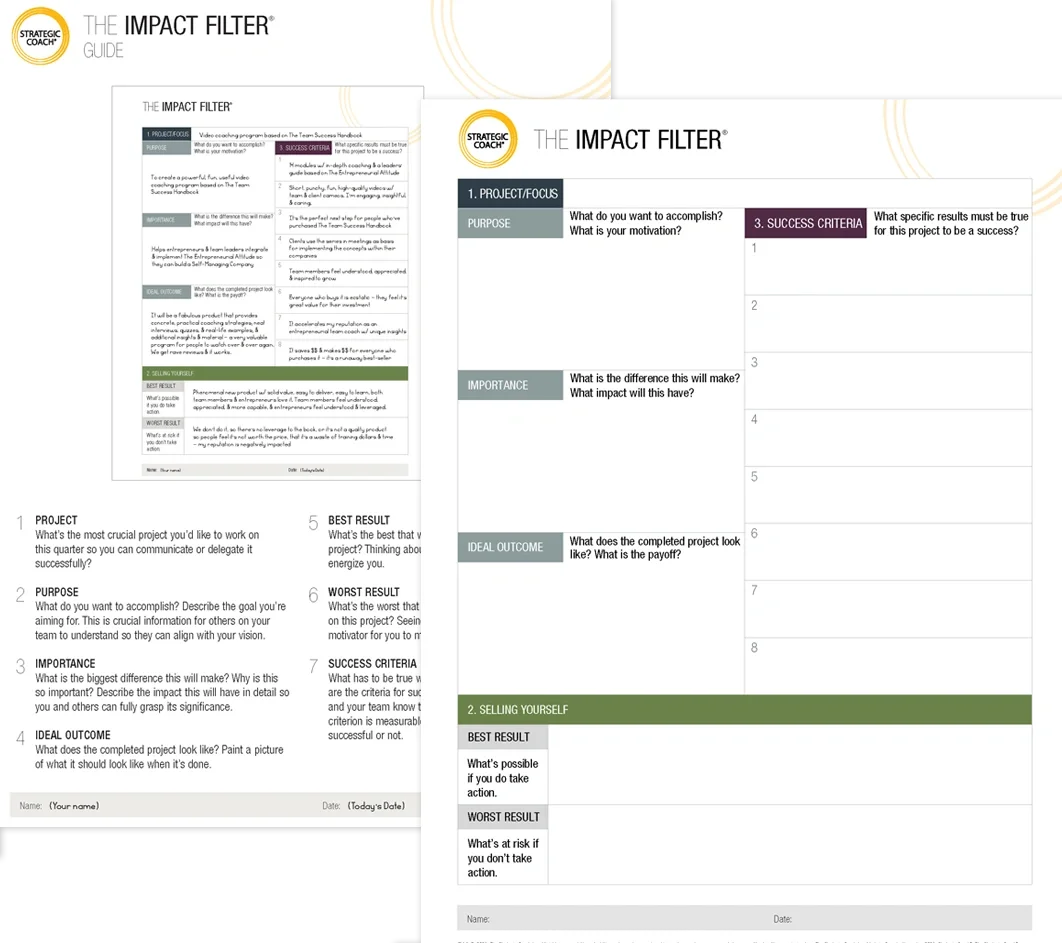
The Impact Filter®
Dan Sullivan’s #1 Thinking Tool
Are you tired of feeling overwhelmed by your goals? The Impact Filter is a powerful planning tool that can help you find clarity and focus. It’s a thinking process that filters out everything except the impact you want to have, and it’s the same tool that Dan Sullivan uses in every meeting.